
ACT Prep in 2 Months: Week-by-Week Study Plan for Real Score Gains
On this page
- Can You Actually Improve Your ACT Score in 2 Months?
- Before You Start: Take a Diagnostic and Set a Realistic Target Score
- How Many Hours Per Week You Actually Need (By Score Band)
- Your 8-Week ACT Study Schedule: Section by Section
- Week 1: Diagnostic and Section Triage
- Week 2: English Section Focus
- Week 3: Mathematics Section Focus
- Week 4: Reading Section Focus
- Week 5: Science Section Focus
- Week 6: First Full-Length Practice Test
- Week 7: Second Full-Length Practice Test and Targeted Re-Drill
- Week 8: Third Full-Length Test or Section Sets
- What to Do When Your Score Stalls: The Most Painful Part of 2-Month Prep
- Weeks 5 to 7: Full-Length Practice Tests and Error-Pattern Review
- Week 8: Exam-Week Pacing, Logistics, and What Not to Do
- How a Strong ACT Score Fits Into Your Broader Admissions Strategy
- FAQ
- Is 2 months enough time to study for the ACT?
- What is a realistic ACT score gain in 2 months?
- Can a student go from a 25 to a 30 on the ACT in 2 months?
- How is the ACT composite score calculated?
- How does a 31 ACT compare to a 1400 SAT?
- Where can I find free ACT practice tests?
Two months is enough time to raise your ACT composite, provided you study 6 to 8 hours per week and follow a structured plan. Start with a full-length diagnostic in Week 1 to identify your weakest section. Spend Weeks 2 to 4 on targeted concept work, Weeks 5 to 7 on timed full-length practice tests with mistake-log review, and Week 8 on light review and pacing rehearsal. In our coaching with students at composites of 20 to 29, this approach typically produces a 3 to 5 point composite gain.
Section structure and timing throughout this article come directly from ACT, Inc.. The harder question isn't whether 8 weeks is enough. It's whether you pick the right section to attack first and stay disciplined about reviewing wrong answers. That's what the rest of this plan is built around.
Our ACT coaches have guided students through every score band from 17 to 35; the 8-week framework below comes directly from that coaching experience.

Can You Actually Improve Your ACT Score in 2 Months?
Yes, but the size of the gain depends on where you're starting and how consistently you put in the hours.
In our coaching with students at this score band:
- Composite 20 to 24: typical gain of 4 to 6 points across 8 weeks of focused prep
- Composite 25 to 29: typical gain of 3 to 5 points
- Composite 30 to 33: typical gain of 1 to 3 points, because ceiling effects start to compress what's possible
A consistent 6 to 8 hours per week across 8 weeks adds up to roughly 50 to 65 total study hours. Not a casual investment, but reasonable for a student with a real test date on the calendar. Public student forums echo the same range. Students reporting jumps from the high-20s to 34 in 5 to 8 weeks consistently describe heavy section drilling followed by three or more full-length timed tests with thorough review.
A floor of three full-length practice tests is non-negotiable. Less than that and you won't have enough data to spot real error patterns. Still deciding between tests? Read our breakdown of is the SAT harder than the ACT before you commit to an 8-week run.
Before You Start: Take a Diagnostic and Set a Realistic Target Score

Photo by Andy Barbour on Pexels
Every plan in this article begins with a diagnostic practice test. No exceptions. Without a baseline composite and four section scores, you're guessing at what to study.
Take an official ACT practice test from act.org, timed, in one sitting, under real test conditions. Phone away. No breaks beyond the official ACT break structure. Score all four sections and record the composite.
Per ACT, Inc., the four sections break down as:
- English: 75 questions, 45 minutes
- Mathematics: 60 questions, 60 minutes
- Reading: 40 questions, 35 minutes
- Science: 40 questions, 35 minutes
Each section is scored 1 to 36, and the composite is the average of the four, rounded to the nearest whole number. A student scoring 28 English, 30 Math, 27 Reading, and 27 Science lands at a composite of 28 (112 divided by 4).
Now set your target composite. A student at baseline composite 24 targeting 29 needs a 5-point gain. If their Science is 20 and English is 25, Science is the priority section, because that's where the largest absolute improvement is available. A 6-point Science gain alone adds roughly 1.5 points to the composite before any other section moves.
If you're still deciding between the ACT and SAT, our detailed comparison of ACT vs SAT difficulty, format, and scoring can help you pick the test that fits your strengths before you commit to an 8-week plan. The two exams test similar logic in different formats, and the distinction matters. For one specific example, see our analysis of ACT vs SAT transitions questions.
How Many Hours Per Week You Actually Need (By Score Band)
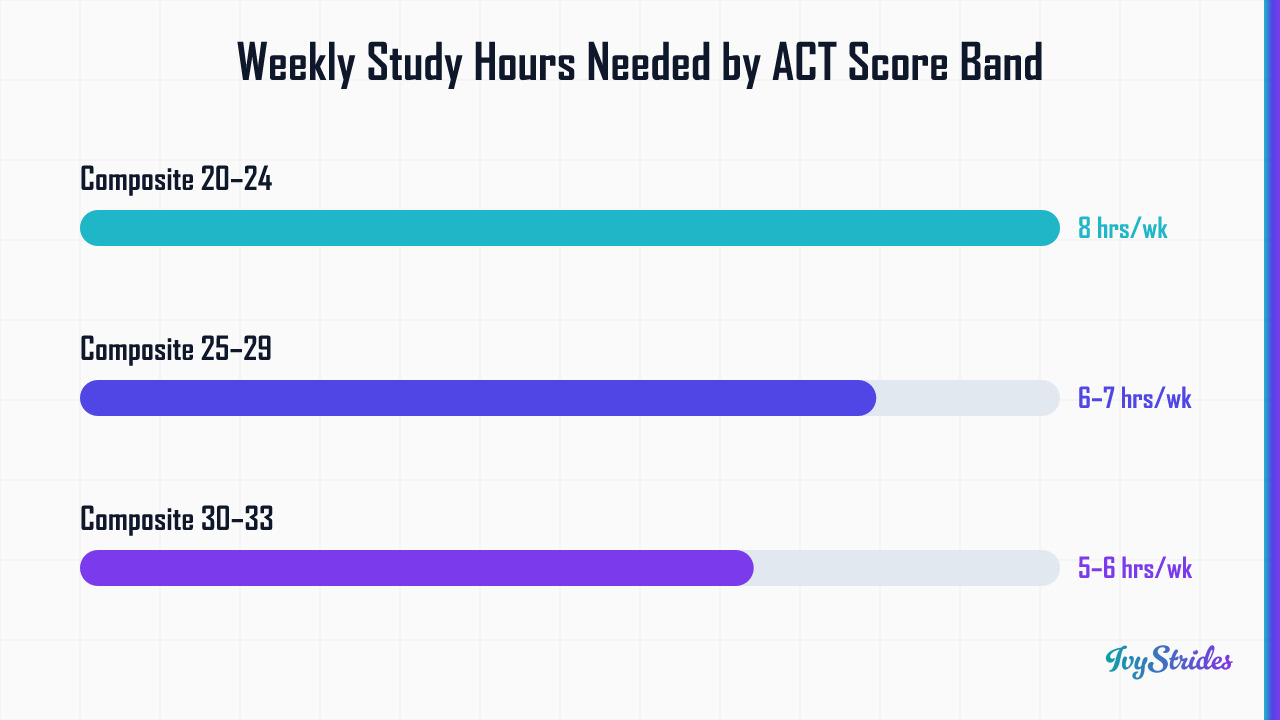
Weekly hour count scales with how much room you have to gain. More room means more drilling.
- Composite 20 to 24: 8 hours per week, roughly 64 total hours
- Composite 25 to 29: 6 to 7 hours per week, roughly 48 to 56 total hours
- Composite 30 to 33: 5 to 6 hours per week, roughly 40 to 48 total hours
These numbers assume real study sessions, not passive video watching with a phone in your lap. A focused 90-minute session beats three hours of distracted reading.
On the resource question: ACT, Inc. publishes free official practice tests at act.org, and those are the most accurate representation of the real exam. A free ACT prep app can supplement vocabulary review or quick drilling between sessions, but it shouldn't replace a full-length timed test. The reason is simple. Pacing fatigue across a 2 hour 55 minute exam (3 hours 35 minutes with Writing) is the single biggest variable on test day, and you can only train it by sitting the full thing.
For mistake tracking, grab a printable tracker from our free downloads page. For a deeper section-by-section playbook beyond what an 8-week schedule can cover, our full plan on how to study for the ACT extends the tactical detail here.
Your 8-Week ACT Study Schedule: Section by Section
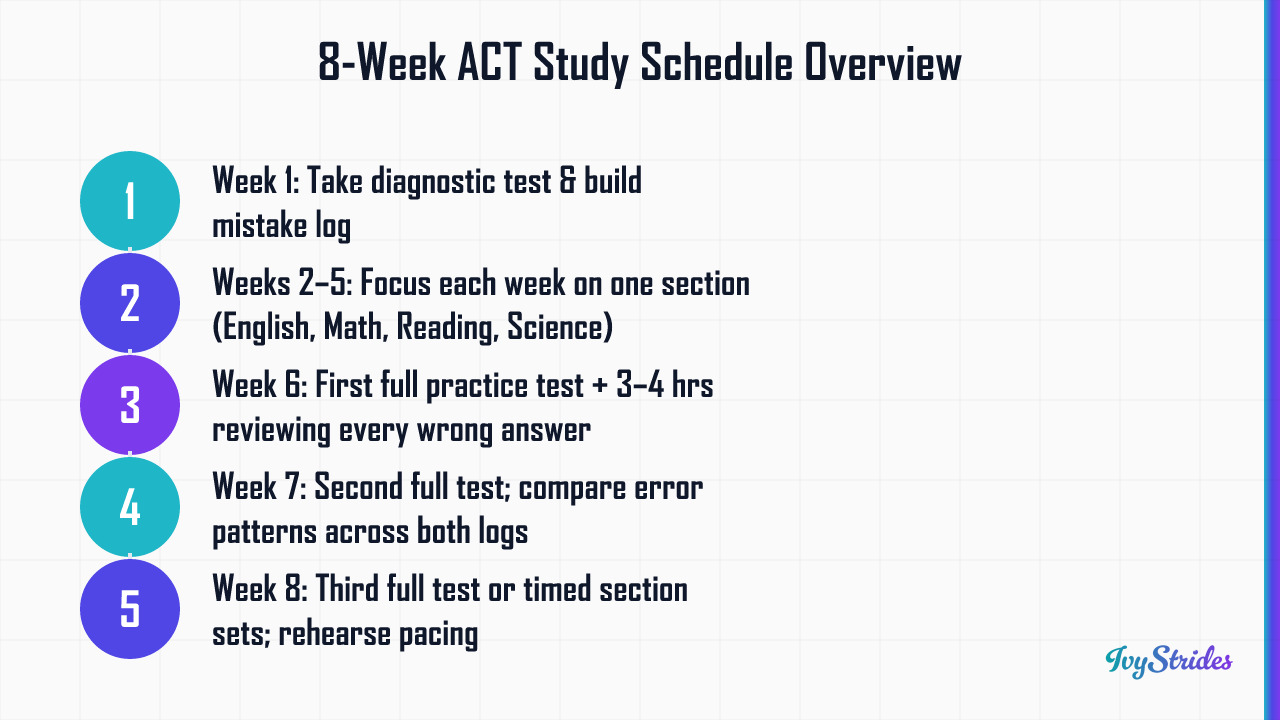
Eight weeks. Each with a defined focus, a defined output, and a defined practice cadence.
Week 1: Diagnostic and Section Triage
Take a full-length official ACT practice test under timed conditions. Score it. Identify the section with the largest gap from your target composite. That section becomes the primary focus for Weeks 2 to 4, with the second-weakest section getting roughly 30% of your weekly time.
Build your mistake log this week. For every wrong answer on the diagnostic, record:
- Question number and section
- Question type (for example: "comma before coordinating conjunction" or "linear function from a word problem")
- Error category (concept gap, careless misread, pacing, or trap-answer trick)
- The correct reasoning, written in your own words
Week 2: English Section Focus
The English section is the highest-use section for most students because the rules are finite and learnable. Per ACT, Inc., it's 75 questions in 45 minutes, which works out to 36 seconds per question. Recurring question types:
- Comma usage (FANBOYS, nonessential clauses, lists)
- Apostrophes (possessive vs plural)
- Transitions (however, therefore, beyond that logic)
- Concision (shortest grammatical answer usually wins)
- Subject-verb agreement across interrupting phrases
Drill each rule with timed sets of 15 questions, then review every miss against the mistake log.
Week 3: Mathematics Section Focus
The Mathematics section is 60 questions in 60 minutes. Algebra and functions represent the largest content area, followed by coordinate geometry, then a smaller slice of trigonometry near the end. Most score-band gains at 24 and below come from cleaning up algebra fundamentals, not from learning new trig identities.
Spend three sessions this week on algebra and functions, one on coordinate geometry, and one on the trigonometry questions you missed on the diagnostic.
Week 4: Reading Section Focus
The Reading section is 40 questions in 35 minutes across four passages. Passage types are literary narrative, social science, humanities, and natural science, in that order. The pacing rule: 8 to 9 minutes per passage, including question time. If you spend more than 4 minutes reading before answering anything, you'll run out of time.
Train passage mapping. Read once, lightly marking shifts in argument, then jump straight to questions. Don't re-read full paragraphs. Pull line references as needed.
Week 5: Science Section Focus
The Science section is 40 questions in 35 minutes across three passage types:
- Data representation (most common, roughly half the passages): graphs, tables, figures
- Research summary: experiments with multiple variables
- Conflicting viewpoints: usually one passage per test, two or more scientists disagreeing
Science isn't a content test. It's a graph-reading and experiment-design test in disguise. In our coaching, a student at composite 26 stalling on Science is typically missing data representation questions because they're misreading graph axes, not because they don't know the underlying biology or chemistry.
Week 6: First Full-Length Practice Test
Take a full timed practice test on Saturday morning, same start time as your real test. Score it. Plan 3 to 4 hours that weekend to review every wrong answer and update the mistake log. Don't skip the review. Taking tests without reviewing them is the most common wasted-effort pattern we see.
Week 7: Second Full-Length Practice Test and Targeted Re-Drill
Repeat the Week 6 process with a fresh full-length test. Compare error patterns between Test 1 and Test 2. Whichever question types appear in both logs are your Week 8 priorities.
Week 8: Third Full-Length Test or Section Sets
Take a third full test by midweek if your schedule allows, or run two timed section sets if you're feeling fatigued. The final days are about pacing rehearsal and exam-day logistics, covered below.
Every week of this plan requires at least one timed section or full test. Our online ACT practice test library includes scored, full-length tests with answer explanations to keep your review structured. For a broader view of our methodology, see our ACT prep overview.
What to Do When Your Score Stalls: The Most Painful Part of 2-Month Prep
Here's the part most students don't see coming. Around Week 4 or 5, early gains slow down. The composite that jumped from 24 to 27 in three weeks suddenly won't move off 27 no matter how many drills you run.
In our coaching, students who plateau between Weeks 4 and 6 are almost always repeating the same 2 to 3 error types without realizing it. The mistake log tells you exactly which ones. If the same question type appears 3 or more times in your log across recent sessions, that's the drill priority for the next week. Not whatever felt hard yesterday. The log.
The protocol when you stall:
-
Audit the mistake log. Sort wrong answers by question type. Find the top 3 repeat offenders.
-
Apply spaced retesting. Drill that question type today. Then retest it 3 to 5 days later before moving on. If you can answer 8 of 10 cold after the spacing gap, it's stuck.
-
Check for a different error category. Sometimes the question type isn't the problem. Pacing is. A student getting 6 of 10 right on untimed Science but 4 of 10 right on timed Science doesn't have a content gap, they have a pacing gap. Different fix.
A junior we worked with last fall hit composite 27 in Week 3 and stayed there through Tests 1 and 2. When we pulled her log, 9 of her last 11 Science misses were data representation questions where she'd flipped the x and y axes under time pressure. Two sessions of axis-labeling drills, then a retest 4 days later. She broke 29 on Test 3.
If a student completes two full-length tests and sees less than 1 point composite improvement, that's the signal to bring in a section-specialist coach. Not a generalist. A coach who works specifically in Science, or specifically in Math, can usually identify the exact error pattern in one session. Students who want a coach to build this plan around their specific diagnostic results and adjust it week by week can explore our 1-on-1 ACT prep, where a section-specialist tutor handles the prioritization for you.
You can also meet our ACT coaches to see who specializes in the section you need.
Weeks 5 to 7: Full-Length Practice Tests and Error-Pattern Review
The second month shifts the work from learning to testing. By Week 5, you've covered the major content gaps from your diagnostic. Now the question is whether you can execute under time pressure for nearly three hours straight.
Non-negotiable rules for full-length tests in this window:
- One sitting, timed, real conditions. Phone off. Breaks only where ACT, Inc. allows them.
- Review takes at least as long as the test. A full ACT runs about 3 hours. Plan 3 to 4 hours for review the same day or the day after.
- Every wrong answer goes in the log. Question type, error category, correct reasoning. No shortcuts.
In our coaching, students who review every wrong answer after each full test gain an average of 1 to 2 additional composite points compared to students who only retake tests without review. The compounding effect is real. A mistake you didn't review on Test 1 will reappear on Test 2.
Official ACT practice tests and new ACT practice test PDFs are available at act.org. Download a printable mistake tracker from our free downloads page to log every wrong answer by question type across all four sections. For section-by-section tactical depth beyond this article, our guide on how to study for the ACT walks through each section in more detail.
Week 8: Exam-Week Pacing, Logistics, and What Not to Do
The final week is about staying sharp without burning out. Most score drops in the last week come from over-studying, not under-studying.
What to do:
- One timed section set on Tuesday or Wednesday. Not a full test. Just enough to keep timing instincts active.
- Review the mistake log only. No new content. If you haven't learned it by now, cramming it Thursday won't help.
- Run pacing drills. Reading: 8 to 9 minutes per passage. Science: roughly 5 minutes per passage for data representation, slightly longer for conflicting viewpoints.
- Sleep 8 hours the two nights before the test. This matters more than any last-minute drill.
What not to do:
- Don't take a full practice test the night before. In our coaching, students who do this consistently underperform their practice scores on test day. Mental fatigue is real and it carries over.
- Don't start new content. The Trigonometry topic you've been avoiding all 8 weeks isn't going to be mastered on Friday.
Test-day logistics: arrive 15 minutes early. Bring photo ID, your admission ticket, an approved calculator, and several sharpened pencils. Eat a real breakfast. Bring a snack for the break.
If you're aiming at highly selective schools, see what an elite composite looks like in context with our breakdown of Stanford ACT requirements.
How a Strong ACT Score Fits Into Your Broader Admissions Strategy
A strong ACT composite matters, but it's one input into a multi-part application. Treating it as the only variable that counts is a mistake that costs students elsewhere.
A few honest framings:
Test-optional doesn't mean test-irrelevant. Policies vary by school and year, and you should check each school's current policy at fairtest.org before deciding whether to submit. At many test-optional schools, applicants who do submit strong scores see higher admit rates than those who don't. The decision is school-specific.
Know the score band that makes you competitive. A composite of 33 or higher is typically competitive at highly selective schools, but the precise number depends on the school. Pull the Common Data Set for any college on your list and look at the 25th to 75th percentile ACT range. That's the real target. For a worked example, see our writeup on the Yale ACT code and score requirements.
AP scores and essays still carry weight. A strong ACT doesn't offset a weak essay or a thin transcript. In our coaching, students who pair ACT prep with AP exam prep and essay work in junior year are better positioned than students who treat each in isolation. If essays are next on your list, talk to a common app essay tutor about your topic before you start drafting.
Caveats worth stating plainly. College admissions outcomes depend on the full application, not test scores alone. AP credit policies vary by college. No ACT composite, on its own, secures admission anywhere.
FAQ
Is 2 months enough time to study for the ACT?
Yes, for most students. Eight weeks is enough to produce a 3 to 5 point composite gain when you study 6 to 8 hours per week and follow a diagnostic-driven plan. Students starting at composites of 20 to 24 typically have the most room to gain. Students already at 30 or above will see smaller but still meaningful improvements. The key variable is consistency. Two months of structured, section-focused work outperforms three months of unfocused review every time.
What is a realistic ACT score gain in 2 months?
In our coaching with students at composites of 20 to 24, a 4 to 6 point composite gain is typical over 8 weeks of focused prep. Students at 25 to 29 typically gain 3 to 5 points. Students at 30 to 33 typically gain 1 to 3 points. These ranges assume 6 to 8 hours of weekly study, at least 3 full-length practice tests, and consistent mistake-log review. Individual results vary based on starting point, effort, and whether prep is self-directed or coach-guided.
Can a student go from a 25 to a 30 on the ACT in 2 months?
A 5-point composite gain from 25 to 30 is achievable in 8 weeks, but it requires consistent effort at the higher end of recommended study hours (7 to 8 hours per week) and a clear section priority. In our coaching, students at composite 25 who have one significantly weak section (for example, Science at 21 or English at 22) often see the largest gains by drilling that single section intensively in Weeks 2 to 4 before shifting to full-length test simulation in Weeks 5 to 8.
How is the ACT composite score calculated?
The ACT composite is the average of your four section scores (English, Mathematics, Reading, Science), each on a 1 to 36 scale, rounded to the nearest whole number. The optional Writing section doesn't affect the composite. Per ACT, Inc., a student scoring 28 English, 30 Math, 27 Reading, and 27 Science would have a composite of 28 (112 divided by 4). Improving one weak section by 4 points adds roughly 1 point to the composite.
How does a 31 ACT compare to a 1400 SAT?
According to official ACT-SAT concordance tables, an ACT composite of 31 is approximately equivalent to an SAT score of 1400 to 1410, placing both scores around the 94th to 95th percentile nationally. Neither score is inherently better for admissions. What matters is which test a student performs better on relative to their target school's 25th to 75th percentile range. Students unsure which test to prioritize should take a full-length diagnostic of each before committing to an 8-week prep plan.
Where can I find free ACT practice tests?
ACT, Inc. provides free official practice tests at act.org, including full-length tests with answer keys. These are the most accurate representation of the real exam. IvyStrides also offers structured ACT practice test packs with scored tests and answer explanations for students who want guided review alongside the raw practice material. For a printable mistake tracker to use alongside any practice test, the IvyStrides free downloads page has a ready-to-use template.
Eight weeks goes faster than you think. The students who get the biggest gains aren't the ones with the most time. They're the ones who pick the right section to attack first and stay disciplined about reviewing every wrong answer.

Award-winning author (South Asian Book Award) and graduate of BITS Pilani and UCLA Luskin School of Public Affairs. Brings a published writer's eye to Common App essays and grammatical precision to SAT and ACT R&W instruction.