
Can International Students Take the PSAT and Enter National Merit?
On this page
- Can International Students Sit the PSAT/NMSQT? The School-Authorization Rule
- Which PSAT Version Qualifies for National Merit, and Which Does Not
- National Merit Eligibility for International Students: The Citizenship Rule
- What the PSAT/NMSQT Still Gives International Students Without National Merit
- FAQ: International Students, the PSAT/NMSQT, and National Merit
- Who is eligible to take the PSAT?
- Can international students get a National Merit Scholarship?
- Can you take the PSAT outside of school?
- Is there a point in taking the PSAT as an international student?
- Your Next Step on the PSAT/NMSQT
Yes, international students can take the PSAT/NMSQT through an authorized secondary school, with no citizenship restriction on sitting the test. National Merit eligibility, though, requires U.S. citizenship or lawful permanent resident status. The PSAT/NMSQT is the junior-year preliminary SAT that doubles as the qualifying test for National Merit.
That split, who can sit the test versus who can win the scholarship, is the whole question. The eligibility and format figures below come from College Board and the National Merit Scholarship Corporation (NMSC), cited at each claim. The harder part is logistics, because the test runs only through schools, inside a fixed October window.
Can International Students Sit the PSAT/NMSQT? The School-Authorization Rule
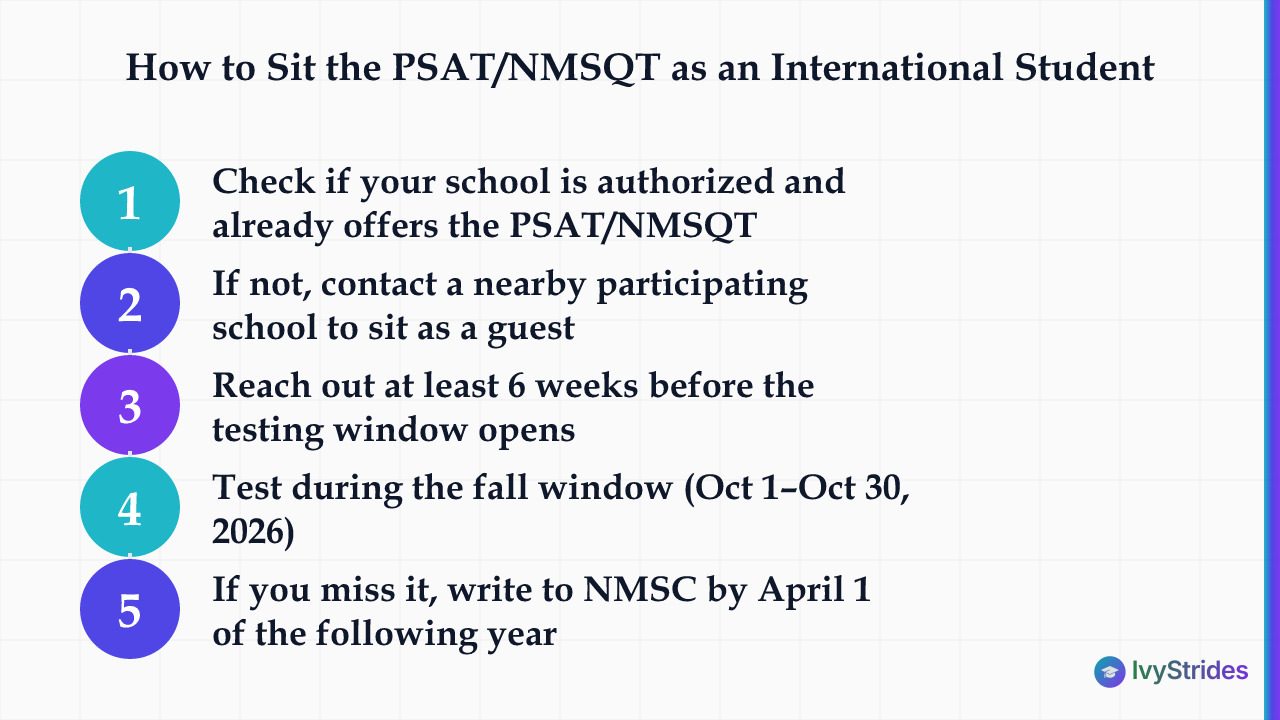
Any student at an authorized secondary school can sit the PSAT/NMSQT, regardless of citizenship or nationality. College Board applies no nationality restriction to taking the test, so location alone never blocks you. The schools administer it in a fixed fall window, and NMSC uses it to screen for National Merit.
Here's the catch most families outside the U.S. miss. You cannot register for the PSAT/NMSQT yourself. It runs only through authorized schools, never at independent public test centers. If your school already gives it, you're set. If it doesn't, you contact a nearby participating school directly and ask to sit as a guest, at least six weeks before the window opens, per College Board's international registrations guidance.
The window is tight. The fall 2026 in-school testing window runs October 1 to October 30, 2026, per College Board's test dates page. For the step-by-step on finding a school and making that call, start there, then map the full fall PSAT calendar so your contact timeline holds.
| Item | Detail |
| Who can sit | Any student at an authorized school, any citizenship |
| Where | Authorized secondary schools only, not public test centers |
| Contact deadline | At least 6 weeks before the testing window |
| Fall 2026 window | October 1 to October 30, 2026 |
| List price | $18 per student for 2026-27; many schools cover it |
| Missed the test? | Write to NMSC by April 1 of the following year |
Cost rarely stops anyone. List pricing for the PSAT/NMSQT is $18 per student for 2026-27, and many schools cover all or part of it, per College Board's district and school pricing. If a junior misses the test because of illness, an emergency, or another extenuating circumstance, NMSC accepts a written request for an alternate route of entry no later than April 1 of the following year.
Which PSAT Version Qualifies for National Merit, and Which Does Not
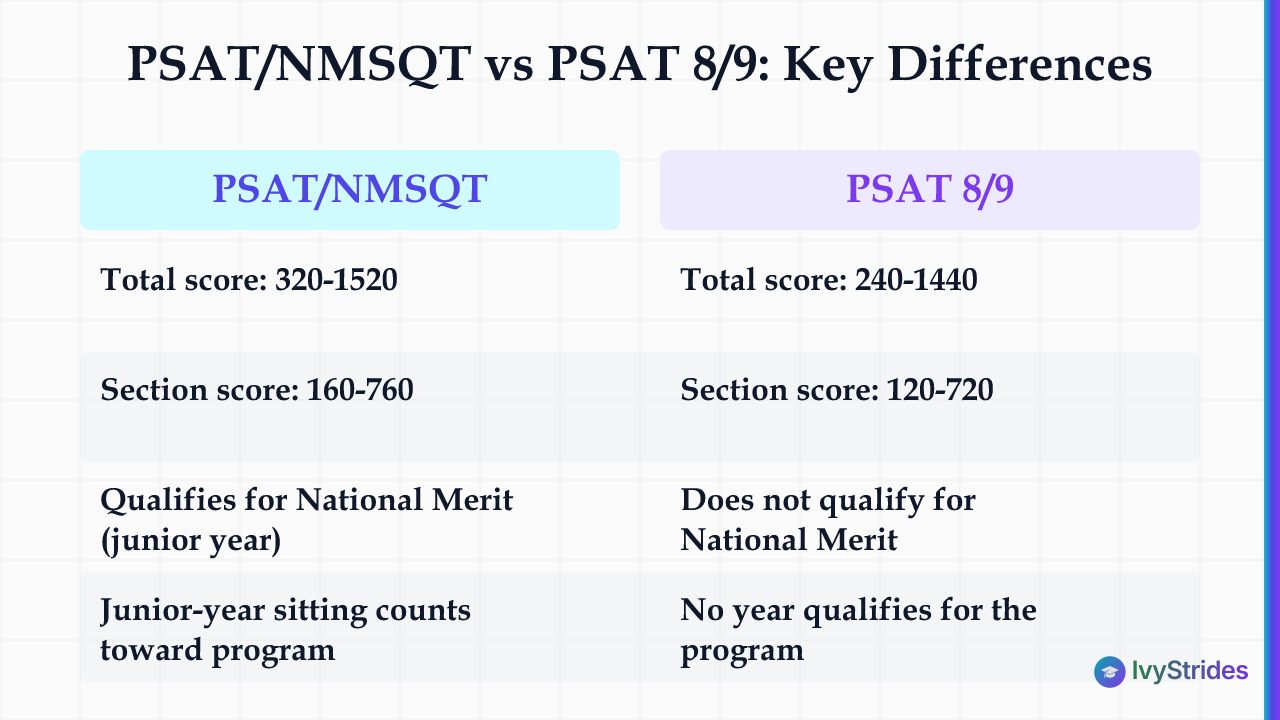
Only the PSAT/NMSQT qualifies for National Merit; the PSAT 10 and PSAT 8/9 are not considered for entry, per NMSC. That six-week school-authorization step from the last section matters most for juniors, because only the junior-year PSAT/NMSQT sitting counts toward the program. Take the wrong version, or take it in the wrong year, and the score never enters the competition.
The three tests share a scale but serve different grades. Here is how they line up, per College Board's score meaning page.
| Version | Total Score Range | Section Score Range | Qualifies for National Merit? |
| PSAT/NMSQT | 320 to 1520 | 160 to 760 | Yes (junior year only) |
| PSAT 10 | 320 to 1520 | 160 to 760 | No |
| PSAT 8/9 | 240 to 1440 | 120 to 720 | No |
The qualifying metric is the NMSC Selection Index. You calculate it by doubling the Reading and Writing section score, adding the Math section score, and dividing the total by 10, on a scale of 48 to 228, per NMSC's Selection Index guidance. So a student scoring 700 Reading and Writing and 710 Math gets (2 × 700 + 710) ÷ 10, a Selection Index of 211. NMSC uses that number to identify about 50,000 high scorers, and roughly 34,000 of them become Commended Students.
One caveat worth stating plainly: NMSC sets the qualifying Selection Index cutoffs per state and per year, and College Board does not publish them. Any cutoff you see before NMSC announces it is an estimate, because the Selection Index range each state demands shifts from year to year. Reaching that range is also only one stage of the path from Commended Student to Semifinalist to Finalist.
National Merit Eligibility for International Students: The Citizenship Rule
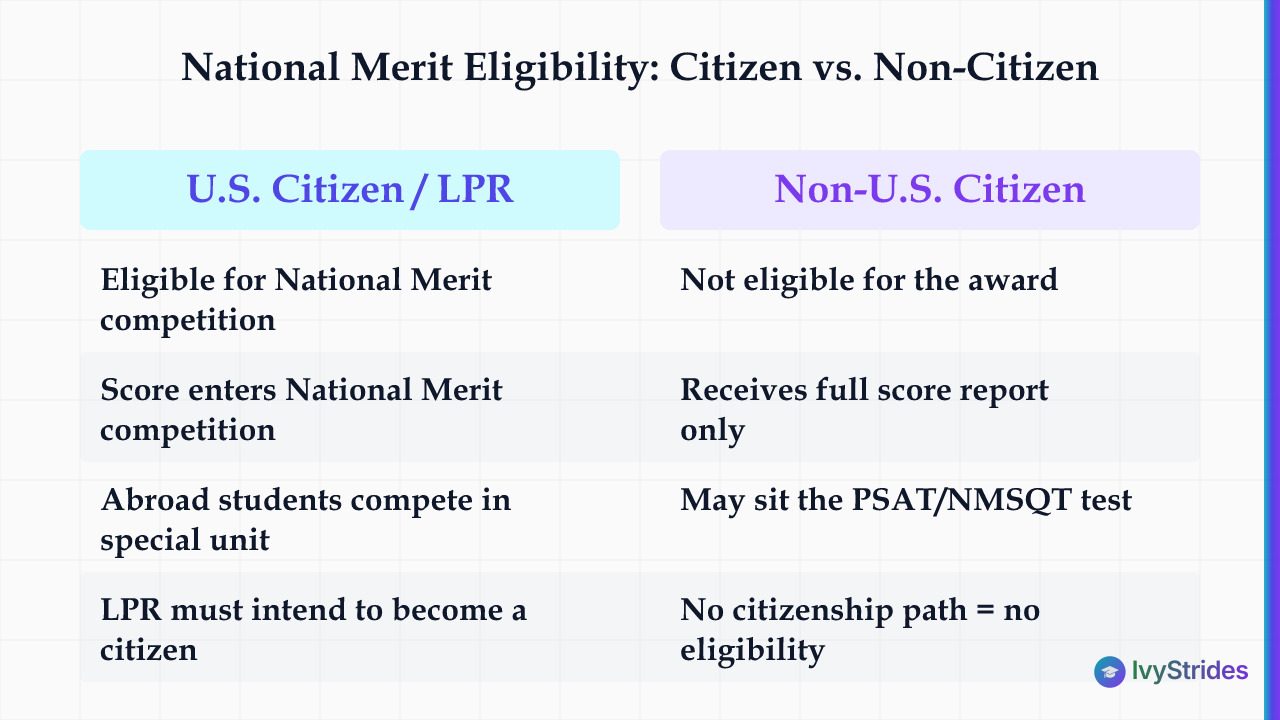
National Merit entry through the PSAT/NMSQT requires U.S. citizenship, or lawful permanent resident status with the intent to become a citizen. That Selection Index threshold from the previous section is the screen, but it only matters once you clear the citizenship gate. A non-U.S. citizen can sit the PSAT/NMSQT and receive a full score report, yet the score never enters the National Merit competition.
U.S. citizens abroad are not shut out. They compete in a special selection unit set up for students outside the fifty states, so an American junior at an international school still has a real National Merit path. Because the PSAT/NMSQT uses the full digital adaptive module structure, a scored sitting can be more useful than a practice test alone for students more familiar with paper exams.
| Requirement | Applies to You? |
| U.S. citizen, or permanent resident intending to become one | Required for entry |
| Took the PSAT/NMSQT (not PSAT 10 or 8/9) | Required |
| Took it in junior year | Required |
| U.S. citizen studying abroad | Competes in a special selection unit |
| Non-U.S. citizen | May sit the test; not eligible for the award |
The timeline runs long. NMSC notifies Semifinalists through their high schools in early September, about eleven months after the qualifying PSAT/NMSQT, and Finalists in February, per NMSC's program timeline. About 95% of Semifinalists are expected to become Finalists. For 2028, NMSC will award some 6,700 National Merit Scholarships plus approximately 620 Special Scholarships, a combined value over $29 million.
A note on status: lawful permanent resident eligibility hinges on intent to become a U.S. citizen, so verify your specific situation directly with NMSC rather than assuming a green card settles it. For what those awards actually pay, see the dollar value of Finalist standing and the full range of corporate and college-sponsored awards.
What the PSAT/NMSQT Still Gives International Students Without National Merit
The PSAT/NMSQT is the only scored run at the full digital adaptive format before your first SAT, which makes it worth taking even for students locked out of National Merit on citizenship. Those scholarship dollar figures above matter only to a slice of international students; the score report matters to all of them.
Because the PSAT/NMSQT uses the same digital adaptive format as the SAT, including two modules per section and the same pace of approximately 71 seconds per Reading and Writing question and 95 seconds per Math question, sitting it in October gives international students a scored rehearsal before their first SAT date. The test runs 98 questions in 2 hours 14 minutes of testing, multistage adaptive by module, per College Board's test structure page.
| Section | Questions | Time | Modules |
| Reading and Writing | 54 | 64 minutes | Two 27-question modules |
| Math | 44 | 70 minutes | Two 22-question modules |
| Total | 98 | 2 hr 14 min | Four, multistage adaptive |
Each module also carries two pretest questions that do not count. Once scores arrive, the score report shows the Selection Index on page 1 and a Knowledge and Skills progress bar for each of the eight content domains, four Reading and Writing and four Math. A common pattern in international students' reports is strong Math domain scores alongside lower Reading and Writing scores, especially in Information and Ideas and Craft and Structure, which lean on U.S. academic reading conventions.
Colleges can find you too. The optional Student Search Service opt-in lets participating colleges contact test-takers, and it's open to every student regardless of citizenship. If you are new to the test, start with what the PSAT is and who it's for, then use your eight domain scores to decide what to study first. The 2024-25 PSAT/NMSQT mean was 950, per College Board's 2025 SAT Suite Annual Report, a useful marker when you read your own report.
Here's the part most international students miss. The report is a diagnostic. IvyStrides PSAT prep starts from your eight domain scores and maps the weakest ones to a targeted SAT study sequence, so October's test becomes the first data point in a plan rather than a one-off.
FAQ: International Students, the PSAT/NMSQT, and National Merit
Who is eligible to take the PSAT?
Any student enrolled at an authorized secondary school can take the PSAT/NMSQT, regardless of citizenship or nationality. The test is not sold at independent public test centers. A student whose own school does not offer it should arrange a seat at a nearby participating school at least six weeks before the October window.
Can international students get a National Merit Scholarship?
Only students who are U.S. citizens, or lawful permanent residents intending to become citizens, can enter the National Merit program. Non-U.S. citizens can sit the PSAT/NMSQT and receive a score report, but those scores are not considered for recognition. U.S. citizens studying abroad compete in a special selection unit.
Can you take the PSAT outside of school?
No. The PSAT/NMSQT runs only through authorized secondary schools, never at independent public test centers. If your school does not offer it, contact a nearby participating school directly, at least six weeks before the October 1 to October 30, 2026 testing window, to ask about a guest seat.
Is there a point in taking the PSAT as an international student?
Yes. Even without National Merit eligibility, the PSAT/NMSQT is the only scored run at the full digital adaptive format before the SAT. The score report maps your performance across eight content domains, giving you a precise picture of which Reading and Writing or Math areas to target in SAT prep.
Your Next Step on the PSAT/NMSQT
The decision splits cleanly on one fact: whether you can sit the test, and whether your citizenship opens the National Merit door. Both answers point to the same early move, since the October window closes fast and schools need lead time.
- Confirm whether your school is authorized, or find a nearby participating school now.
- The six-week lead time before October 1 has already passed for this cycle, but the window is open through October 30, 2026, so contact a school immediately if you have not yet arranged a seat, or plan your lead time for the next cycle.
- If you are a U.S. citizen or qualifying permanent resident, mark the junior-year sitting as your National Merit attempt and verify your status with NMSC.
- Either way, plan to read your eight domain scores as the starting point for SAT prep.

Award-winning author (South Asian Book Award) and graduate of BITS Pilani and UCLA Luskin School of Public Affairs. Brings a published writer's eye to Common App essays and grammatical precision to SAT and ACT R&W instruction.