
What Is Columbia's ED Acceptance Rate? 14%, and Who Is Ready by Nov 1
On this page
- What Is Columbia's ED Acceptance Rate, and How Does It Compare to RD?
- Columbia ED Deadlines, Binding Rules, and the Decision Timeline
- What Columbia Weighs in Its Holistic Review: The Seven Very Important Factors
- Is Your Columbia File Ready by November 1? A Readiness Checklist
- FAQ: Columbia ED Acceptance Rate and Deadlines
- Is Columbia ED binding?
- Does Columbia have ED 1 and ED 2?
- Which Ivies have the highest ED acceptance rate?
- Can I get into Columbia with a 1470 SAT?
- Your Next Step on Columbia ED
Columbia's Early Decision acceptance rate for the fall 2025 entering class was approximately 14%: 819 students admitted from 5,868 ED applications, per the 2025-26 Common Data Set. Early Decision binds you: a Columbia admission means you enroll and withdraw every other application.
That 14% rate is IvyStrides' own arithmetic. The Columbia CDS publishes the application count and the admitted count but not the rate, so we divide 819 by 5,868. The harder question is whether your file justifies committing by November 1.

What Is Columbia's ED Acceptance Rate, and How Does It Compare to RD?
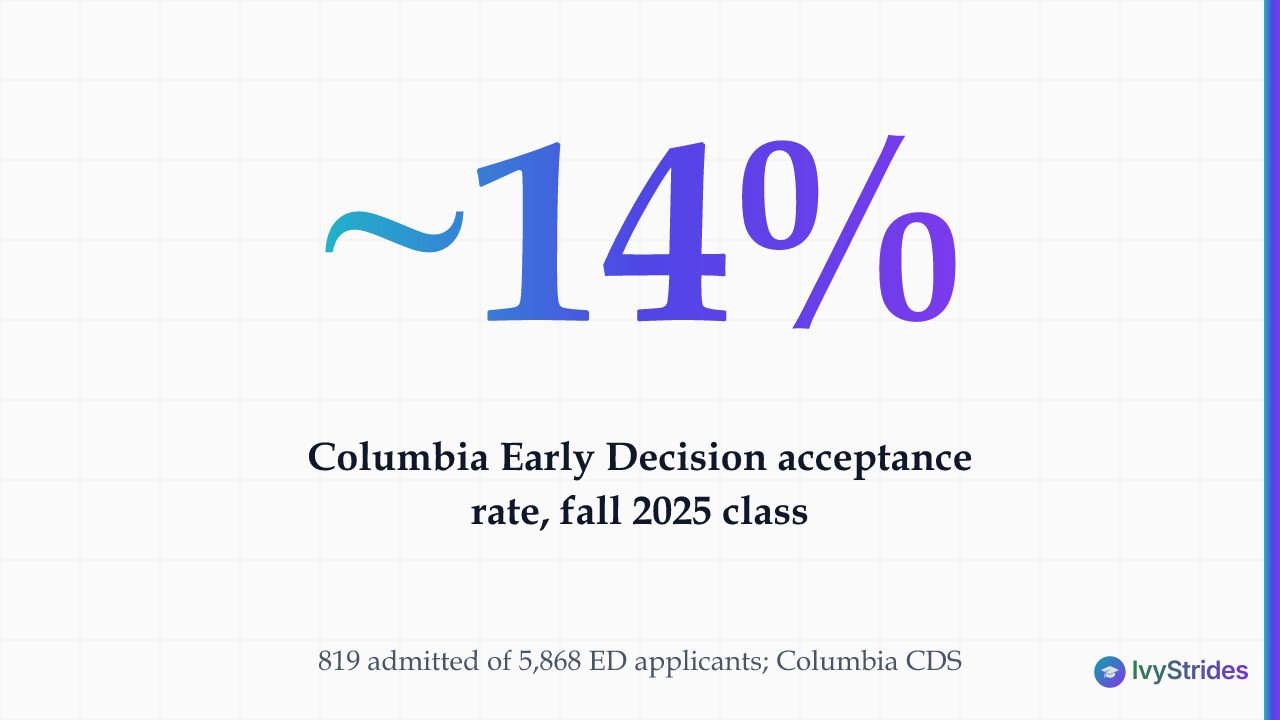
Columbia's Early Decision acceptance rate was about 14% for the fall 2025 entering class. Columbia does not publish an overall acceptance rate in the materials cited here, so we do not state a precise all-rounds comparison. These figures cover Columbia College and Columbia Engineering (SEAS) only. The School of General Studies runs a separate process, out of scope here.
Why the gap exists. ED self-selects for applicants who are certain and prepared, and the binding commitment lets Columbia protect its yield. A higher ED rate is real, but the bar does not drop. Columbia applies the same holistic review to both rounds.
| Round | Applications (fall 2025 class) | Admitted | Approximate Rate |
| Early Decision | 5,868 | 819 | ~14% (IvyStrides) |
| All rounds combined | not stated here | not stated here | not stated here |
Source: application and ED admit counts from the Columbia 2025-26 Common Data Set. IvyStrides derives the 14% ED figure from the two CDS inputs.
This higher-early-rate pattern holds across selective schools. For context on another highly selective school, Duke's ED acceptance rate is roughly triple its RD rate. The lesson repeats everywhere: ED can help, but only when the school is a genuine first choice and the file is ready.
Columbia ED Deadlines, Binding Rules, and the Decision Timeline
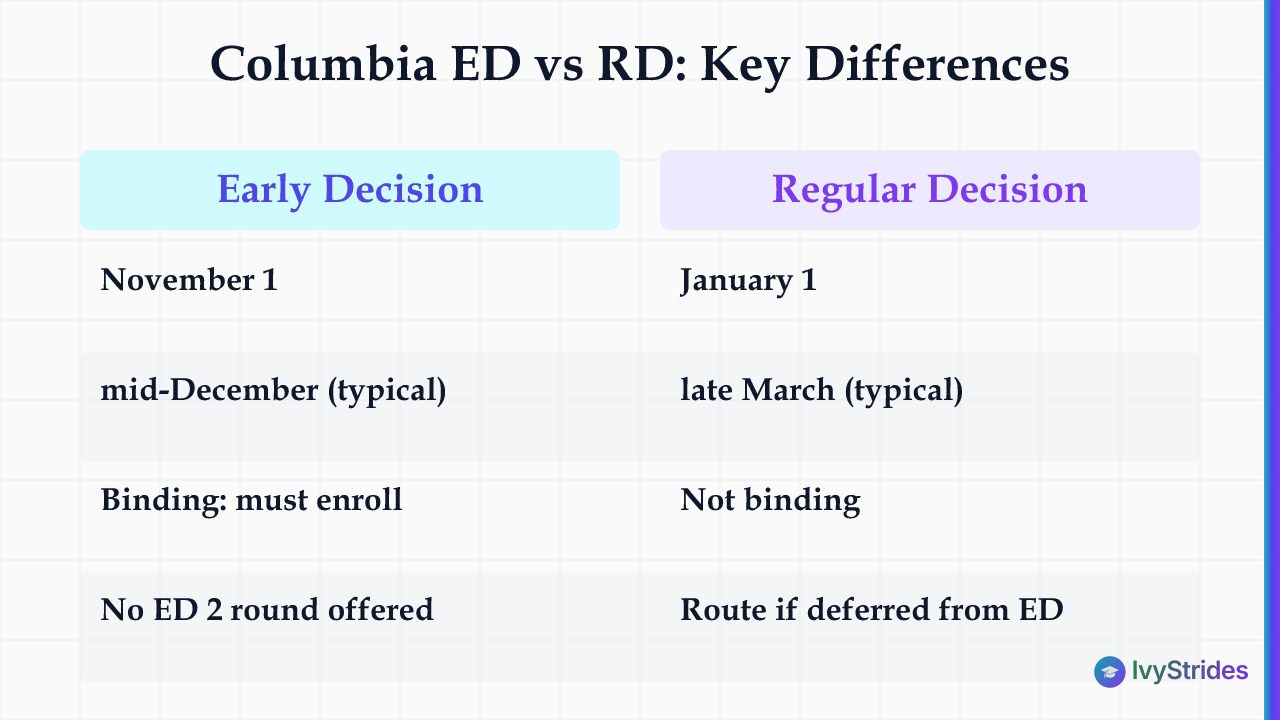
Columbia sets its Early Decision deadline at November 1 and releases decisions in mid-December, a date Columbia describes as typical that may vary in a given year. Binding means this: a Columbia ED admission requires you to enroll and withdraw all other college applications. Columbia College and Columbia Engineering run no ED 2 round.
Because ED binds you, your score-submission choice matters more than it does under Regular Decision. Columbia stays test-optional for the 2026-27 cycle (entry fall 2027), so you answer yes or no on whether Columbia should consider your scores. You cannot change or withdraw a yes after you submit it. You can switch a no to a yes until the fourth Wednesday in November as an ED applicant.
| Round | Deadline | Decision Release | Binding? |
| Early Decision | November 1 | mid-December (typical) | Yes |
| Regular Decision | January 1 | late March (typical) | No |
Source: Columbia Undergraduate Admissions first-year application and testing pages. Columbia describes decision-release months as typical, and they may vary.
The platforms and the fine print. Columbia accepts the Common App, the Coalition Application on Scoir, and QuestBridge. Admitted students may request deferred enrollment for up to two years (CDS C18). If you miss November 1 or Columbia defers you, Regular Decision is the route, with a January 1 deadline. If you are still weighing ED against EA and RD across your list, our guide to Early Decision vs Early Action vs Regular Decision lays out the full framework for each round.
What Columbia Weighs in Its Holistic Review: The Seven Very Important Factors
Columbia's holistic review names seven Very Important factors in its 2025-26 Common Data Set, section C7: rigor of secondary school record, class rank, academic GPA, application essay, recommendation, extracurricular activities, and character or personal qualities. Columbia applies no formula and no cut-off GPA or test score. No candidate reaches an offer without discussion by multiple officers.
That committee-based, contextual review reads your record against your school's resources and your circumstances: family responsibilities, work, commute. Columbia asks what opportunities you took among those available to you.
| Factor | What Columbia Looks For |
| Course rigor | The most demanding load your school offers |
| Class rank | Standing within your class |
| Academic GPA | Strong performance across subjects |
| Application essay | Individual voice and curiosity |
| Recommendation | Credible, specific teacher support |
| Extracurriculars | Depth and genuine commitment |
| Character | Integrity, kindness, collaboration |
Source: Columbia 2025-26 Common Data Set, section C7. Columbia rates interview, state residency, religious affiliation, and level of applicant's interest as Not Considered.
Five dimensions behind the factors. Columbia's admissions page frames review around academic preparation, curiosity, engagement with others, individual voice, and knowledge of Columbia. That last one rewards specifics: the Core Curriculum, a traditional campus in a city, New York City itself. Engineering applicants need physics and calculus and two teacher recommendations, at least one of which must be from a math or science teacher. Confirm the total number of required teacher letters on the admissions page before you apply.
The supplement is not a formality. The Columbia-specific questions include a 100-word list of texts and resources that shaped your thinking outside class, plus a set of short-answer questions. A common pattern in applications pairs a strong personal statement with a Columbia supplement treated as a checklist rather than a second chance to show curiosity and individual voice. Real fit here is one of the five named dimensions; our guide to writing a specific 'Why This College' essay shows how to make it concrete.
Columbia stays test-optional for the 2026-27 cycle (entry fall 2027), so submit a score only if it strengthens your file. Columbia will require scores beginning with fall 2028 entry, so plan ahead if you are applying in a later cycle. Test-optional policies vary by school and year, so confirm Columbia's current policy before you apply. If your SAT or ACT sits below Columbia's typical submitted range, weigh a retake against the tradeoffs of applying Early Decision with a borderline test score.
Is Your Columbia File Ready by November 1? A Readiness Checklist

Photo by https://kaboompics.com/ on Pexels
Your Columbia file is ready for the November 1 Early Decision deadline when every item below is genuinely done, not nearly done. Because ED binds you, a file with gaps spends your single strongest shot at Columbia. The decision rule is simple: all boxes checked, apply ED; any box open, plan a stronger Regular Decision application instead.
Work through these honestly against Columbia's holistic criteria:
-
Course rigor. You are taking the most demanding load your school offers. Columbia accepts AP, IB, A Levels, and national systems equally, with no preference.
-
Personal statement. You drafted, revised, and reviewed it, rather than writing it the week before.
-
Columbia supplement. You drafted the 100-word list and the short-answer questions, and they show curiosity, not filler.
-
Recommendations. You confirmed two academic-subject teacher letters, plus the counselor recommendation and school report. Engineering applicants need two teacher recommendations, at least one of which must be from a math or science teacher; confirm the total on the admissions page.
-
Score decision. You decided yes or no on submitting, knowing you cannot reverse a yes.
-
Knowledge of Columbia. Your supplement names the Core Curriculum, the campus-in-city setting, or New York City with specifics.
-
Financial fit. Because ED binds you to enroll, confirm the aid package would be acceptable before committing.
-
Full-application sense. Your outcome depends on the whole file. No single factor, and no formula, guarantees admission.
Where coaching helps. A common pattern in ED applications is a strong personal statement paired with a Columbia supplement, particularly the 100-word intellectual list, treated as a checklist rather than a chance to show knowledge of Columbia. Closing that gap under a November 1 clock is exactly what college admissions counseling that audits your file against each college's criteria is built for. Every other deliverable belongs on your 2026-27 college application timeline, working back from November 1.
If the checklist surfaced a gap, the deadline will not wait for you to solve it alone.
FAQ: Columbia ED Acceptance Rate and Deadlines
Is Columbia ED binding?
Yes. If Columbia admits you under Early Decision, you must enroll and withdraw all other college applications. You make the commitment when you submit the ED agreement. One nuance: if Columbia's financial aid offer falls short, the office may release you from the commitment, but verify this directly with admissions before applying.
Does Columbia have ED 1 and ED 2?
No. Columbia College and Columbia Engineering offer one Early Decision round, with a November 1 deadline and mid-December decisions. Columbia runs no ED 2 round. Students who miss the ED deadline, or whom Columbia defers, apply or reapply under Regular Decision, which closes January 1.
Which Ivies have the highest ED acceptance rate?
There is no consistent public ranking. ED acceptance rates vary by year, and the eight Ivies do not report them the same way, so compare each school's own Common Data Set for the same year. Columbia's roughly 14% ED rate for the fall 2025 class reflects the self-selection of a binding round, so ED fits only when Columbia is a true first choice.
Can I get into Columbia with a 1470 SAT?
Columbia stays test-optional for the 2026-27 cycle (entry fall 2027), so submitting a 1470 is a judgment call. A 1470 sits at the 96th percentile of SAT takers but below Columbia's SAT middle 50% range of 1510–1560, which describes enrolled students who submitted a score (2025-26 CDS), not all admitted students. If your other components are very strong, not submitting may serve you better. Test-optional policies vary by school and year, so verify the current policy before applying.
Your Next Step on Columbia ED
Columbia's Early Decision round is more forgiving on the numbers and less forgiving on the commitment. Treat the 14% rate as context, not permission, and let your file decide the round.
- Weigh your honest readiness against the eight-item checklist above.
- Make a deliberate yes or no on submitting a score, knowing a yes is final.
- Confirm your supplement shows real knowledge of Columbia, not generic praise.
- If any box stays open, build a stronger Regular Decision application rather than spending ED on an unfinished file.

Hemant is a seasoned entrepreneur, investor, and growth strategist with deep ground in education and technology-driven learning. His core training is in Mathematics and Physics — he authored Physics for IB Diploma: Ultimate Revision Guide, recognized as a top student resource.