
How to Get Feedback on your College Essay in 2026: A Step-by-Step Guide That Actually Works
On this page
- The Short Answer: Who to Ask and in What Order
- What Admissions Officers Actually Notice in a College Essay
- The Feedback You Are Not Getting: Why Most Essay Reviews Fall Flat
- How to Ask for Feedback on Your Essay: The Exact Questions to Use
- Can You Use AI to Review Your College Essay? An Honest Answer
- When to Hire a Professional: What a Coach Catches That Others Miss
- How to Evaluate Conflicting Feedback Without Losing Your Voice
- A Step-by-Step Feedback Plan You Can Start Today
- FAQ
- How many people should review my college essay before I submit it?
- Is it okay to ask a parent to review my college essay?
- What is the difference between a college essay review and college essay coaching?
- Can I get free feedback on my college essay online?
- How do I ask a teacher to review my college essay without it being awkward?
- Should I use ChatGPT to review or rewrite my college essay?
- How is feedback on a supplemental essay different from feedback on the Common App personal statement?
To get useful feedback on your college essay, ask three types of readers in sequence: a trusted peer or family member who can tell you where they lost interest, a teacher or school counselor who can check prompt fit and structure, and a professional coach for admissions-context notes. Ask each reviewer a specific question, not "what do you think?" The 2025-2026 Common App personal statement has a 650-word hard cap and seven prompts, unchanged from the prior cycle.
These prompt and word-limit facts come directly from Common App's official prompt announcement for the current cycle. The harder question, and the one this article is built around, is what to do when five different readers hand you five contradictory notes.
The Short Answer: Who to Ask and in What Order
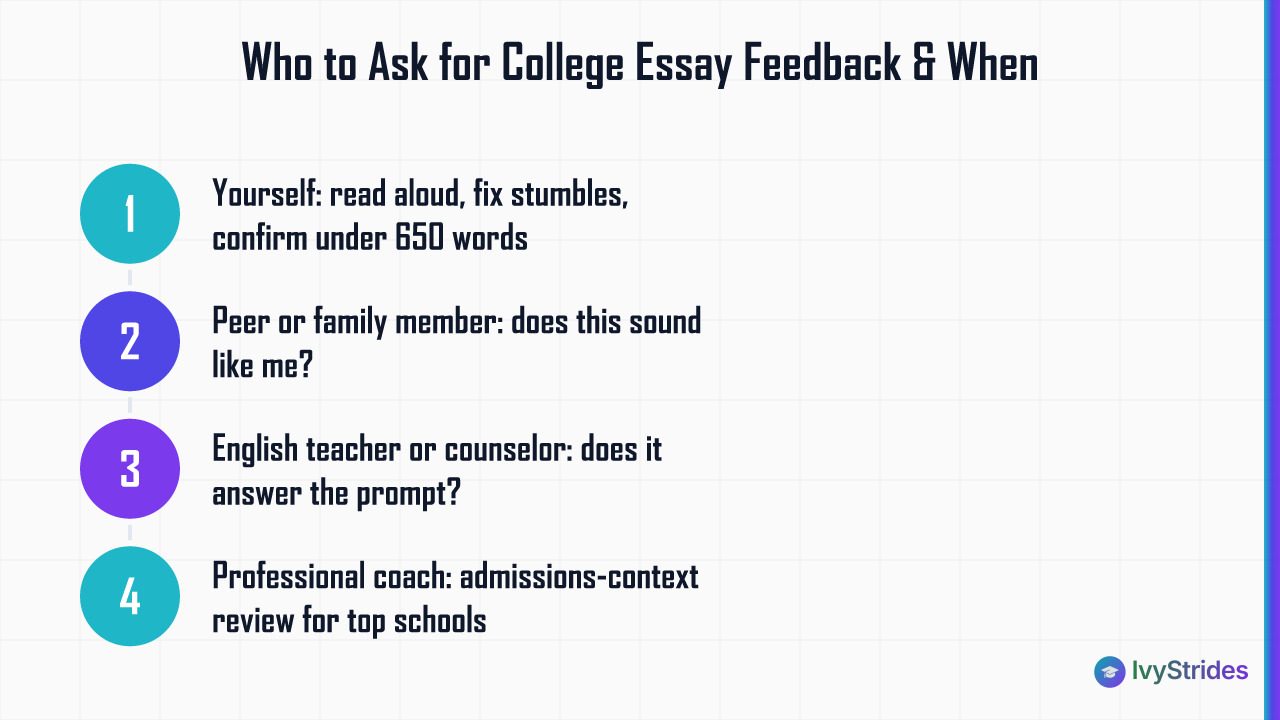
Here's the sequence that consistently produces stronger drafts:
-
Yourself, first. Read the essay aloud. Fix the sentences that made you stumble. Confirm you're under 650 words.
-
A peer or family member who knows you well. One question: does this sound like me?
-
An English teacher or school counselor. Two questions: does it answer the prompt, and does the second paragraph earn its place?
-
A professional essay coach or essay review service if the school is high-priority. Admissions-context notes that classroom readers usually can't give.
Notice the order. Voice check comes before structure check. Structure check comes before strategic admissions review. Reverse the sequence and you'll spend a week polishing sentences in an essay that answers the wrong prompt.
Three points of context on the Common App piece itself. The 650-word limit is a hard cap, not a target; most strong drafts we see land between roughly 550 and 650 words. The seven prompts are stable for the 2025-2026 cycle, per the Common App announcement linked above. And the personal statement is only half the writing job at most selective schools. Supplemental essays, each with their own prompt and word limit, need their own feedback pass. If your topic itself feels off before you even ask for feedback, revisit your college essay ideas that work list before another reader touches the draft.
What Admissions Officers Actually Notice in a College Essay
Before you gather feedback, you need to know what good feedback is trying to protect.
Admissions officers at selective schools read hundreds to thousands of essays per cycle. What they notice, and what Harvard's own student writing tips reinforce, is specificity and voice. Not vocabulary. Not five-syllable words. The Tuesday-afternoon detail. The line only you would write. The moment where the reader thinks, this is a real person.
Four qualities separate a strong essay from a competent one:
- Authentic voice. The essay sounds like the applicant, not their parent, not their English teacher, not a committee.
- Specificity over generality. "My grandfather's kitchen smelled like turmeric and burnt cardamom every Sunday morning" beats "I love spending time with family."
- Prompt fit. The essay answers the actual prompt, not a nearby prompt the student wishes had been asked.
- Narrative arc. Something changes across the essay. The student at the end sees something the student at the start did not.
A note on the 3 D's: Death, Divorce, Drugs. These topics aren't off-limits, but they require exceptional execution. In our coaching, we've watched strong writers pull off a divorce essay and other writers use the same topic to accidentally center a family member instead of themselves. If feedback later reveals that your topic isn't landing, it may be worth revisiting your brainstorm before revising further. Feedback also frequently surfaces one of the common college essay mistakes to avoid, and knowing those in advance helps you interpret notes faster.
One more layer. At test-optional schools, where a student has chosen not to submit SAT or ACT scores, the personal statement and supplementals carry more of the narrative weight. Test-optional policies vary by school and year; the FairTest tracker is the standard reference. This matters for feedback prioritization: if you're applying test-optional to a highly selective school, the essay is doing more of the work, so the review process deserves proportionally more of your calendar.
The Feedback You Are Not Getting: Why Most Essay Reviews Fall Flat

Photo by Rufaro Makaya on Pexels
Here's the honest picture. Most students don't suffer from too little feedback. They suffer from too much of the wrong kind.
The pattern is familiar. A student shows the draft to Mom, who tightens the grammar and softens two jokes. Dad reads it and suggests adding a line about leadership. An older sibling says the introduction is "fine." An English teacher fixes semicolons. A friend says "I love it!" Five reads, zero direction. The student now has a draft that has been edited by committee and sounds like no one.
That's why the same question shows up over and over on Reddit and Quora: where do I go for feedback that will actually be helpful?
Two problems drive it. First, most reviewers default to grammar-level editing because grammar is the easy target. A comma fix is a satisfying, visible contribution. Story-level editing, the kind that tells you whether the entire second paragraph is earning its place, requires the reader to hold the whole essay in mind and evaluate it against a prompt and an admissions context. That's harder and less commonly offered.
Second, the readers closest to the student have the least emotional distance. Parents want the essay to sound impressive. Friends want to be encouraging. Neither instinct produces the sharp, unvarnished note that actually moves a draft forward.
In our coaching, the most common pattern we see is a student who has received five rounds of feedback from family and still doesn't know whether the story is landing. They know their comma usage is clean. They don't know whether the essay answers the prompt. Those are different problems. Once you've collected feedback, you'll still need a structured how to edit and revise your college essay process, because feedback tells you what to change; revision tells you how to change it without unraveling what already works.
How to Ask for Feedback on Your Essay: The Exact Questions to Use
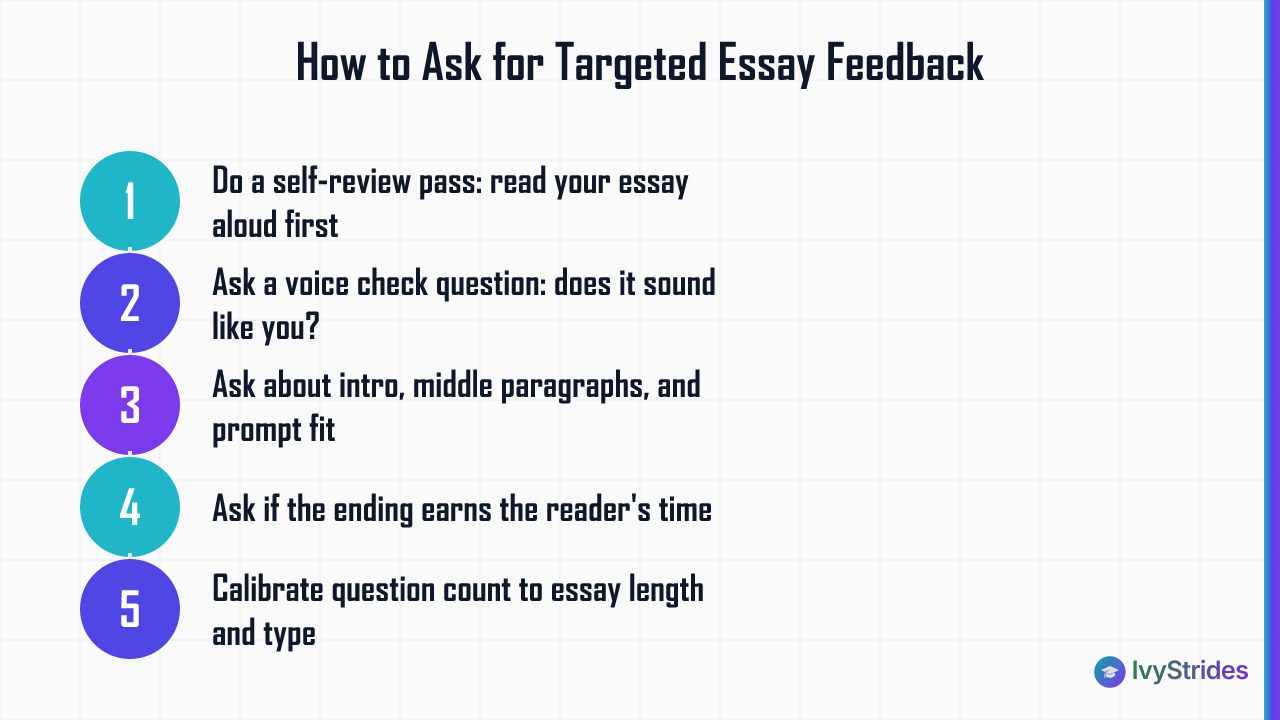
Specific questions produce specific feedback. Vague requests produce vague responses. If you send a draft with "let me know what you think," you'll get exactly that: what they think, in whatever direction their instincts pull them, usually toward grammar.
Send targeted questions instead. Copy these, adjust as needed:
-
For the voice check: "Does this essay sound like me, or does it sound like it was edited by a committee?"
-
For the introduction: "I'm not sure my introduction is pulling the reader in. Can you tell me where your attention drifted?"
-
For the middle: "Read the second and third paragraphs. If I cut either one, would the essay be weaker or just shorter?"
-
For prompt fit: "Here's the prompt. Does this essay answer it directly, or am I answering a related question I wish had been asked?"
-
For the ending: "Does the last paragraph earn the reader's time, or does it repeat what came before?"
Two operating rules.
First, don't send the first draft. Do a self-review pass first: read the essay aloud, a technique consistently recommended in Harvard's student writing guidance. Reading aloud catches sentences your eye skims. Fix those before another reader sees the draft, or you'll waste a reviewer's attention on issues you could have caught yourself.
Second, calibrate your questions to the essay type. A 650-word personal statement can absorb five separate reviewer questions. A short supplemental essay for a school like UPenn or Johns Hopkins, sometimes as tight as roughly 150 to 250 words, cannot. For a short supplemental, ask one question: "Does this answer the specific prompt and show genuine reason for applying to this school?" Anything more and you're asking a reader to weigh in on a single paragraph. If you want structured help beyond copy-paste questions, our essay review service can build the question set around your specific draft.
Can You Use AI to Review Your College Essay? An Honest Answer
Short version: AI is a useful diagnostic tool. It's a bad ghostwriter. The line between those two uses is the line you need to hold.
What AI can do reliably:
- Flag run-on sentences, passive voice, and awkward phrasing.
- Confirm word count against the 650-word Common App limit or the varying supplemental limits.
- Identify repeated words or transitions.
- Highlight sentences that are unclear on first read.
What AI can't do:
- Tell you whether your story is compelling to an admissions officer who has read hundreds of essays this week.
- Evaluate whether your voice is authentic, because it doesn't know what your authentic voice sounds like.
- Assess prompt fit at a school-culture level. Rice's residential-college culture and MIT's problem-solver culture produce different "good" answers.
- Judge whether the story you've chosen is the strongest story you could tell.
Then there's the integrity question. Passing off AI-generated prose as your own writing raises academic integrity concerns at most colleges, and admissions officers are increasingly attuned to prose that sounds AI-produced: technically fluent, emotionally flat, and generically polished. Detection tools exist, but their accuracy is contested; the safer framing is that this is a risk, not a certainty. In our coaching, students who use AI to rewrite sections often end up with prose that reads as clean but generic, which is the opposite of what a personal statement needs.
Use AI the way you'd use a spellchecker with opinions. Ask it to flag structural issues. Do not ask it to rewrite paragraphs, generate anecdotes, or make your voice "stronger." A session with a one-on-one Common App essay coach who reads admissions essays for a living solves the problem AI can't touch: is this story landing on the reader you're trying to reach?
When to Hire a Professional: What a Coach Catches That Others Miss
Not every student needs a professional coach. Some drafts land at the second round. But if you're applying to highly selective schools, or if you've done three rounds of feedback and the essay still feels stuck, a professional read is usually worth it.
Here's what a coach with admissions context evaluates that a classroom reader typically doesn't:
- Prompt alignment at a nuanced level. Common App Prompt 1 (background/identity) and Prompt 5 (personal growth) can look similar in a draft. A coach catches when you're technically answering Prompt 5 while your teacher thought you were answering Prompt 1.
- Story selection. Sometimes the essay is well-written but you've chosen the wrong story from your life. A teacher rarely says this. A coach will.
- Narrative arc across paragraphs. Not sentence-level flow. Story-level movement.
- The "so what" test. After the last sentence, what does the admissions officer know about you that they didn't know before? If the answer is thin, no amount of grammar polishing fixes it.
Two kinds of professional help exist, and they solve different problems. A one-time review is a single-pass assessment: you send a completed draft, receive a prioritized list of changes, and revise on your own. A Common App essay tutor engagement is iterative, running from brainstorm through final draft with feedback at each stage.
In our coaching across supplemental essay drafts, the single most common issue a professional catches that peers miss is a story that's technically well-written but doesn't answer the prompt. A close second: an essay that's about the applicant's grandmother or coach or coding teacher, and only obliquely about the applicant. Both are diagnosable in one read and salvageable with targeted revision. Neither is typically flagged by parents or peers.
On cost: families investing in college prep often spend well into the low five figures across test prep, coaching, and application support. A single essay review service session is a proportionally small line item, and it's the piece that shows up on every application the student sends. If the essay carries strategic weight, the review is one of the highest-use dollars in the process.
How to Evaluate Conflicting Feedback Without Losing Your Voice
You will get contradictory notes. It's not a sign anyone is wrong; it's a sign different readers care about different things. The skill is filtering.
Use this simple decision framework:
| Note received | Source type | Act or ignore |
| Grammar or word-choice fix | Any reader | Act, if it doesn't flatten voice |
| "This doesn't sound like you" | Peer or family who knows you well | Act |
| "This doesn't answer the prompt" | Teacher, counselor, or coach | Act |
| "Add a line about your leadership" | Parent | Ignore unless a second source agrees |
| "The ending feels rushed" | Anyone | Act if a second reader agrees |
| "I loved it, don't change a thing" | Anyone | Get a second opinion |
Two decision rules make this fast.
The two-source rule. If two independent readers flag the same issue, act on it. If only one reader flags it, hold. Independent readers converging on a problem is signal. A single reader's preference is noise.
Weight by admissions relevance. A coach or counselor with admissions context outweighs a family member on questions of prompt fit and story selection. A close peer outweighs a coach on the voice-authenticity check, because they actually know how you talk. Neither reader is more valuable overall; they're more valuable in their domain.
The over-editing trap is real. In our coaching, students who act on every note they receive often produce a fifth draft that's technically cleaner but less compelling than the second. Voice erodes under too many hands. Grammar tightens. Specificity fades. You end up with an essay that's technically correct and emotionally beige.
Feedback tells you what to change; a structured revision process tells you how to change it without unraveling what already works. Before you accept your third round of notes, review the common college essay mistakes to avoid list and use a repeatable how to edit and revise your college essay framework so each round of feedback lands cleanly.
Know when to stop. The essay is done when it sounds like you, answers the prompt, and closes with a "so what" that makes the reader feel they know you better than they did 650 words ago. Not before. Not after.
A Step-by-Step Feedback Plan You Can Start Today
Budget roughly three to four weeks for the full cycle before any submission deadline. For an Early Decision or Early Action deadline around November 1, that means starting no later than early October. For Regular Decision deadlines around January 1 or January 15, start by early December.
Step 1: Self-review pass. Read the essay aloud, top to bottom. Fix the sentences that made you stumble. Confirm you're under 650 words. Do not send the draft to anyone else until this pass is complete.
Step 2: Voice check with a peer or family member. Send the draft with one question: "Does this sound like me?" Not "is this good?" Not "any thoughts?" Just the voice question. Give them three days.
Step 3: Structure and prompt-fit review with a teacher or counselor. Send with two specific questions: "Does this answer Common App Prompt [number]?" and "If I cut the second-to-last paragraph, would the essay be weaker or just shorter?" Give them about a week.
Step 4 (optional): AI tool for a structural pass. Ask it to flag run-on sentences, passive voice, and word count. Do not ask it to rewrite. Take the flags, apply your own judgment.
Step 5: Professional coach or essay review service for high-priority schools. This is where admissions-context notes come in. Prompt alignment, story selection, narrative arc, the "so what" test. Skip this step for safety schools if your budget is tight. Include it for reach and target schools.
Step 6: Consolidate feedback and apply the two-source rule. Sit with all notes. Circle the ones two or more readers flagged. Draft the revision. One revision pass, not five.
Step 7: Final read-aloud before submission. One more time, out loud. If a sentence makes you wince, fix it. If nothing makes you wince, submit.
Two calibrations. Supplemental essays for schools like UPenn, Johns Hopkins, or MIT need their own feedback cycles. A short "why us" essay for Johns Hopkins isn't a lighter version of your personal statement; it's a different task with a different prompt and a different reader posture. If Hopkins is on your list, our take on should you apply to Johns Hopkins University covers the fit-and-application context that informs the supplementals. And if your topic itself is shaky before Step 1, back up and revisit your brainstorm. Feedback on the wrong story is expensive time. Our college essay ideas that work piece is a good place to restart.
FAQ
How many people should review my college essay before I submit it?
Three to four reviewers is the practical ceiling. More than that produces contradictory notes that erode voice rather than strengthen the essay. Aim for one peer, one teacher or counselor, and one professional reviewer if the school is a high priority. Any additional readers should be filling a specific gap, not adding another general opinion.
Is it okay to ask a parent to review my college essay?
Yes, but assign them a specific role. Ask whether the essay sounds like you, not whether it's grammatically correct or impressive enough. Parents tend to over-edit toward formality, which is the opposite of what a personal statement needs. Their authenticity check is valuable; their line-level edits often aren't.
What is the difference between a college essay review and college essay coaching?
A review is a single-pass assessment of a completed draft: you receive prioritized notes and revise on your own. Coaching is iterative: a coach works with you across multiple drafts, from brainstorm through final revision, with feedback at each stage. For students writing for highly selective schools or stuck after multiple rounds of amateur feedback, coaching typically produces a stronger result.
Can I get free feedback on my college essay online?
Free options include AI tools for structural feedback, school counselors, and peer-review programs at some high schools. The limitation is admissions context: a free tool can tell you the essay is well-written, but it can't tell you whether it's competitive for a specific school's applicant pool. For high-priority schools, a professional review is typically worth the investment.
How do I ask a teacher to review my college essay without it being awkward?
Be specific and respectful of their time. Send the essay with a one-sentence context note ("This is my Common App personal statement for early decision applications due November 1") and one or two specific questions ("Does the introduction pull you in?" and "Does the essay answer Prompt 5 directly?"). Give them at least a week and offer to discuss their notes in person.
Should I use ChatGPT to review or rewrite my college essay?
Using ChatGPT for a structural first pass, checking for run-on sentences, passive voice, or word count, is low-risk. Using it to rewrite paragraphs or generate content is high-risk: the output is generic, lacks your voice, and raises academic integrity concerns. Admissions officers read many essays a week and are increasingly attuned to AI-generated prose. Use AI as a diagnostic tool, not a ghostwriter.
How is feedback on a supplemental essay different from feedback on the Common App personal statement?
Supplemental essays are shorter (often around 150 to 350 words), school-specific, and prompt-driven. Feedback must focus tightly on whether the essay answers the specific prompt and demonstrates genuine reason for that school. The personal statement is about you; supplementals are about the fit between you and a specific institution. A reviewer who doesn't know the school's culture and values can't give useful supplemental feedback.
Good essays don't come from more feedback. They come from the right feedback in the right order, filtered through your own judgment about what makes the draft sound like you. Follow the seven-step plan, hold the two-source rule, and stop revising when the essay answers the prompt in your voice.
Note: college admissions outcomes depend on the full application, not the essay alone. Test-optional policies and supplemental prompts vary by school and year; verify each school's current requirements before you submit.

Award-winning author (South Asian Book Award) and graduate of BITS Pilani and UCLA Luskin School of Public Affairs. Brings a published writer's eye to Common App essays and grammatical precision to SAT and ACT R&W instruction.