
How to Get Into Stanford: Two Deep Activities Can Beat Six Clubs
On this page
- What Stanford's Holistic Review Actually Weighs
- Why Two Deep Activities Beat Six Clubs at Stanford
- What Stanford's Test Score Requirement Actually Means for Fall 2027
- What Stanford's Application Requires Before You Submit
- FAQ: Getting Into Stanford
- Is it very hard to get into Stanford?
- Can a 3.7 GPA get you into Stanford?
- How hard is it to get into Stanford as an international student?
- What is Stanford's Restrictive Early Action deadline for 2026-27?
- Your Next Step Toward Stanford
Getting into Stanford means mastering the hardest curriculum your school offers, posting competitive SAT or ACT scores (required for fall 2027), and showing genuine intellectual curiosity. Stanford University is a test-required, holistic-review university that weighs nine factors as Very Important and reads every application as one whole.
Those criteria come from Stanford's own holistic admission page and its 2025-2026 Common Data Set. The harder question is not what Stanford lists, but how to build a file that reflects it instead of a resume that assumes it.

What Stanford's Holistic Review Actually Weighs
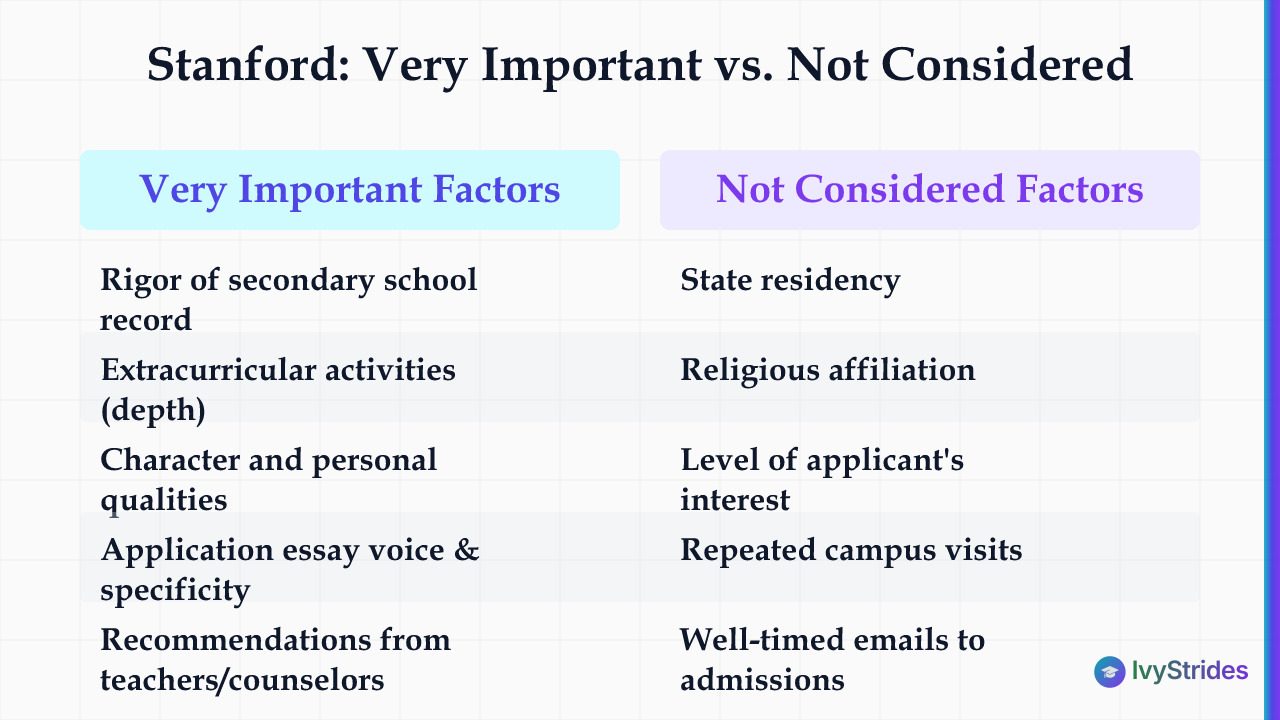
Stanford's holistic review rates nine factors as Very Important, and academic excellence is the foundation of every file. Stanford expects mastery of the hardest curriculum available at your school, and it says curiosity matters more than collecting AP, IB, or honors labels (Stanford Holistic Admission).
One whole, read in context. Holistic review means Stanford reads each part of the application as part of one whole, weighing your achievements against your circumstances, background, schooling path, and any work or family duties. A near-perfect transcript at a school offering fifteen AP courses reads differently from the same transcript where only three were available. That is context evaluation, and it runs through every factor below.
Here are the nine factors Stanford rates Very Important in section C7 of its Common Data Set.
| Factor | What Stanford Is Looking For |
| Rigor of secondary school record | The hardest courses your school offers |
| Class rank | Standing within your cohort |
| Academic GPA | Sustained performance in rigorous work |
| Standardized test scores | SAT or ACT, required for fall 2027 |
| Application essay | Voice, specificity, and intellectual energy |
| Recommendations | Teacher and counselor perspective |
| Extracurricular activities | Depth of commitment, not quantity |
| Talent/ability | A distinctive strength |
| Character/personal qualities | Who you are, read across the file |
What it does not weigh. Stanford rates three factors Not Considered: state residency, religious affiliation or commitment, and level of applicant's interest. So demonstrated-interest tactics, repeated campus visits, or well-timed emails do nothing at Stanford. Stanford reads how many AP courses you took against what your school offered, not against a national number.
Why Two Deep Activities Beat Six Clubs at Stanford
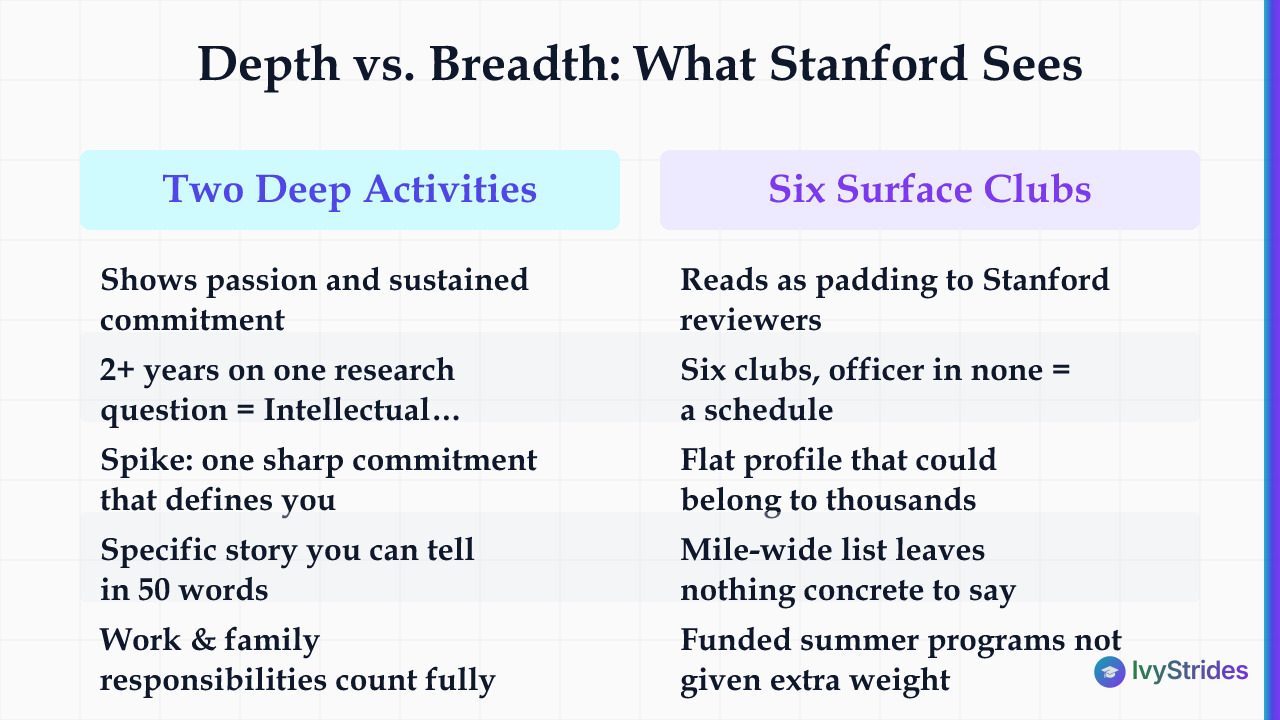
Stanford values depth over breadth: strong commitment to one or two activities can show passion better than a long list of memberships (Stanford Holistic Admission). Against the rigor of secondary school record and the activities factor above, this is where most applicants misread the signal. They pad. Stanford reads through padding.
Depth connects to Intellectual Vitality. Intellectual Vitality is a named dimension of Stanford's review that looks for curiosity, openness, and imagination, and asks how a student's energy would add to campus. A student who spent two years building and iterating one research question shows that energy. A student in six clubs, officer in none, shows a schedule.
This is the spike concept: one sharp, sustained commitment that defines you, rather than a flat profile that could belong to thousands. To build one, start with what a spike in college admissions actually is and work backward from grade 9 or 10.
Jobs and family responsibilities count fully. Stanford states that jobs and family responsibilities count as much as any other activity. A student working 15 hours a week at a family business, or caring for younger siblings, is not disadvantaged against the student with a funded summer program. Context evaluation reads both against their circumstances.
Stanford's own guidance favors depth: its short questions reward specificity over volume, and a mile-wide list leaves nothing concrete to say. Building this depth is a multi-year process, and the earlier a student maps the commitment, the more genuine it reads by application time.
Does Your Activities List Show Stanford-Level Depth?
- One or two activities you have pursued for 2+ years
- A leadership role, a built thing, or a measurable result in at least one
- A clear line from the activity to a genuine interest, not a title
- Work or family responsibilities listed, not hidden
- An activity you would keep doing with no admissions payoff
- A story you could tell in 50 words that names a specific moment
The activities that resonate at Stanford are not the same ones that signal fit everywhere, so a list-level view of which extracurriculars carry weight at selective universities helps before you commit a year to one.
What Stanford's Test Score Requirement Actually Means for Fall 2027

Photo by Andy Barbour on Pexels
Stanford requires the SAT or ACT for fall 2027 applicants (the 2026-27 cycle), and it accepts superscores for both tests (Stanford First-Year Testing). The same page that confirms the activities depth principle above rates standardized test scores as one of the nine Very Important factors, so a competitive score is part of the foundation, not an afterthought.
Because Stanford superscores, you can combine your best section results across test dates. Applicants self-report scores on the application, and official scores are needed only after admission. One caveat worth holding: test-optional and test-required policies shift by school and by year. Stanford is required for fall 2027, but that status is set per cycle, so confirm it on Stanford's admission site each year before you submit.
| Test | Score Scale | Superscore Accepted | Self-Report Allowed |
| SAT | 400 to 1600 | Yes | Yes |
| ACT | 1 to 36 composite (average of English, Math, and Reading; Science is a separate score) | Yes | Yes |
Scores are context, not a cutoff. Stanford publishes no required minimum. For where a given score lands nationally, use the College Board's SAT percentile tool, which tells you where a score sits among test takers, not whether it clears a Stanford bar. There is no bar. A strong score sits alongside eight other Very Important factors, and a weaker one has to be offset by genuine strength elsewhere. For how to send your best result once you have it, see how Stanford's superscore policy and score-sending work.
So the practical question is whether your current score is already competitive or whether a retake is worth the hours before the November 1 deadline. That is a diagnostic question, not a guess. A timed Bluebook or ACT practice test measures the gap before you spend a month closing it. If you are weighing where a given score lands across peers, it helps to know how a 1540 SAT score reads at other highly selective schools.
What Stanford's Application Requires Before You Submit
Stanford accepts first-year applications through the Common App, with two rounds: Restrictive Early Action, due November 1, and Regular Decision, due January 5 (Stanford First-Year Applicants). Beyond the diagnostic decision about your score above, the full component list and the REA restriction shape your fall timeline.
| Round | Deadline | Decision | Key Restrictions or Notes |
| REA | Nov 1 (Oct 15 with arts portfolio) | Mid-December | No early apps to other private U.S. colleges |
| RD | Jan 5 (Dec 5 with arts portfolio) | Early April | Reply due May 1 |
| Midyear transcript | By February 15 | N/A | Required of all applicants |
| Interview | By invitation | N/A | Optional, no penalty for declining |
The REA restriction is strict. If you apply Restrictive Early Action to Stanford, you may not apply early (EA, REA, ED, or Early Notification) to any other private U.S. college (Stanford Decision Process). Non-binding early plans at public universities, non-binding rolling admission, and non-U.S. early plans are allowed. So REA is right only if Stanford is your clear first choice and no binding ED elsewhere competes for it.
Required components, every round. The Common App, SAT or ACT scores, the School Report with a counselor letter, transcripts, a midyear transcript by February 15, and two teacher recommendations from academic subjects.
The essays carry the voice. Stanford asks five short questions of 3 to 50 words each and three short essays (Stanford First-Year Application). The short questions cover society's most significant challenge, how you spent your last two summers, a historical moment you wish you had seen, more detail on one activity, job, or family responsibility, and five things important to you.
These supplemental essays are where Intellectual Vitality becomes visible, and each one rewards a concrete story over a general claim. In our coaching, the five short questions are where students most often default to a category; the answers that stand out name a specific person, moment, or idea. For tactical approach, our guide to writing supplemental essays that work breaks down the method.
The interview is optional. Trained alumni volunteers interview applicants by invitation, offered across the U.S. and 60-plus other countries including India, the UK, and Canada (Stanford Alumni Interview). The application is complete without one, and declining carries no penalty. Managing all of this across multiple colleges is where counseling for grades 11 and 12 keeps a timeline honest.
FAQ: Getting Into Stanford
Is it very hard to get into Stanford?
Yes. Stanford is among the most selective universities in the world. Admitted students typically combine near-perfect grades in the most rigorous courses their school offers, competitive SAT or ACT scores, and a profile showing genuine curiosity and deep commitment to one or two pursuits. Admission depends on the full application, never a single number.
Can a 3.7 GPA get you into Stanford?
Stanford publishes no minimum GPA, and its holistic review reads a 3.7 in context: course rigor, your school's grading scale, and your circumstances all factor in. That said, Stanford expects mastery of the hardest curriculum available. A 3.7 would need exceptional strength in other Very Important factors to balance it.
How hard is it to get into Stanford as an international student?
Stanford applies the same holistic review to international applicants as to domestic ones, with no separate quota. The SAT or ACT is required for fall 2027 applicants regardless of country. Alumni interviews are offered in more than 60 countries. The competitive bar is the same as for any applicant, and context evaluation still weighs your schooling path and circumstances.
What is Stanford's Restrictive Early Action deadline for 2026-27?
Stanford's REA deadline is November 1, 2026 (October 15 for applicants submitting an arts portfolio), with decisions released in mid-December. REA applicants may not apply early to any other private U.S. college, though non-binding early plans at public universities are allowed.
Your Next Step Toward Stanford
Stanford rewards a file that reflects genuine depth, not a padded one. Everything above points to the same move: read your application the way Stanford's holistic review does, one whole, and find the one or two commitments that carry your Intellectual Vitality.
- Audit your activities against the depth checklist and pick the one or two to develop.
- Take a timed diagnostic to see whether your score is already competitive or worth a retake.
- Draft the five short questions with a specific moment in each, not a category.
- Decide REA versus RD based on whether Stanford is your clear first choice.
- Confirm Stanford's test policy and deadlines on its admission site before you submit.

Two decades teaching quantitative and verbal aptitude on standardized tests. Rare dual expertise across Math and Verbal — particularly effective for students with gaps on both sides. Senior AP Mentor for our Calculus and English tracks.