
Is Free AP Prep Enough to Score a 5? An Honest Answer
On this page
- The Short Answer: It Depends on Three Specific Factors
- What Free AP Study Resources Actually Exist (and What Each One Does)
- What Percentage Score Do You Need to Earn a 5 on an AP Exam?
- When Free AP Prep Is Not Enough: The Gaps That Cost Students Points
- Not Sure If Your AP Prep Is on Track?
- Which AP Subjects Are Hardest to Score a 5 On?
- A Practical Free AP Study Plan: What to Use and in What Order
- How AP Scores Affect College Admissions and Credit Policies
- When Structured AP Coaching Is Worth the Investment
- FAQ
- Is 70% a 5 on an AP exam?
- Is 7 AP classes enough for Harvard?
- How many practice tests should I take before an AP exam?
- Is one month enough time to study for an AP exam?
- How helpful are free video courses for AP prep?
- Has anyone ever scored perfectly on an AP exam?
- Ready to Know Exactly Where Your AP Prep Stands?
Free AP prep can be enough to score a 4 or 5, but only under three specific conditions: the subject has a relatively high 5-rate, you already have a strong content baseline, and you can accurately self-diagnose your own errors without expert feedback. For a subject like AP Physics 1, where fewer than 10% of test-takers earn a 5, the honest answer for most students is no, free resources alone won't get you there. For AP Psychology, where the 5-rate runs above 20%, a disciplined free-study plan absolutely can.
Those score-distribution figures come from the College Board AP Program, which publishes them after each exam cycle. The harder question is which specific gaps your subject and target score actually demand, and that's where the next section starts. This piece reflects the 2026 AP exam formats and is reviewed annually.
The Short Answer: It Depends on Three Specific Factors
Three variables decide whether free prep gets you to a 5. Miss any one of them and the free-only path starts leaking points.
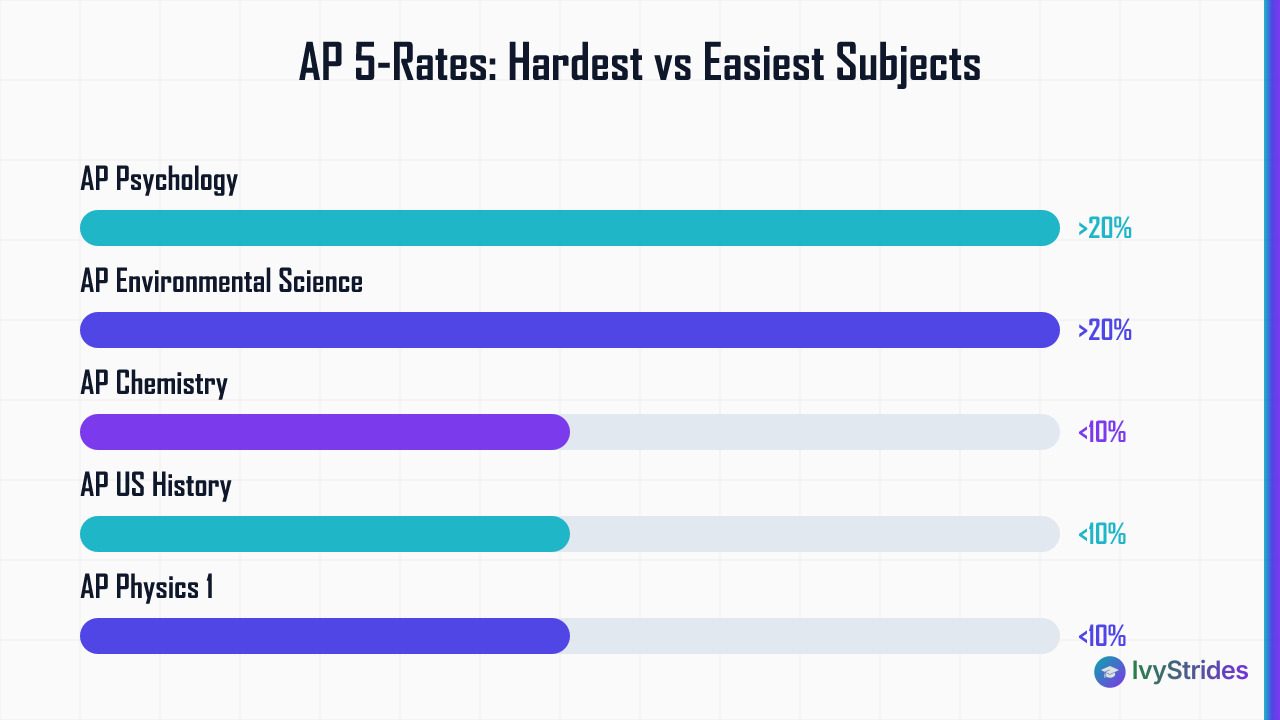
Factor one: the subject's 5-rate. AP exams are not equally hard. AP Physics 1 sits near the bottom of the AP score distribution, with a 5-rate that has stayed below 10% in recent years. AP Psychology, by contrast, has typically posted a 5-rate above 20%. That gap is enormous. A free-study plan that comfortably produces a 5 in AP Psychology can leave an AP Physics 1 student stranded at a 3, doing the exact same number of hours.
Factor two: your content baseline. If you're already carrying an A in an AP-level course and scoring in the 4 range on early practice, free materials plus discipline can close the last stretch. If you're self-studying a subject your school doesn't teach, or you're starting from a 2, the math changes.
Factor three: whether you can self-diagnose. This is the one students underrate. The College Board AP Classroom is the official free resource, loaded with unit-aligned questions, but it requires a school-issued join code from your teacher, and it won't tell you why your free-response answer lost points. Reading a rubric and applying it to your own writing are different skills.
Get all three factors in your favor and free prep is often enough. Miss one, especially on a low-5-rate subject, and structured help starts to earn its keep. If you're weighing that decision, our ap courses online pages lay out what a per-subject specialist actually does differently.
What Free AP Study Resources Actually Exist (and What Each One Does)
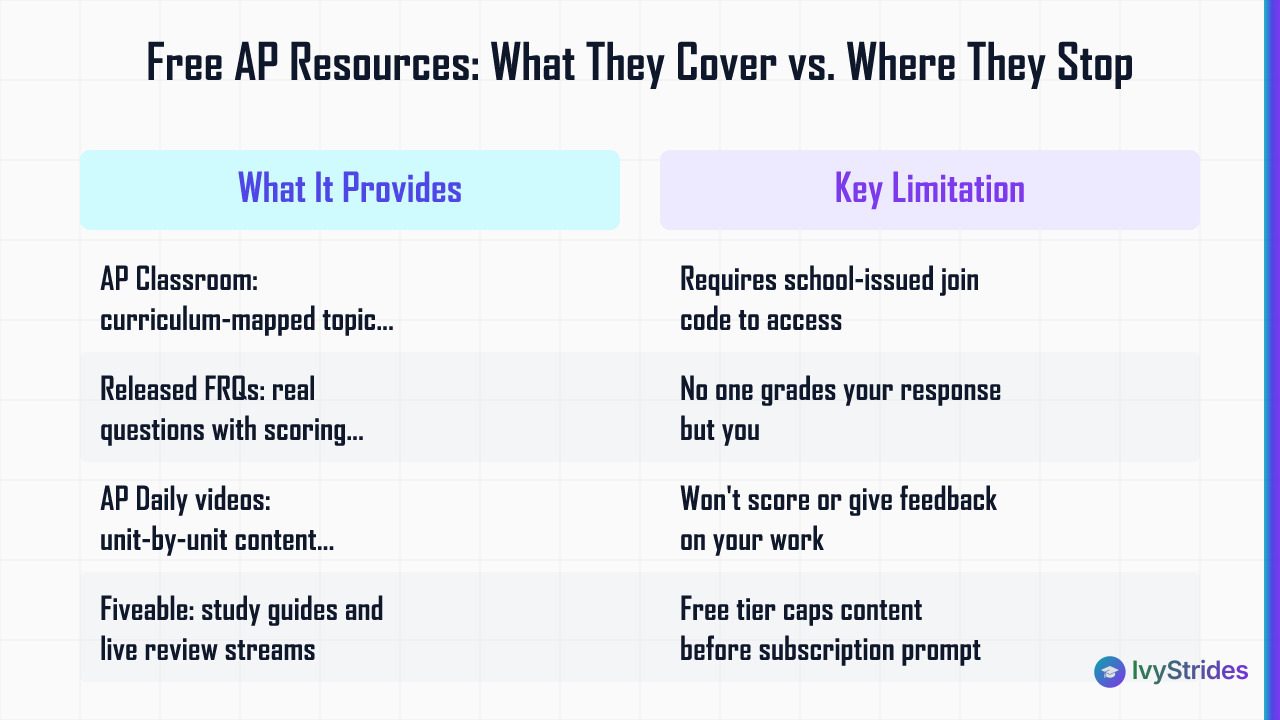
Here's the real landscape, resource by resource, because "just use free resources" is useless advice without knowing what each one covers and where it stops.
College Board AP Classroom is the official hub, and it's the one every student should be using. It contains topic questions and progress checks mapped directly to the AP curriculum framework for your subject. The catch: you need a school-issued join code from your AP teacher to access it. Self-studiers without an enrolled class often can't get in, which is a real gap.
AP Daily videos, also from College Board, are organized unit by unit and taught by AP teachers. They align exactly to the framework units. Strong for content instruction. They won't score your work.
Official released AP practice exams (PDF). After each administration, College Board publicly posts free-response questions and their scoring guidelines. These are gold. Real questions, real rubrics. The limitation is obvious: nobody grades your response but you.
Free AP-aligned video courses and other free AP study websites offer instruction for a subset of subjects, strong on content delivery and practice problems, weaker on anything resembling personalized feedback.
Fiveable provides community-written study guides and live review streams. Useful for a quick unit refresher and for exam-week cramming structure. Its free tier caps how much content you can access before a subscription prompt appears.
Question-bank platforms typically run a free tier with a subset of practice questions and put the full bank behind a subscription.
The Reddit AP Students community is where you'll find the "is free AP prep enough reddit" conversations, plus threads on which units tend to trip people up. Treat it as crowd-sourced intel, not authority. Verify any format or scoring claim against College Board.
One more thing that matters for 2026: most AP exams are now delivered digitally through the Bluebook digital testing app. If you only practice on paper PDFs, you're rehearsing the wrong interface. Build in Bluebook practice.
And if your school doesn't offer the subject at all, that AP Classroom access problem becomes central. See No AP at Your School? How to Take AP Online and Still Earn Credit.
What Percentage Score Do You Need to Earn a 5 on an AP Exam?
Here's the part most students misunderstand. There is no fixed percentage. The College Board sets the score cutoff for each subject after the exam is administered, based on that year's data. So anyone quoting you a hard "you need 85%" number is guessing.
That said, there's a defensible working target. Historically, a composite raw score of roughly 65-75% has corresponded to a 5 across most subjects. Treat 70% as a directional benchmark, not a promise. Some subjects have run lower; some higher.
How does the composite work? Your score combines two parts: the multiple-choice component and the free-response question (FRQ) section. The FRQ typically carries about 40-55% of the composite, depending on the subject. That weighting is why FRQ performance so often decides the 3-versus-5 outcome.
For calibration: a composite raw score around 50% usually lands you a 3 on most exams, not a 5. Somewhere around 75% is generally comfortable 5 territory on many subjects, though not all. The point isn't to memorize these bands. It's to understand that on a low-5-rate subject, you need to be converting a large majority of both sections, and the FRQ is where thin margins get decided.
If AP US History is on your schedule and you want to see how the DBQ and LEQ scoring maps into that composite, read How to Study for AP US History and Score a 5.
When Free AP Prep Is Not Enough: The Gaps That Cost Students Points
Free resources fail in four predictable places. Naming them is the whole point, because most guides that list free tools never tell you what those tools can't do.
Gap one: no FRQ feedback. This is the big one. College Board releases FRQ scoring guidelines publicly, but interpreting them accurately without a trained reader is genuinely hard for most students. In our coaching with AP Physics 1 students, the FRQ section is consistently where the difference between a 3 and a 5 is decided; the free rubrics help, but they don't replace someone identifying exactly where your experimental-design response lost a point for a missing control variable. You can read the rubric all day. Knowing your own paper against it is a different act.
Gap two: no adaptive weakness targeting. Free tools give you questions. They don't map your unit-by-unit knowledge gap and then send your hours to the units that actually move your score. Working a prep book cover to cover means re-studying material you already know.
Gap three: no pacing coaching. Section timing on AP exams is unforgiving, and free practice rarely diagnoses why you're running out of time on the multiple-choice or leaving the last FRQ half-written.
Gap four: no accountability. Self-study collapses under a busy junior-year schedule more often than students expect.
For subjects like AP Physics 1 or AP Chemistry, where the 5-rate sits below 10%, IvyStrides' ap prep courses pair a per-subject specialist with a diagnostic plan built around your exact weak units, not a generic syllabus. Every IvyStrides AP engagement starts with a diagnostic snapshot that maps your current unit-by-unit knowledge against the College Board curriculum framework, so prep hours go to the units that move your score, not the ones you already know.
In our coaching, students who enter exam day having had their FRQ responses scored against the actual rubric at least three or four times perform measurably better on the free-response component than students who only self-scored. That's the ap physics 1 prep difference in a single sentence.
Not Sure If Your AP Prep Is on Track?
Book a free 15-minute strategy call. An IvyStrides AP specialist will review your current prep approach, identify your biggest score gaps, and recommend a concrete next step, whether that is a free resource plan or structured coaching.
Which AP Subjects Are Hardest to Score a 5 On?
Difficulty is not a vibe. It's in the AP score distribution data, and it directly changes whether free prep is enough.
At the hard end, AP Physics 1 has one of the lowest 5-rates of any AP subject, staying below 10% in recent years. That's the clearest case where free prep alone rarely produces a 5 for a student without a strong physics foundation. AP Chemistry and AP US History are the other names that come up constantly among high-difficulty exams, driven partly by dense content and partly by demanding FRQ formats: multi-step stoichiometry reasoning in Chemistry, the DBQ and LEQ in US History. AP Calculus BC and AP English Literature round out the group students most often underestimate.
At the friendlier end, AP Psychology and AP Environmental Science have posted 5-rates above 20% in recent years. For a prepared student, a disciplined free-study plan using official materials can realistically produce a 5 in these.
A quick curiosity, since it comes up: AP Italian Language and Culture is among the rarest, with only around 2,241 test-takers in 2025 per College Board's administration data. Low enrollment, but that has nothing to do with your odds of a 5. Difficulty and popularity are separate axes.
The takeaway is simple. On a subject with a 5-rate above 20%, free prep plus discipline is a reasonable bet. On a subject below 10%, the FRQ feedback gap becomes the deciding factor, and that's where ap chemistry prep with a trained reader tends to pay off. The same logic applies to ap calculus bc prep, where a single sign error propagated through a multi-part FRQ can quietly cost you the score band you were aiming for.
A Practical Free AP Study Plan: What to Use and in What Order
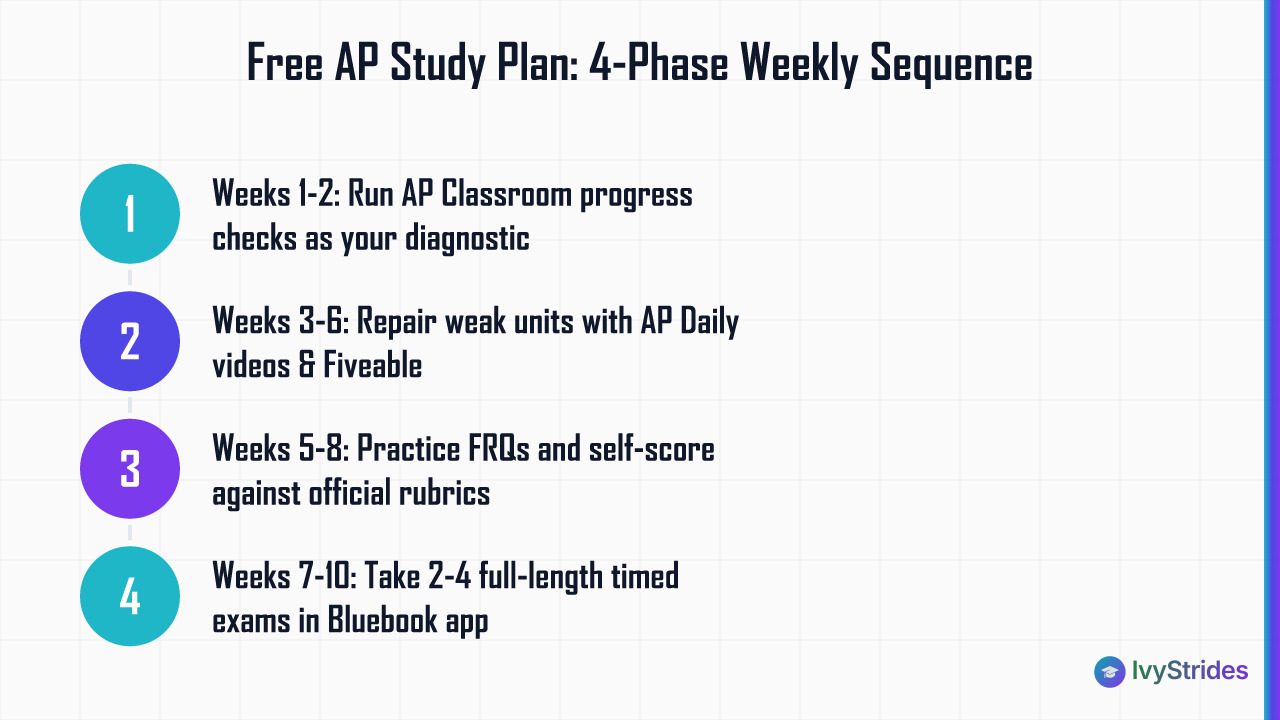
Suppose you've decided to run the free route, at least to start. Good. Here's the sequence that actually works, in order.
Weeks 1-2: Baseline and content map. Start no later than roughly 8-10 weeks before the exam if you're targeting a 5 on a high-difficulty subject. One month is not enough time to reach a 5 on a hard subject from a low baseline; 8-12 weeks is the realistic minimum. Open AP Classroom (get your teacher's join code) and run the progress checks unit by unit. This is your diagnostic snapshot, done manually. Note where you're below 70%.
Weeks 3-6: Targeted content repair. Use AP Daily videos for the weak units, since they map directly to the AP curriculum framework. Layer Fiveable study guides for quick reinforcement. Don't re-study units you already own.
Weeks 5-8: FRQ practice with self-scoring. Pull the officially released AP practice exams PDF files and their scoring guidelines. Write full FRQ responses, then score yourself against the released rubric. Flag every response where you genuinely can't tell why you lost points. That flagged pile is the exact gap free resources can't close for you.
Weeks 7-10: Full-length timed exams in Bluebook. Take at least two full-length official practice exams under timed conditions before exam day; three to four is better on a high-difficulty subject. Because most 2026 AP exams run through the Bluebook digital testing app, practice in Bluebook, not only on paper, so the interface isn't a surprise.
For a worked example of this sequence, see how to study for AP US History and score a 5. If your school doesn't offer your subject, our guide on online AP courses for schools that don't offer them covers the access workarounds. And if you're weighing the free path against structured help on cost, how much online AP courses cost gives you the real numbers.
How AP Scores Affect College Admissions and Credit Policies
AP scores do two separate jobs, and students conflate them. One is credit after you enroll. The other is signal during admissions. Both matter.
On credit: policies vary sharply by college, and you should always verify against the specific institution's registrar page or Common Data Set. Harvard, for instance, accepts only scores of 5 for course credit, and a student generally needs four scores of 5 to qualify for Advanced Standing, per the College Board AP credit framework and Harvard's own registrar policy. That policy can change, so confirm it against Harvard's current registrar page before you count on it. The broader point: a 4 that earns credit at one school earns nothing at another.
On admissions signal, AP scores matter beyond exam day. Most Ivy League admits complete roughly 10-14 AP courses by graduation, and students with 12 or more are especially well-represented in admitted cohorts. So the quality of your prep has downstream admissions implications, not just credit ones.
Is seven APs enough for a school like Harvard? It can be, depending on the rigor of the courses, your grades, and the strength of the rest of your application. The number alone is never the deciding factor. A 5 in AP Physics 1 carries more weight than a 4 in a lower-difficulty subject, precisely because admissions officers read the difficulty. And at test-optional schools, a strong AP score in a rigorous subject remains a clean signal of academic readiness even when an SAT or ACT isn't submitted. Test-optional policies themselves vary by school and by year, so check each college's current stance.
For how this connects to standardized testing on the admissions side, see whether is a 1500 SAT score enough for Ivy League admission. If you're still calibrating targets, what is a good SAT score sets the benchmarks.
When Structured AP Coaching Is Worth the Investment
Let me give you a straight decision rule instead of a sales pitch.
Structured coaching earns its cost when the gap between where you are and where you need to be is wide, and the subject is hard. In our coaching, the students who benefit most are those scoring a 2 or 3 on their first full-length practice exam while targeting a 4 or 5 on a low-5-rate subject like AP Physics 1, AP Chemistry, AP Calculus BC, or AP US History. Those four combine dense content with FRQ formats that punish self-diagnosis.
If you're already scoring a 4 on practice and targeting a 5 on a moderate-difficulty subject, the honest answer is you probably don't need a full program. Disciplined free-resource use plus one or two FRQ review sessions with a trained reader often closes that gap.
What IvyStrides adds where it matters: our best online AP courses assign a per-AP-subject specialist, not a generalist tutor, so your teacher knows the specific FRQ rubric conventions for that subject, whether that's the experimental-design question in Physics 1 or the LEQ contextualization point in US History. Every plan starts from a diagnostic and runs on spaced retesting, so you're re-tested on weak units at intervals rather than once. For the newer computing exams, we cover ap computer science a prep with the same subject-specialist model. The same holds for ap cs principles prep.
Expect structured coaching to need roughly 8-12 weeks to show meaningful results. Anyone promising a jump in two weeks isn't being honest with you.
FAQ
Is 70% a 5 on an AP exam?
On most AP subjects, a composite raw percentage of roughly 65-75% has historically corresponded to a 5, which makes 70% a reasonable working target. But the exact score cutoff is set by the College Board after each exam administration and varies by subject and year. Treat 70% as a directional benchmark, not a guaranteed threshold.
Is 7 AP classes enough for Harvard?
Seven AP courses can be competitive, but most Ivy League admits complete around 10-14 AP courses by graduation, and students with 12 or more are especially well-represented in admitted cohorts. The number matters less than the rigor of the courses, the grades earned, and the scores achieved. A 5 in AP Physics 1 carries more weight than a 4 in a lower-difficulty subject. And admissions always depends on the full application, not AP counts alone.
How many practice tests should I take before an AP exam?
For a high-difficulty subject like AP Physics 1 or AP Chemistry, plan for at least three to four full-length timed practice exams before exam day. For moderate-difficulty subjects, two full-length exams plus targeted FRQ practice is a reasonable floor. Score each exam against the official released rubric, and spend more prep time on the units where you lost the most points.
Is one month enough time to study for an AP exam?
One month is tight but workable if you already have a solid content foundation and you're targeting a 3 or 4 on a moderate-difficulty subject. For high-difficulty subjects, or if you're starting from a low baseline, one month is unlikely to produce a 5. Give yourself roughly 8-12 weeks for meaningful score improvement.
How helpful are free video courses for AP prep?
Free AP-aligned video courses are genuinely useful for content instruction and practice problems in subjects where solid aligned material exists, including AP Biology, AP Calculus AB, AP Statistics, and AP US History. Their strength is teaching the material. Their limitation is that they don't provide personalized FRQ feedback or adapt to your specific diagnostic gaps the way a subject specialist does.
Has anyone ever scored perfectly on an AP exam?
College Board does not publish data on perfect composite scores, and because the composite combines the multiple-choice and FRQ components, a true 100% is rare. The more meaningful benchmark is the 5 cutoff, which typically requires roughly 65-75% of available composite points depending on the subject and year.
So, is free AP prep enough? For a prepared student on a high-5-rate subject, yes. For a student starting mid-band on AP Physics 1 or AP Chemistry, the FRQ feedback gap is usually the thing standing between a 3 and a 5, and that's the one gap free tools structurally cannot fill. The smart move is to take one full-length official practice exam under timed conditions, score it honestly against the rubric, and see which side of that line you land on.
Ready to Know Exactly Where Your AP Prep Stands?
In 15 minutes, an IvyStrides AP subject specialist will map your current knowledge against the College Board curriculum framework, tell you which units need the most work, and recommend the right prep path for your subject and timeline. No pressure, no obligation.

Two decades teaching quantitative and verbal aptitude on standardized tests. Rare dual expertise across Math and Verbal — particularly effective for students with gaps on both sides. Senior AP Mentor for our Calculus and English tracks.