
Rice Admissions Reads Every File in Pairs: What Each Reader Checks
On this page
- What the Academic Reader Checks in Your Rice File
- What the Personal-Elements Reader Checks in Your Rice File
- How Rice Tracks Your Interest and What the Optional Interview Signals
- What Rice Admissions Requirements Look Like by School of Study
- FAQ: Rice Admissions Questions
- What GPA do you need to get into Rice?
- Is Rice a difficult school to get into?
- Can you get into Rice with a 1400 SAT?
- Apply ED to Rice: does it improve your chances?
- Your Next Step on a Rice Application
Rice admissions uses a Committee-Based Evaluation: pairs of officers read every file, one on academics, one on personal elements. Rice rates nine factors Very Important, including test scores, the application essay, and character and personal qualities. For fall 2027 entry, Rice is test-optional.
That structure comes from Rice's own application-philosophy page, where Rice says it has used this paired system since 2017 and is careful not to overweight any single metric. The academic reader handles your transcript, school profile, and recommendations; the personal-elements reader handles your activities, honors, and essays.

What the Academic Reader Checks in Your Rice File
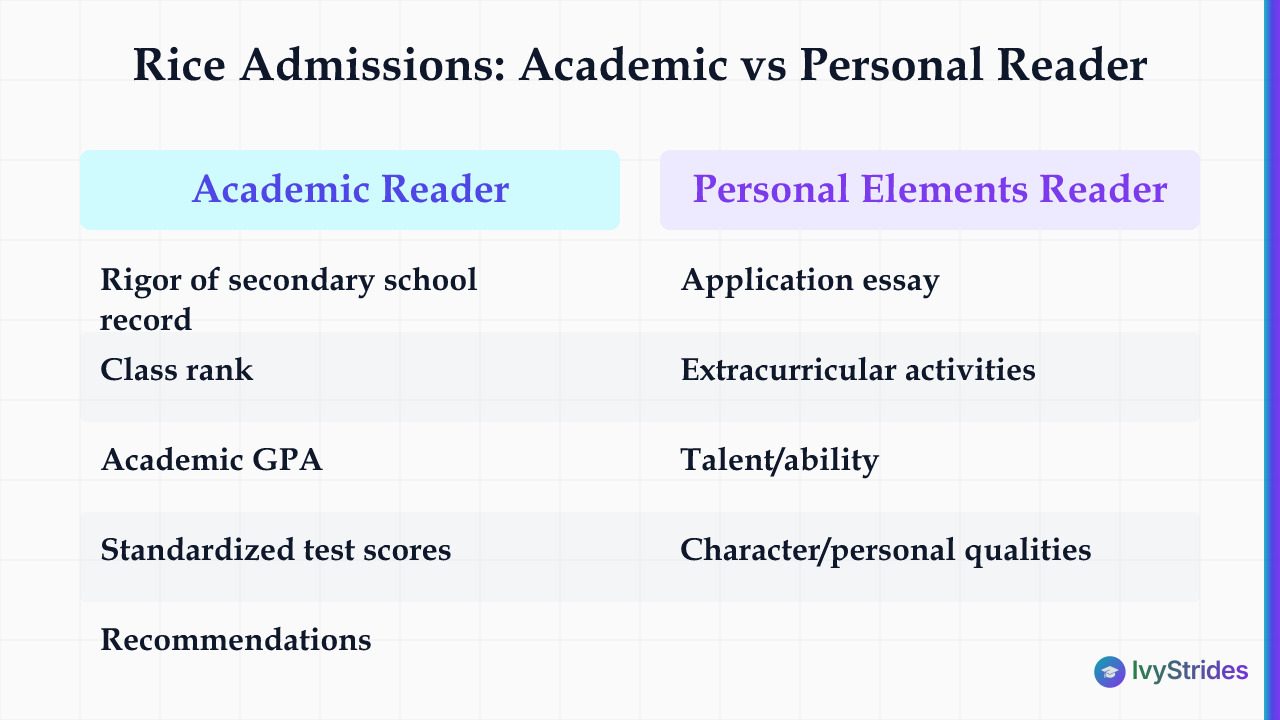
The academic reader at Rice evaluates your transcript, school profile, and recommendations. Per Rice's application-philosophy page, this officer reads your record against the school profile your counselor submits, so rigor is always judged relative to what your high school offered.
Rice's 2025-26 Common Data Set rates nine factors Very Important. Rice does not assign each factor to a reader, but read against its description of the two roles, five sit with the academic reader: rigor of secondary school record, class rank, academic GPA, standardized test scores, and recommendations. The other four, application essay, extracurricular activities, talent/ability, and character/personal qualities, sit with the personal-elements reader.
| Factor | Rice Rating | Reader |
| Rigor of secondary school record | Very Important | Academic |
| Class rank | Very Important | Academic |
| Academic GPA | Very Important | Academic |
| Standardized test scores | Very Important | Academic |
| Recommendation(s) | Very Important | Academic |
| Application essay | Very Important | Personal elements |
| Extracurricular activities | Very Important | Personal elements |
| Talent/ability | Very Important | Personal elements |
| Character/personal qualities | Very Important | Personal elements |
| Level of applicant's interest | Considered | Not assigned |
| Religious affiliation/commitment | Not Considered | Not assigned |
The Reader column is IvyStrides' reading of Rice's description of each role; Rice does not publish a factor-by-factor split.
Recommendations, counted precisely. Rice requires one counselor letter and two core-subject teacher letters, per its first-year page. Extra recommenders, a coach or research supervisor, are allowed but not needed, so an overstuffed file does not read as stronger.
On test scores. Rice is test-optional for fall 2027 entry: it recommends submitting SAT or ACT scores if available, and applicants who prefer not to submit receive full consideration. Rice superscores both tests, using the highest score from each section across all test dates, so a strong score still strengthens the academic reader's case for you even in a test-optional cycle.
Whether the SAT helps your case for a selective college depends on the rest of your file, not the score alone.
What the Personal-Elements Reader Checks in Your Rice File
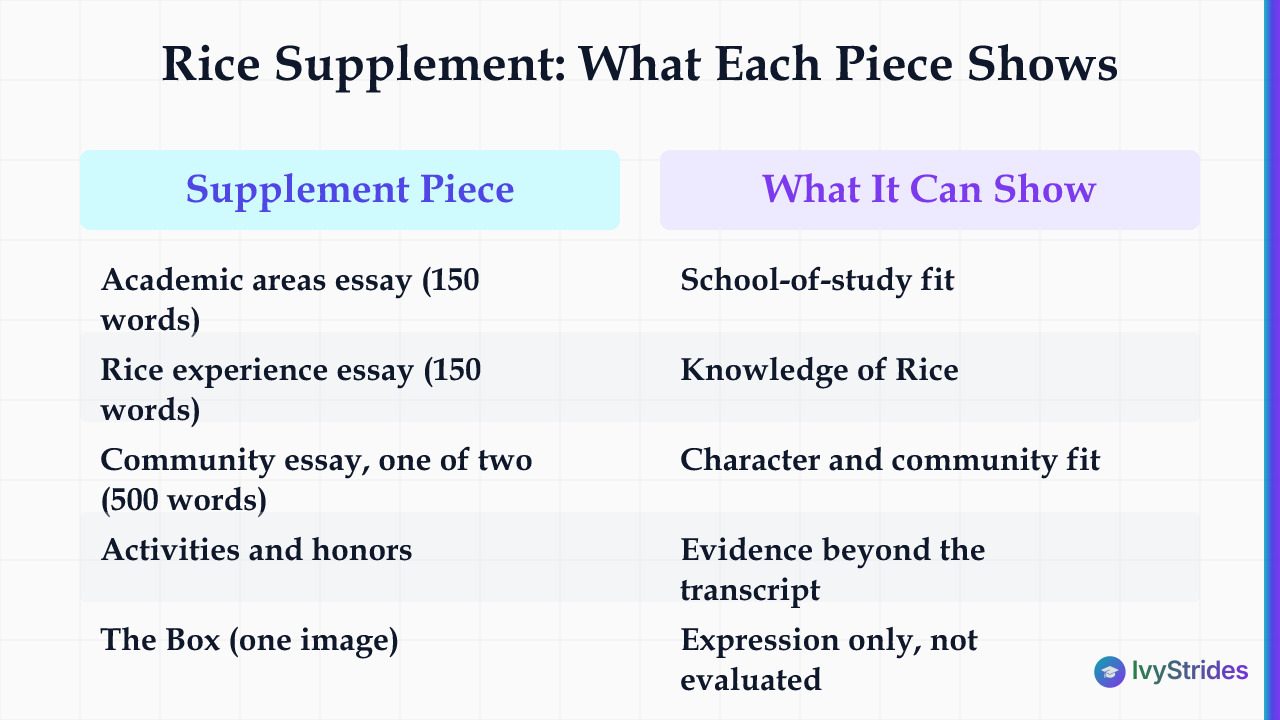
The personal-elements reader at Rice weighs your activities, honors, and essays: the human evidence the transcript cannot carry. Where the academic reader checked your rigor and recommendations, this reader asks who you are beyond the metrics, and Rice's application-philosophy page frames the whole review as reading accomplishments in the context of a student's life experiences.
Rice describes its ideal students on its apply page as "voracious lovers of life" with "unquenchable curiosity about the world." Your essays are where that temperament shows up.
Three Rice Supplement essays carry most of this weight, each feeding a distinct review function.
| Essay | Word Limit | What the Reader Is Assessing |
| Academic areas and how you'd explore them at Rice | 150 words | School-of-study fit and preparedness |
| Elements of the Rice experience that appeal to you | 150 words | Knowledge of Rice, genuine interest |
| Life experiences/perspectives to share with Owls, OR background-shaped perspectives as a change agent (choice of two) | 500 words | Character, residential-college contribution |
In our view, the 500-word community prompt is the most consequential piece of writing in your Rice file, because it is the longest and the personal-elements reader weighs essays, activities, and honors together. Treat the 150-word academic essay as the primary school-of-study fit signal rather than a formality, and give it as much care as the longer prompts.
The Box. Every applicant uploads a two-dimensional image of something that appeals to them. Rice states it is not used for evaluative purposes, so treat it as expression, not strategy.
Mapping your activities, essays, and school-of-study choice against the nine Very Important factors before you draft is exactly the kind of file audit that a counselor who reads your file the way Rice does can run with you. In our coaching, students research Rice's residential college system before drafting the 500-word prompt, so the community they describe is specific rather than generic. For the tactical frame on structure and voice, see what differentiates a strong supplemental essay.
How Rice Tracks Your Interest and What the Optional Interview Signals
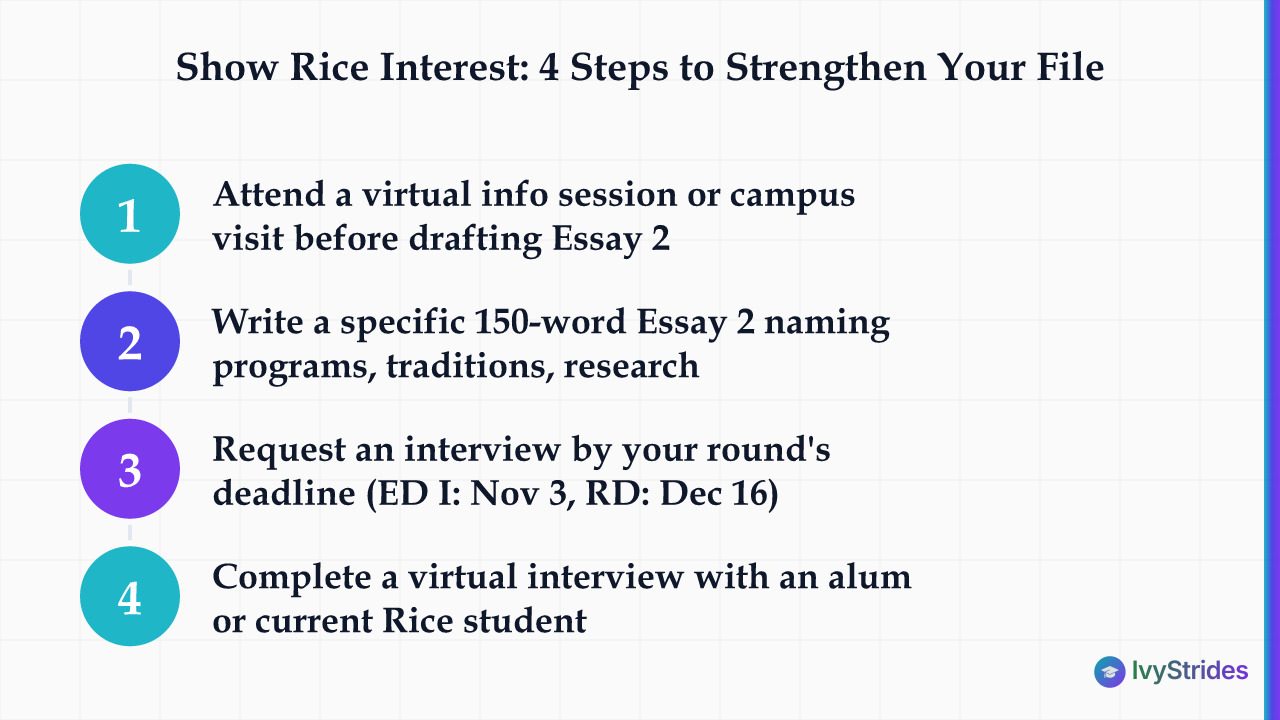
Rice rates level of applicant's interest as Considered in its 2025-26 CDS, one tier below the nine Very Important factors.
Rice's application-philosophy page tells applicants to show real understanding of the Rice undergraduate experience through visits, virtual events, and the optional interview.
Your second supplement essay, the 150-word "elements of the Rice experience" prompt, is the primary written vehicle here. Name specifics: a residential college tradition, a named program in your school of study, a research path. Generic enthusiasm reads as generic.
The interview. Rice recommends an interview for first-year applicants, but it is optional and not guaranteed. A Rice Alumni Volunteers for Admission member or a current Rice student conducts it, and every 2026-27 interview is virtual, per the first-year page. Alumni and student interviews are weighted equally, and not being matched with an interviewer will not affect your decision.
| Action | When to Complete |
| Attend a virtual info session or visit | Before you draft Essay 2 |
| Write a specific Essay 2 on Rice fit | With your supplement |
| Request an interview (ED I) | By Nov 3 |
| Request an interview (RD priority) | By Dec 16 |
| Request an interview (ED II / RD) | By Jan 6 |
What a campus visit actually records is narrower than most families assume, so read what colleges track from demonstrated interest before you plan a trip around it.
What Rice Admissions Requirements Look Like by School of Study
Rice admissions requirements start with a single choice: you apply to one of seven schools of study, not to Rice at large.
Those schools are architecture, business, engineering and computing, humanities and arts, music, natural sciences, and social sciences, and the academic reader assesses your preparedness and alignment to the majors you select, per Rice's FAQ. The 150-word academic essay is where that alignment lives.
You can generally change schools of study after you enroll, but music and architecture are the exception: you must be admitted to those schools, either as an entering student or later through an application. Admitted music students must also stay in the program at least a year before changing schools. Both schools carry extra materials, and music runs on its own calendar.
| School | Standard Application | Additional Requirement | Key Deadline |
| Architecture | Common App + Supplement | Portfolio PDF (15 MB max): cover page plus up to 10 pages | ED I Nov 1 / RD Jan 4 |
| Music | Common App + Supplement | Preliminary Submission + live audition | Regular Decision only; all materials by Dec 1 |
| Business | Common App + Supplement | None | ED I Nov 1 / RD Jan 4 |
| Engineering and computing | Common App + Supplement | None | ED I Nov 1 / RD Jan 4 |
| Humanities and arts | Common App + Supplement | None | ED I Nov 1 / RD Jan 4 |
| Natural sciences | Common App + Supplement | None | ED I Nov 1 / RD Jan 4 |
| Social sciences | Common App + Supplement | None | ED I Nov 1 / RD Jan 4 |
Music runs on its own calendar. Music applicants cannot apply through Early Decision or QuestBridge; the Shepherd School admits by regular decision only, per its FAQ. Fall 2027 music applicants file a Preliminary Submission or Audition Profile Form, with all materials complete by December 1. Live on-campus auditions run mid-January to mid-February, and recordings are accepted only in exceptional circumstances.
The early plans. ED I closes November 1; ED II and Regular Decision both close January 4, per Rice's FAQ. Music applicants are not eligible for either ED round. Both ED rounds are binding, with outcomes of admit, defer, or deny, and Rice offers no non-binding Early Action.
Whether binding early decision suits your situation depends on your readiness, not a statistical edge. The rigor the academic reader checks often tracks how many AP courses you took against what your school offered.
FAQ: Rice Admissions Questions
What GPA do you need to get into Rice?
Rice publishes no minimum GPA cutoff, and the Common Data Set does not contain one. Academic GPA is rated Very Important in Rice's 2025-26 CDS, but the academic reader weighs it alongside course rigor and class rank, always against your school profile. No single number admits or disqualifies you.
Is Rice a difficult school to get into?
Yes. Rice is highly selective. Admission depends on the full file, not one metric, which is the point of the two-reader system.
Can you get into Rice with a 1400 SAT?
A 1400 is possible but sits below Rice's score submitters: in its 2025-26 Common Data Set, the 25th percentile SAT for enrolled students who sent scores was 1510, and 97.7% of them scored 1400 to 1600. Rice is test-optional for fall 2027 entry, so you are not required to send a score.
In IvyStrides' view, a score below that 25th percentile is usually better omitted, letting your transcript, essays, and activities carry the academic case. Confirm Rice's current policy at admission.rice.edu first.
Apply ED to Rice: does it improve your chances?
Rice's FAQ states that applying Early Decision does not necessarily improve your chances. Both ED I (November 1) and ED II (January 4) are binding, with outcomes of admit, defer, or deny. The real reason to apply ED is genuine first-choice commitment, not a statistical edge.
Your Next Step on a Rice Application
Rice reads your file in pairs, so a strong application answers both readers: the academic officer who checks rigor, scores, and recommendations, and the personal-elements officer who reads your essays, activities, and character. Policies and dates shift each cycle, so confirm everything at admission.rice.edu before you apply.
- Map your transcript, test score, and recommendations against the five academic factors.
- Draft the 150-word academic essay as a real fit argument, not a formality.
- Research the residential college system before writing the 500-word community prompt.
- Lock your school of study early if you are targeting architecture or music, and plan music for Regular Decision.
- Decide on ED only if Rice is your genuine first choice.

Rajesh is a technology leader, entrepreneur, and angel investor with 28+ years in Business & Technology Leadership and Product & Solution Engineering. He is passionate about education, mentoring, and driving digital transformation.