
When Is the PSAT in 2026: Exact Timing, Deadlines, and How to Plan Ahead
On this page
- Quick Answer: When Is the PSAT in 2026
- Which PSAT Version Do You Take, and When
- How PSAT Registration Works (and Why Your School Controls the Deadline)
- Not Sure When Your School's PSAT Deadline Is? Let's Figure It Out Together.
- The National Merit Connection: Why Junior Year Timing Matters
- What Month Do You Take the PSAT, and What Does the Test Look Like
- What Is a Good PSAT Score, and What Does the Top 1% Look Like
- When Do PSAT Scores Come Out in 2026
- How to Prepare Before the October Window
- What to Do After You Get Your PSAT Score
- FAQ
- Can you take the PSAT more than once?
- Is the PSAT graded, and does it go on your transcript?
- What time does the PSAT start on test day?
- Does a 1400 PSAT score qualify for National Merit?
- When should my child start preparing for the PSAT?
- Where can I find PSAT dates near me in 2026?
- Ready to Turn Your PSAT Score Into an SAT Plan?
The PSAT/NMSQT testing window for 2026 runs October 1–30, with a primary Saturday date on October 17. Sophomores and juniors take this version in the fall. Tenth graders can also take the PSAT 10 in the spring window, March 2 to April 30, 2026. Eighth and ninth graders take the PSAT 8/9 during that same spring window or in October. Registration goes through your school, not directly with College Board. Fall 2026 scores release on October 22, November 5, or November 12, depending on your test date.
These dates come from the College Board PSAT/NMSQT test-dates page, the source worth trusting on timing, since College Board can adjust windows year to year. The harder problem is not the date. No student registers for the PSAT directly, and the deadline that actually matters is the one your school sets internally. That is where most families get caught, and it's where the next sections spend real time.

Quick Answer: When Is the PSAT in 2026
Here's the full picture across all three versions of the PSAT suite.
The PSAT/NMSQT is offered October 1–30, 2026, with a primary Saturday administration on October 17. Schools pick a specific weekday or the Saturday date inside that window. This is the version 10th and 11th graders take, and it feeds the National Merit Scholarship Program for juniors.
The PSAT 10 runs in a spring window, March 2 to April 30, 2026. Same test, same score scale as the PSAT/NMSQT. It gives 10th graders a spring option, and it does not qualify for National Merit.
The PSAT 8/9 is available in that same spring window, March 2 to April 30, and also October 1–30, 2026. This is the entry-level version for 8th and 9th graders.
Fall 2026 scores release on one of three dates, October 22, November 5, or November 12, 2026, and which date you get depends on when your school administered the test. All dates here trace to College Board official documentation. Verify against that page before locking in any calendar plans, because College Board occasionally shifts windows.
Which PSAT Version Do You Take, and When
Your grade decides your version. Simple as that.
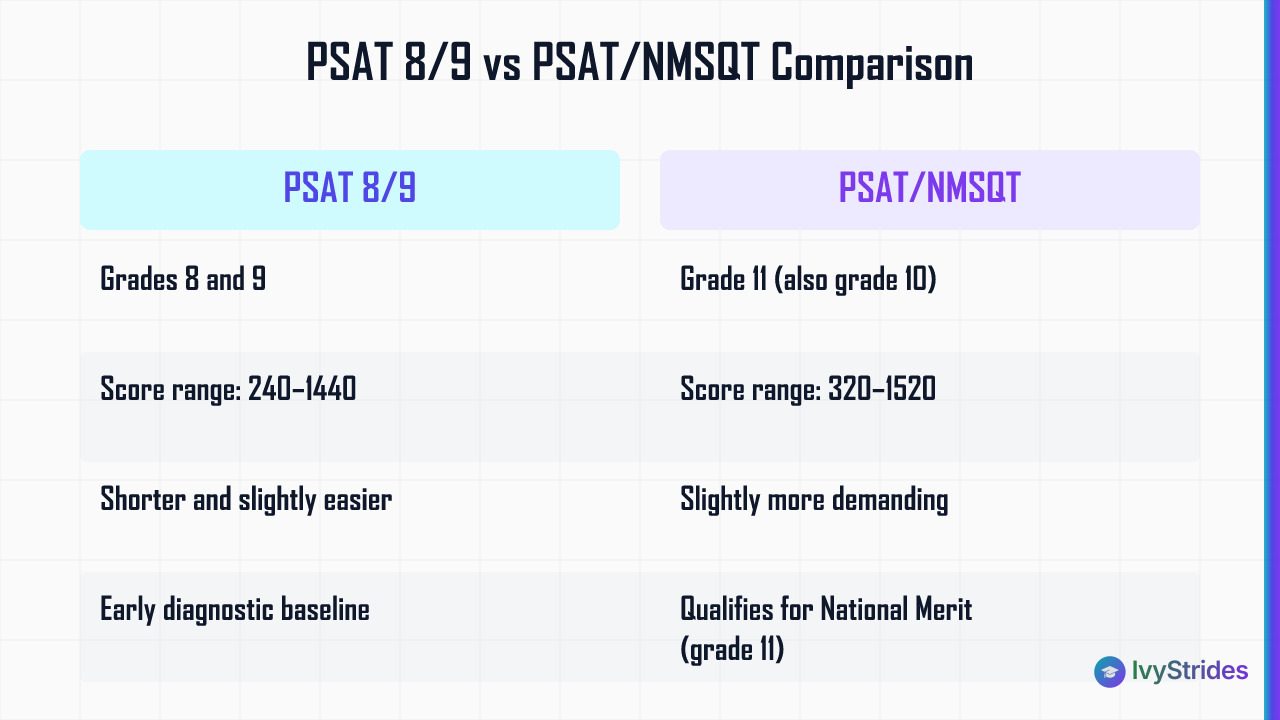
Eighth and ninth graders take the PSAT 8/9, scored on a range of 240–1440. It's shorter and slightly easier than the PSAT/NMSQT, built to give younger students an early diagnostic baseline without a scholarship on the line.
Tenth graders have two doors. They can take the PSAT 10 in the spring window, or sit the PSAT/NMSQT in October. Both use the 320–1520 score range, and structurally they're the same test. The only difference is timing and purpose. Neither one counts for National Merit when a sophomore takes it.
Eleventh graders take the PSAT/NMSQT in October, and this is the administration that matters most. Only junior-year PSAT/NMSQT scores qualify for the National Merit Scholarship Program. A high sophomore score is a great confidence signal and a useful diagnostic, but it carries no scholarship weight.
Students often ask whether the PSAT is harder than the SAT before deciding how seriously to prepare; the short answer is that the SAT is slightly more demanding, but the formats are nearly identical. If that question is on your mind, our breakdown of whether the PSAT is harder than the SAT walks through the difficulty gap section by section. For the broader distinction, see the difference between SAT and PSAT.
So the mental model is a ladder: PSAT 8/9 in middle school and freshman year, PSAT 10 or PSAT/NMSQT sophomore year for practice, and PSAT/NMSQT junior year for the scholarship stakes.
How PSAT Registration Works (and Why Your School Controls the Deadline)
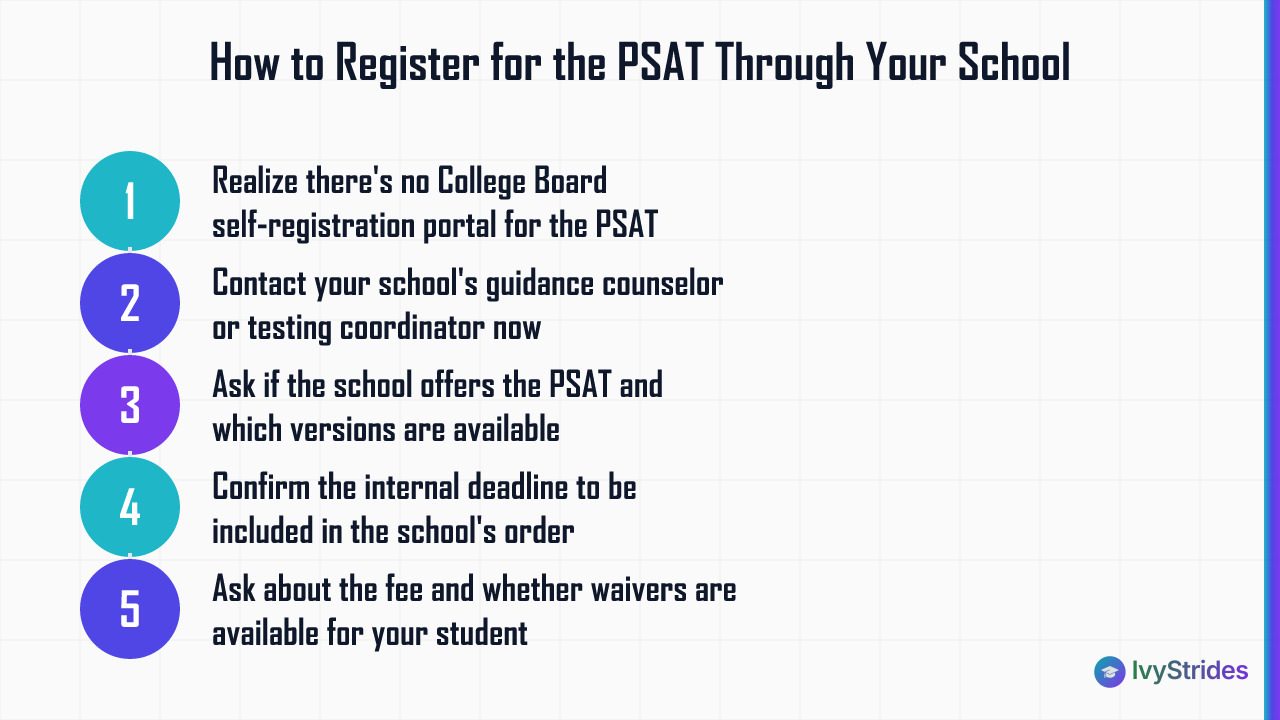
There is no College Board portal where you register for the PSAT yourself. None. You cannot sign up as an individual the way you register for the SAT or ACT. Your school administers the PSAT, orders the tests, and sets its own internal deadline for who's testing.
This is the single most common way families get blindsided. A school's internal cutoff often lands in September, or earlier, weeks ahead of the October testing window. Parents assume they'll handle registration "closer to the test," go looking for a sign-up page, and find there isn't one. By then the school has already placed its order.
What you actually do: contact your school's guidance counselor or testing coordinator now. Ask three questions. Does the school offer the PSAT, and which versions? What is the internal deadline to be included in the order? Is there a fee, and are fee waivers available?
On cost, the College Board base fee is modest, roughly $18 to $35 in recent years, and many schools absorb part or all of it. Fee waivers are available through the school for eligible students, so cost should never be the reason a student skips the test. Confirm the exact figure with your school, since districts handle billing differently.
A pattern we see repeatedly in our coaching: students who skip the PSAT in 10th grade arrive at junior-year prep with no baseline, which adds roughly two to four weeks of diagnostic work before targeted prep can begin. Registering early is not just administrative. It protects your prep timeline.
Not Sure When Your School's PSAT Deadline Is? Let's Figure It Out Together.
Book a free 15-minute strategy call. We will help you confirm your school's registration timeline, set a realistic prep schedule, and identify whether the PSAT/NMSQT or PSAT 10 is the right focus for your student this year.
The National Merit Connection: Why Junior Year Timing Matters
If National Merit is on your radar, one rule overrides everything else: only your junior-year PSAT/NMSQT score qualifies. A sophomore score, no matter how high, does not enter you into the competition. That's why the October of 11th grade administration carries so much weight.
Qualification does not run off your total score. It runs off the Selection Index, a number from 48 to 228 built by doubling the sum of your Reading and Writing and Math section scores. The practical takeaway: Reading and Writing gets weighted more heavily than Math in this formula. A student with a strong Math score but a soft Reading and Writing score can end up with a lower Selection Index than the raw total suggests.
Cutoffs vary by state, and they vary a lot. If your junior-year PSAT/NMSQT score is near the 1420–1520 range, state-specific National Merit cutoffs will determine whether you advance; those cutoffs vary significantly by state. High-competition states like California, Massachusetts, and New Jersey typically require a Selection Index that maps to roughly 1470–1520 in total-score terms, while lower-competition states sit closer to 1420. Our state-by-state breakdown of National Merit cutoffs by state shows where each line has historically fallen.
There are two tiers to understand. The Commended Student threshold is a national number and sits below every state's Semifinalist cutoff. Roughly the top few percent of test-takers earn Commended status; a smaller slice per state advances to Semifinalist. Both are worth having on a college application, and the National Merit scholarship benefits extend beyond the headline scholarship to college-specific awards.
One caveat worth stating plainly: a 1400 total may or may not qualify depending on your section split and your state. Don't assume. Check the cutoff, and check how your Reading and Writing score lands.
What Month Do You Take the PSAT, and What Does the Test Look Like
October for the PSAT/NMSQT. March and April for the PSAT 10 and PSAT 8/9. That's the seasonal answer.
Now the format. The PSAT/NMSQT is a digital adaptive test delivered through the Bluebook app, on a school device or the student's own laptop or tablet. Per College Board, total time is 2 hours 14 minutes, split into two sections: the Reading and Writing section runs 64 minutes and the Math section runs 70 minutes.
The adaptive piece is what students most need to understand. Each section has two modules. Your performance on Module 1 determines the difficulty of Module 2. Do well on the first Reading and Writing module, and you're routed into a harder second module that unlocks the higher end of the score range. So pacing on Module 1 is not just about finishing. It's about the accuracy that earns you the harder, higher-ceiling second module. In our coaching, students who understand this before test day stop rushing the first module and start protecting accuracy.
College Board is releasing new full-length Bluebook practice tests for the PSAT/NMSQT and PSAT 10 in late summer 2026. Those are the closest thing to the real interface. Working a full-length in Bluebook before October removes the "where do I click" friction on test day. Our PSAT practice tests library helps students build that familiarity alongside the official Bluebook forms.
What Is a Good PSAT Score, and What Does the Top 1% Look Like
A perfect PSAT/NMSQT score is 1520, on the 320–1520 scale. The average total score sits around 930. The spread between average and elite is wide, which is exactly why the score is a useful diagnostic.
Here's how to read the bands. A score of about 1270 or higher puts a student around the top 10 percent of test-takers. The top 1 percent, roughly the 99th percentile, runs approximately 1420–1520 for 10th graders and closer to 1480 and up for 11th graders, since juniors as a group score higher. In section terms, the 99th percentile lands near 700 in Reading and Writing and near 740 in Math. These are approximate benchmarks, and percentile tables shift slightly year to year.
What about a 1400? For a sophomore, that's a genuinely strong result. It signals real SAT potential and a comfortable Commended-range trajectory if the student holds or improves it. But it does not qualify for National Merit, because only the junior-year test counts. For a junior in a high-competition state, a 1400 may land below the Semifinalist line depending on the section split.
For the full benchmark tables, our guide to what is a good PSAT score breaks it down by percentile. If you're a sophomore specifically, the deeper cut on good PSAT scores for 10th graders is calibrated to your grade's percentile curve.
When Do PSAT Scores Come Out in 2026
Fall 2026 PSAT scores release on one of three dates: October 22, November 5, or November 12, 2026. Which date is yours depends on the day your school administered the test. Earlier test dates generally map to earlier score releases.
You access scores through your College Board student account at collegeboard.org, using your login. If your student took the PSAT for the first time, they may need to create or link a College Board account; the school usually walks students through this during the pre-test session.
The score report shows your Reading and Writing score, your Math score, your total score, and percentile ranks that compare you against your grade nationally. It also flags question-level detail, which is the part worth studying. Knowing you missed points isn't useful on its own. Knowing you missed them on a specific Reading and Writing question type is.
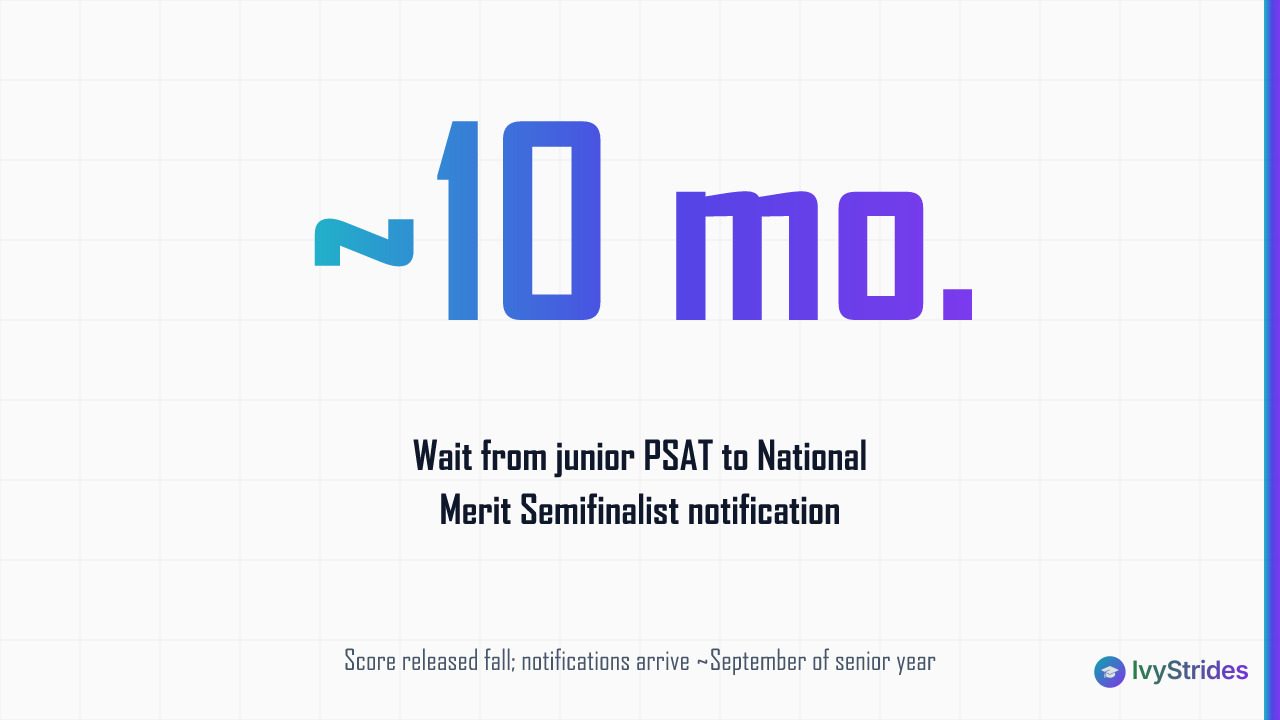
One timing note for National Merit hopefuls: score release and scholarship notification are two different clocks. You'll see your junior-year score in the fall, but National Merit Semifinalist notifications don't arrive until roughly September of senior year, about ten months after the test. Patience required.
Once you have the score, the next move is deciding what it means for your SAT plan. Our breakdown of PSAT results and SAT readiness connects the two.
How to Prepare Before the October Window
Start roughly eight to twelve weeks before your test date. That window gives you enough runway for two full-length practice tests plus targeted section work, without the burnout that comes from six months of grinding a test that's ultimately a diagnostic.
Step one is always a full-length diagnostic. Taking a full-length PSAT practice test before October gives you a realistic baseline and makes the actual test feel familiar on test day. In our coaching, students who take a diagnostic first and then focus on their two or three weakest question types improve more efficiently than students who review all content equally. Broad review feels productive. Targeted work on your actual weak spots is what moves the score band.
For the fall 2026 cycle, College Board's new full-length Bluebook practice tests for the PSAT/NMSQT arrive in late summer 2026. Use at least one of them, because Bluebook is the real testing environment and the adaptive routing behaves the same way. Remember the module logic: Reading and Writing Module 2 difficulty increases based on Module 1 performance, so practicing accuracy on the first module has a compounding effect on your ceiling. Our PSAT practice tests library gives you a second bank of forms once you've worked the official ones.
If your first diagnostic lands somewhere in the 1200s and you're wondering how close that is to a strong result, our read on whether a 1280 is a good PSAT score puts it in context by grade.
What to Do After You Get Your PSAT Score
The PSAT is a preview of your SAT. That's its most valuable function once the scholarship question is settled. A PSAT score of 1100–1200 for a sophomore typically projects to an SAT score in roughly the 1150–1280 range with no additional prep. That projection is a starting line, not a ceiling.
Here's where the PSAT-to-SAT bridge becomes a plan. Once you know when the PSAT is, the next question is what score to aim for; our breakdown of good PSAT scores by grade shows the percentile benchmarks for each version. Our guide to PSAT results 2026 shows how each score band maps to SAT readiness.
A PSAT score in the 1100–1200 range for a sophomore typically signals that targeted SAT prep starting roughly six to nine months before the SAT test date can close the gap to a competitive 1350–1400. In our coaching, we've seen sophomores in that band reach 1350–1400 on a first SAT attempt after a structured 16-week plan starting the following January. Those are typical outcomes for students completing the program, not a promise; every student's gain depends on hours, consistency, and starting point.
Timing matters on the back end too. In our coaching, students who begin targeted SAT prep within about four to six weeks of receiving PSAT scores have more room for spaced retesting before junior-year SAT dates. Waiting until spring of junior year compresses everything.
One caveat on the bigger picture: many colleges are test-optional, and those policies vary by school and by year, so verify each college's current stance through FairTest or the school's own admissions page. Even at a test-optional school, a strong SAT score can strengthen a merit-aid case and an application overall. A strong PSAT is where that path starts.
If you want a plan built on your student's actual diagnostic rather than a generic curriculum, our coaches do exactly that. You can read how we work on the IvyStrides About page. Meet the section-specialist tutors who coach Reading and Writing and Math separately. For the mechanics of moving a score up, our guide on how to improve your SAT score lays out the diagnostic-and-targeted-weakness method.
FAQ
Can you take the PSAT more than once?
Yes. Students can take the PSAT/NMSQT in both 10th and 11th grade, and the PSAT 8/9 in 8th and 9th grade. Only the junior-year PSAT/NMSQT score counts toward National Merit eligibility. Taking it in 10th grade is purely for practice and benchmarking, which is genuinely useful for building a baseline before junior year.
Is the PSAT graded, and does it go on your transcript?
No. The PSAT is not graded in the academic sense and does not appear on your high school transcript or affect your GPA. It produces a score report that you and your school can see. Colleges do not receive PSAT scores unless you specifically choose to share them, and there's rarely a reason to.
What time does the PSAT start on test day?
The PSAT is administered during the school day on weekday dates, typically starting in the morning at the time your school sets. Saturday administrations also begin in the morning. Your school communicates the exact start time. Plan to arrive at least 15 minutes early with your device charged and the Bluebook app updated to the current version.
Does a 1400 PSAT score qualify for National Merit?
Not automatically. A 1400 total is strong, but National Merit qualification depends on your state's cutoff and your section score split, not just the total. High-competition states like California, Massachusetts, and New Jersey typically require roughly 1470–1520. The Selection Index weights Reading and Writing more heavily than Math, so a 1400 with a lower Math score can still fall short. Check your state's cutoff before assuming qualification.
When should my child start preparing for the PSAT?
For the October PSAT/NMSQT, starting roughly eight to twelve weeks before the test window gives enough time for one or two full-length practice tests plus targeted section work. For a junior aiming at National Merit, starting in June or July before 11th grade is reasonable. A diagnostic practice test should always come first, so prep time targets actual weak areas rather than content the student already knows.
Where can I find PSAT dates near me in 2026?
The PSAT is administered at your school, not at an independent testing center, so "near me" means your own school building. If your school doesn't offer it, contact your district's testing coordinator or a nearby school to ask about guest testing. The College Board PSAT/NMSQT official page lists the national windows; your school sets the specific day within that window.
Knowing when the PSAT is only helps if you act before your school's internal deadline and turn the score into a real plan afterward. The date is the easy part. The prep timeline and the PSAT-to-SAT bridge are where the score actually moves.
Ready to Turn Your PSAT Score Into an SAT Plan?
Our coaches start with a diagnostic baseline, build a personalized prep plan around your student's actual weak spots, and track progress toward a target score. Book a free 15-minute call and leave with a concrete next step.

Award-winning author (South Asian Book Award) and graduate of BITS Pilani and UCLA Luskin School of Public Affairs. Brings a published writer's eye to Common App essays and grammatical precision to SAT and ACT R&W instruction.