
Do Yale's Supplemental Essays Ask 'Why Yale'? Where to Show Fit Now
On this page
- What Yale's 2026-27 Supplemental Essays Actually Are
- What Yale Is Actually Evaluating in Each Supplemental Piece
- How to Write Each Yale Supplemental Piece Well
- Yale's Supplemental Essay Deadlines and Submission Platforms
- FAQ: Yale Supplemental Essays 2026-27
- Does Yale have a supplemental essay?
- How many supplemental essays are required for Yale University applications?
- Does Yale accept supplemental recommendations?
- Are Yale supplementals out yet?
- Your Next Step on Yale's Supplemental Essays
For Common App and Coalition applicants, Yale's 2026-27 supplement is five required pieces: one 200-word academic interest response, three 200-character short takes, and one 400-word essay from three options. No standalone "Why Yale" prompt exists.
Fit shows through the academic interest answer and the 400-word essay. Those prompts come from Yale's official essay topics page, labeled 2026-2027. The distinction most applicants miss: fit at Yale is not a dedicated question you answer, it is a quality the committee reads out of what you choose to write about and how specifically you write it.
What Yale's 2026-27 Supplemental Essays Actually Are
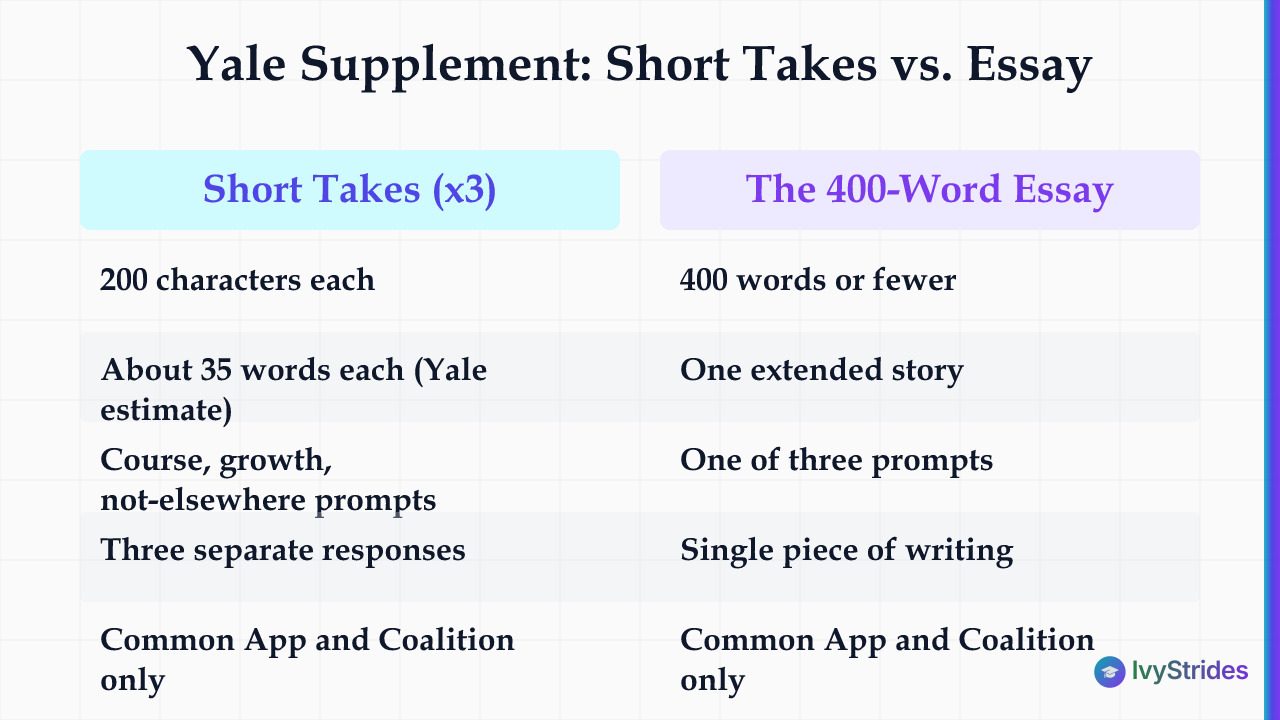
Yale's 2026-27 supplemental essays are five required writing pieces you submit alongside the Common Application, the Coalition Application on Scoir, or QuestBridge, per Yale admissions. You first choose up to three academic areas, then write about a topic within them.
QuestBridge applicants answer those academic questions through Yale's QuestBridge Questionnaire; the short takes and the essay are for Common App and Coalition applicants only.
Yale puts each 200-character short take at approximately 35 words, so by IvyStrides' count the total required supplemental writing for 2026-27 runs to roughly 700 words: 600 for the academic interest response and the essay, and about 105 across the three short takes.
No "Why Yale" prompt exists. The academic interest response is the closest anchor, and the 400-word essay carries your one extended story. Everything else is short.
| Piece | Prompt focus | Limit | Platform |
| Academic interest response | A topic or idea that excites you | 200 words | All applicants (QuestBridge via Yale's questionnaire) |
| Short take 1 | A course, book or artwork you'd create | 200 characters | Common App and Coalition |
| Short take 2 | One aspect of yourself to grow in college | 200 characters | Common App and Coalition |
| Short take 3 | Something not included elsewhere in your application | 200 characters | Common App and Coalition |
| The essay | One of three prompts | 400 words | Common App and Coalition |
Because Yale is test-required for the 2026-27 cycle, your SAT or ACT score arrives in the file alongside these essays; here is how to send SAT scores to Yale so the committee sees the full picture. The Common App personal statement, up to 650 words per Common App, is separate from this supplement and should not repeat the story you tell in the 400-word essay.
One caveat worth holding onto: Yale has said it will keep revising these prompts. The set below is labeled 2026-2027 as of this writing, and Yale News signals the topics may shift year to year. Confirm on Yale's own page before you draft.
What Yale Is Actually Evaluating in Each Supplemental Piece
Yale evaluates each supplemental piece against two questions it asks of every applicant: who is "likely to make the most of Yale's resources" and who "will contribute most significantly to the Yale community," per Yale's admissions criteria. Those two questions are the lens behind every prompt in the supplement.
In its 2025-26 Common Data Set (file dated 2026-06-16), Yale rates the Application Essay, Character/personal qualities, Rigor of secondary school record, Academic GPA, Recommendations, Extracurricular activities, Talent/ability and Class rank all as "Very Important." Level of applicant's interest is "Not Considered." Note that this 2025-26 CDS was filed while Yale's test-flexible policy was in effect, so the test-score rating there may not reflect the current required-score policy.
Character has a specific definition at Yale. Yale frames it as "moral concern and consideration for others": collegiality, empathy, respect for differences, and concern for the common good. That is what the short takes can quietly surface in 200 characters.
Intellectual values are just as specific. Yale values open-mindedness, creativity, and a willingness to explore new areas. The academic interest response is where that intellectual curiosity lands.
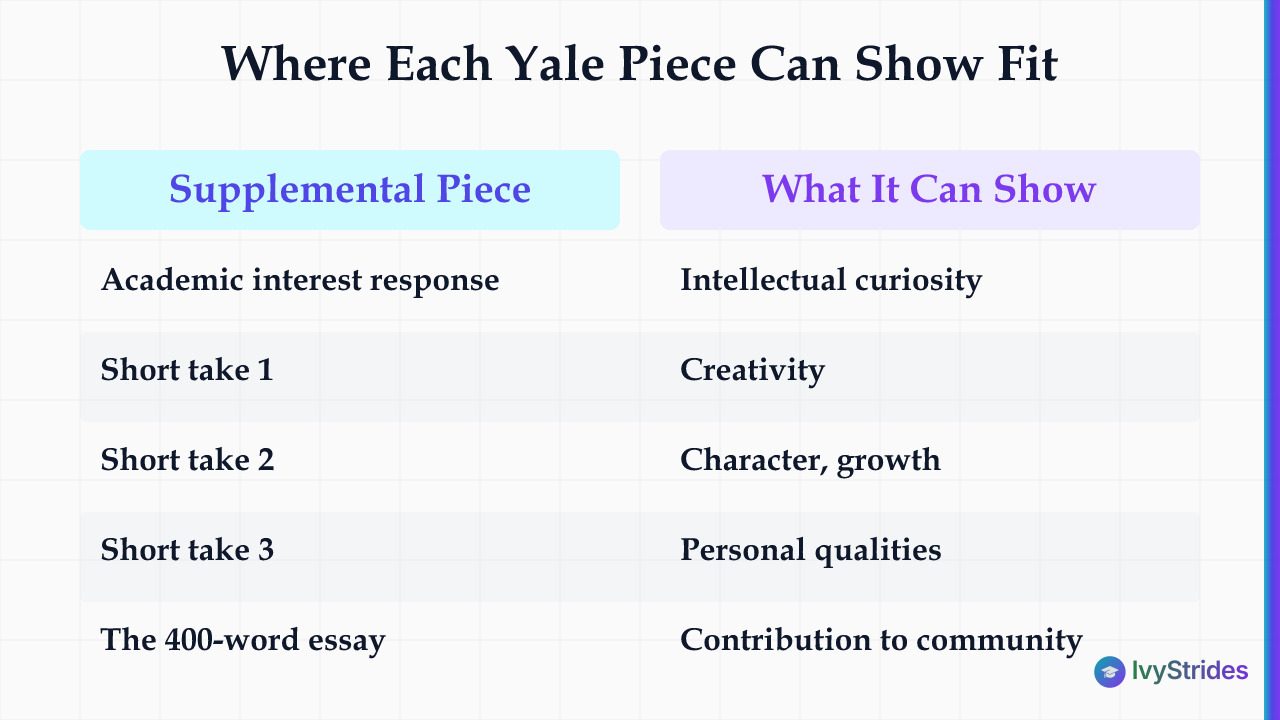
| Supplemental piece | Yale criterion it surfaces | What a strong response shows |
| Academic interest response | Intellectual curiosity | A specific idea, not a field |
| Short take 1 | Creativity | Concrete taste and voice |
| Short take 2 | Character, growth | Self-awareness |
| Short take 3 | Personal qualities | Personality under constraint |
| The 400-word essay | Contribution to community | Lived values, shown |
The criterion column is IvyStrides' reading of where each piece can show the values Yale describes; Yale does not assign criteria to individual prompts.
Yale is clear that test scores play an important role in showing readiness but never decide admission on their own, and that the transcript is "the single most important document" in the file. The essay cannot replace rigor; it carries the voice. For context on course load, selective colleges read how many AP courses you took against what your school offered. To see how strong responses read, our annotated responses across prompt types show the difference.
Admissions outcomes depend on the full application, not the essays alone. No supplemental approach guarantees a result at a school this selective.
How to Write Each Yale Supplemental Piece Well
Each Yale supplemental piece rewards a different kind of specificity, and treating all five the same is the fastest way to write a generic file.
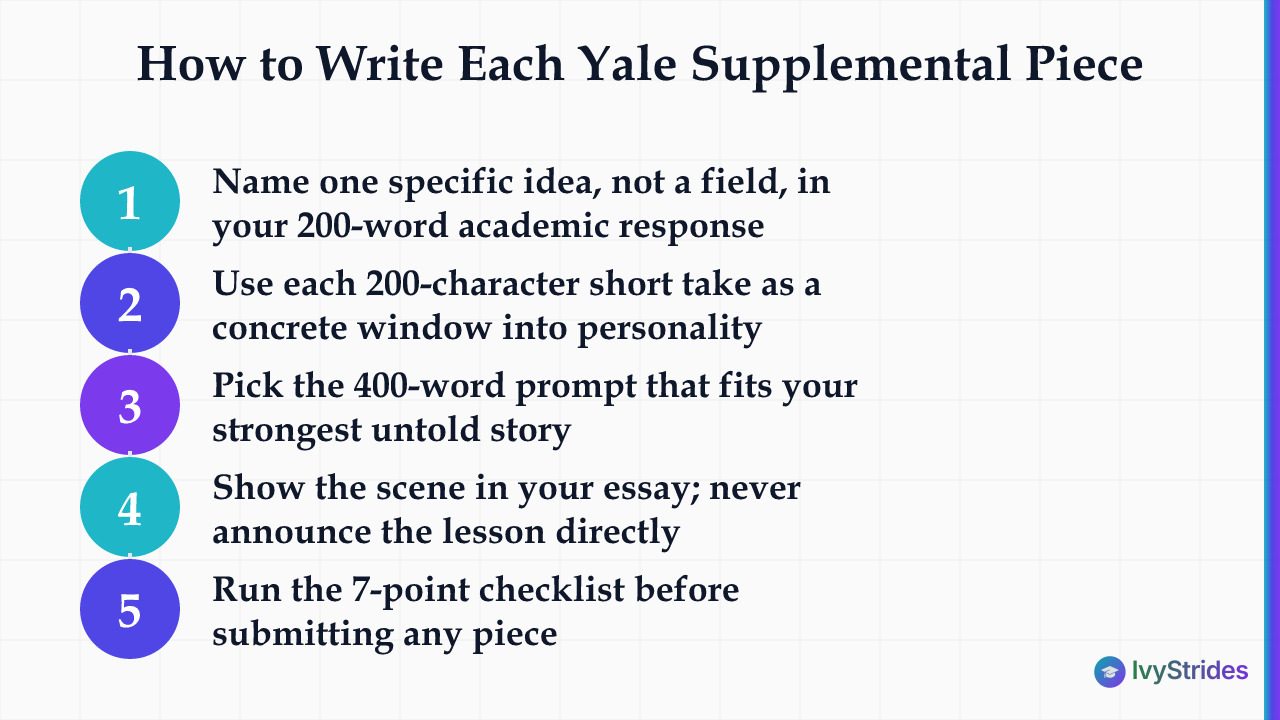
The academic interest response needs a question or idea, not a resume summary. In our coaching, a common first-draft problem here is naming a field like "neuroscience" rather than the particular problem inside it that keeps a student reading past midnight.
The 200-word academic interest response. Yale asks for "a topic or idea that excites you" within your chosen areas. Pick one. Name the moment you first noticed it, then show where your thinking went. Depth beats breadth at this length.
The three 200-character short takes. These are not mini-essays. In our coaching, the short takes are often the pieces students leave until last, treating them as filler rather than compressed windows into personality. Be concrete and specific. One vivid detail reads louder than a polished abstraction here.
The 400-word essay. This is your only extended narrative, so choose the prompt that matches a story you have not told elsewhere. In our coaching, we steer students toward the option that fits their strongest untold story rather than the one that looks easiest. Show the scene; do not announce the lesson, which is the show-don't-tell technique this piece needs.
Run this check before you submit anything:
-
Does the academic interest response name one idea, not a department?
-
Does each short take reveal something the rest of the file doesn't?
-
Does the 400-word essay tell a story absent from your personal statement?
-
Have you cut every sentence that states a lesson instead of showing it?
-
Does each piece sound like you out loud?
-
Have you checked every limit against Yale's live page?
-
Have you asked a reader who knows you whether it sounds like you?
When prompt selection and revision stall, that is the work our college essay coaching does with you piece by piece.
Here is the stake: five pieces, one November 1 deadline, and no second chance to pick the 400-word prompt once you commit. Guessing which story fits best is where strong applicants lose weeks.
Yale's Supplemental Essay Deadlines and Submission Platforms
Yale's supplemental essays are due with your full application on one of two dates, per Yale's timelines. Single-Choice Early Action closes November 1 with decisions in mid-December; Regular Decision closes January 2 with decisions in late March.
SCEA is non-binding but restrictive: alongside it you may apply early only to non-binding rolling programs, non-binding early programs at public institutions, early programs that notify after January 1, and institutions outside the United States.
Because that November 1 date drives the whole plan, sequencing five pieces against it matters more than any single draft. Here is how the logistics stack up.
| Round | Deadline | Decision | Notes |
| SCEA | November 1 | Mid-December | Non-binding; restricts other binding early apps |
| Regular Decision | January 2 | Late March | No early restriction |
| Platforms | Any round | n/a | Common App, Coalition on Scoir, QuestBridge |
| Recommendations | With application | n/a | Two core-subject teachers plus counselor |
Two optional supplements can strengthen the file. Yale offers an optional STEM Research Supplement, a form describing your research and your own role in any collaboration, with a paper, abstract or poster attached; Yale says full papers are usually most helpful. Optional arts portfolios cover visual art, music, dance and film.
Interviews are by invitation only. Yale does not require interviews and you cannot request one. The committee offers them mainly when it wants more information, and many admitted students are never interviewed. Not being invited is not a signal.
For recommendations, Yale requires two teachers of core academic subjects plus a counselor, and advises asking teachers who know you well rather than adding extra letters. To see how these dates sit beside your other schools, check how the main 2026-27 deadlines line up.
Choosing which 400-word prompt to write and sequencing all five pieces against November 1 is exactly the planning a counselor who maps your writing against each deadline works through with you in early fall. The risk of going it alone is simple: a missed sequencing window means rushed drafts on the pieces that carry the most weight.
FAQ: Yale Supplemental Essays 2026-27
Does Yale have a supplemental essay?
Yes, though not a "Why Yale" essay. Common App and Coalition applicants write five pieces, and the academic interest response and the 400-word essay are where fit shows.
How many supplemental essays are required for Yale University applications?
Five for Common App and Coalition applicants in 2026-27: one 200-word academic interest response, three 200-character short takes, and one 400-word essay. QuestBridge applicants answer the academic questions through Yale's QuestBridge Questionnaire.
Does Yale accept supplemental recommendations?
Yale requires two teacher recommendations from core academic subjects and one counselor recommendation. Extra letters are not encouraged; Yale advises choosing teachers who know you well rather than piling on more. The optional STEM Research Supplement does let a research mentor submit a separate letter about your work.
Are Yale supplementals out yet?
Yes. Yale's 2026-2027 essay topics are published on its essay topics page. The Single-Choice Early Action deadline is November 1, 2026, with Regular Decision on January 2, 2027.
Your Next Step on Yale's Supplemental Essays
Yale's five pieces reward specificity and a clear sense of who you are, read against a transcript and scores that Yale weighs heavily. Start narrow, write in your own voice, and confirm every limit on Yale's live page before you commit.
- Choose the one idea for your 200-word academic interest response this week.
- Draft the three short takes as concrete details, not summaries.
- Pick the 400-word prompt that fits a story you have not told elsewhere.
- Build a writing order that clears the November 1 SCEA date with room to revise.

Award-winning author (South Asian Book Award) and graduate of BITS Pilani and UCLA Luskin School of Public Affairs. Brings a published writer's eye to Common App essays and grammatical precision to SAT and ACT R&W instruction.