
Do Online AP Courses Count for College Credit? What Colleges Accept
On this page
- The Short Answer: Your Exam Score Earns the Credit, Not the Course
- Does the Format of Your AP Course Affect Whether Colleges Accept the Credit
- Which Colleges Accept AP Credit and Which Ones Do Not
- What Score Do You Actually Need to Earn College Credit by AP Subject
- How AP Credit Affects Your High School GPA (A Separate Question from College Credit)
- How to Choose Which AP Courses Are Worth Taking for College Credit
- Is AP Credit Better Than Dual Enrollment for College Admissions
- How to Register for the AP Exam and Send Your Scores to Colleges
- FAQ
- Does taking an AP course automatically give you college credit?
- Do you get college credit for a score of 3 on an AP exam?
- Does Harvard give college credit for AP scores?
- Can you add online AP course credits to your college application or transcript?
- Which AP subjects are most widely accepted for college credit?
- How many college credit hours does an AP exam typically earn?
Online AP courses count for college credit only if you pass the official College Board AP exam and the college you attend accepts your score under its published policy. Course format, online or in a traditional classroom, is irrelevant to credit eligibility. What matters is the score: most colleges require a 3, 4, or 5 depending on the subject, and highly selective schools typically require a 4 or 5. The authoritative lookup is the College Board AP Credit Policy Search, which shows the minimum score and credit hours awarded by each institution.
Those policies come directly from each college's registrar and are aggregated by College Board, but they change yearly. The harder question is which threshold applies to your target schools, why Ivy League policies look different from state flagships, and how to choose AP subjects where the credit is actually reachable given your academic starting point.

The Short Answer: Your Exam Score Earns the Credit, Not the Course
The AP course is preparation. The AP exam is the currency. Colleges don't review your course syllabus, your online platform, or your teacher's credentials when deciding whether to award credit. They look at one number on your official College Board score report: 1, 2, 3, 4, or 5.
The College Board defines the scale this way: 3 means qualified, 4 means well-qualified, and 5 means extremely qualified. Colleges use those bands to set their own thresholds. A state university might award credit for a 3 in AP Psychology. Yale might award credit only for a 5 in select subjects. Harvard might not award credit at all and instead offer advanced standing.
Here's the part most students miss. Sitting through an AP course, even a rigorous one, does nothing on your college transcript unless you register for and pass the May exam. If you're wondering whether the online format itself is a legitimate pathway, our post on can you take AP classes online walks through what the College Board actually requires.
Does the Format of Your AP Course Affect Whether Colleges Accept the Credit
No. And it's worth stating twice because the confusion shows up constantly in student forums.
Colleges receive one document from the College Board when evaluating AP credit: the official score report. That report lists your subject, your score, and the exam year. It doesn't list your course provider. It doesn't distinguish between a student who took AP Biology in a physical classroom in Ohio and a student who took AP Biology online from Singapore. Both sit the same exam. Both are scored on the same rubric. Both are treated identically by the receiving college.
There is one operational catch. Students taking online AP courses must register for the official May AP exam through a school AP coordinator or an authorized testing site. The College Board doesn't administer the exam through the online course provider itself. Register by the November deadline, confirm a seat at a testing location, and sit the exam like any other AP student.
If you're still shopping for a course, our overview of the best online ap courses covers what a well-designed AP class actually looks like. For international students, understanding the exam fee structure matters before enrollment, so our breakdown of AP exam fees for international students covers exactly that.
Which Colleges Accept AP Credit and Which Ones Do Not
This is where families get surprised. The gap between "my school accepts AP credit" and "my school accepts AP credit for the specific subject and score I have" is enormous.
Roughly, colleges fall into three buckets. Open-credit schools, which include most public flagships and many private liberal arts colleges, award credit for a score of 3 or higher in a broad range of subjects. Selective schools tighten the threshold to a 4 or 5 and narrow the eligible subject list. And a small group of the most selective schools award no transferable credit at all, using AP scores only for placement.
The Ivy League is where policies get idiosyncratic:
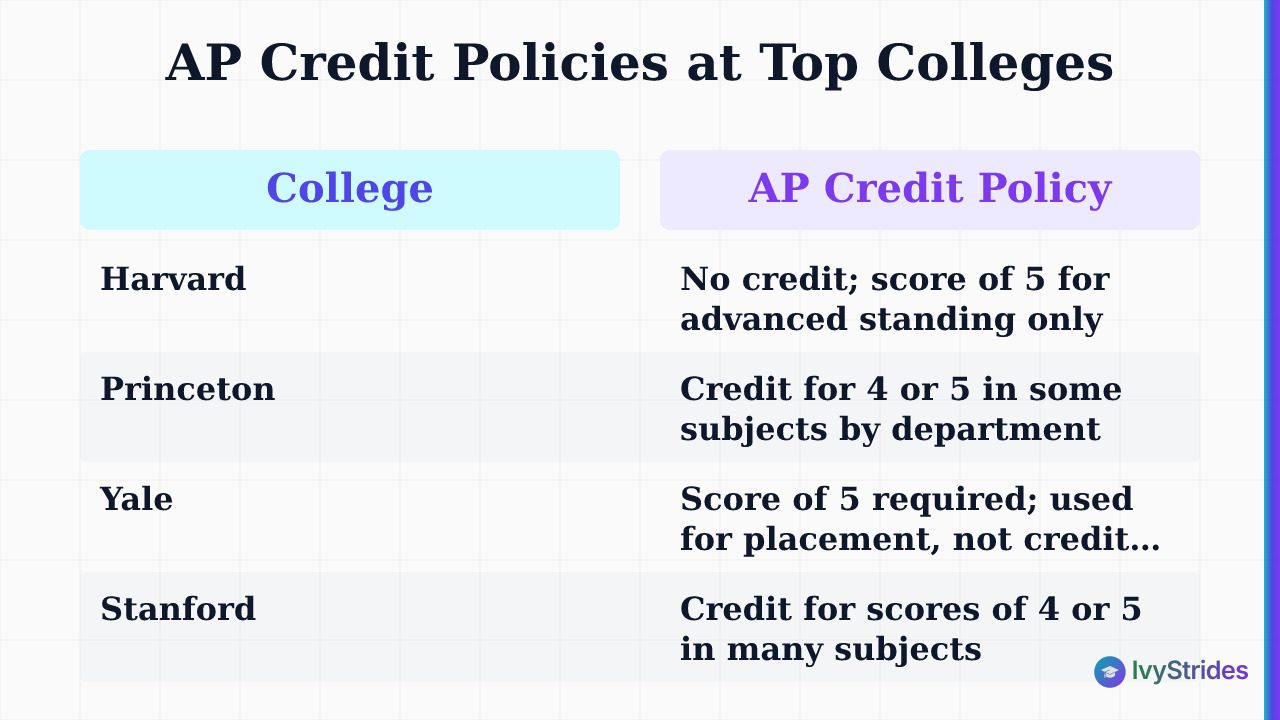
- Harvard does not award college credit for AP scores. It uses strong scores, typically a 5 in core subjects, for advanced standing, which can allow qualified students to pursue an accelerated degree path. Verify current policy at college.harvard.edu.
- Princeton accepts AP scores of 4 or 5 for credit in some subjects, with variation by department.
- Yale typically requires a 5 for credit in select subjects, and its credit is generally used to enable advanced course placement rather than reduce total credits required.
- Stanford accepts scores of 4 and 5 for credit in many subjects; check the Common Data Set for the current year.
- MIT grants credit in a limited set of subjects, typically requiring a 5, and does not award credit for many humanities APs.
In our coaching, students who verify their target school's credit threshold before choosing AP subjects are far less likely to be surprised by a score that earns no credit. A common pattern: a student scores a 3 on AP Biology and assumes credit is coming, only to discover the target school requires a 4 in that subject. That's one of the most avoidable planning mistakes in the entire AP process.
One caveat worth surfacing. The same strategic thinking that applies to submitting test scores at test-optional schools applies to AP scores: a strong score adds to your application, but a weak one rarely helps, which is why our guide on should you submit ACT scores if test-optional is worth reading alongside this one. And if you're targeting schools where your 1540 sat score or comparable stats put you in the competitive band, AP score strategy becomes part of the same integrated planning conversation.
What Score Do You Actually Need to Earn College Credit by AP Subject
The honest answer: it depends on the subject and the school. But there are patterns worth knowing.
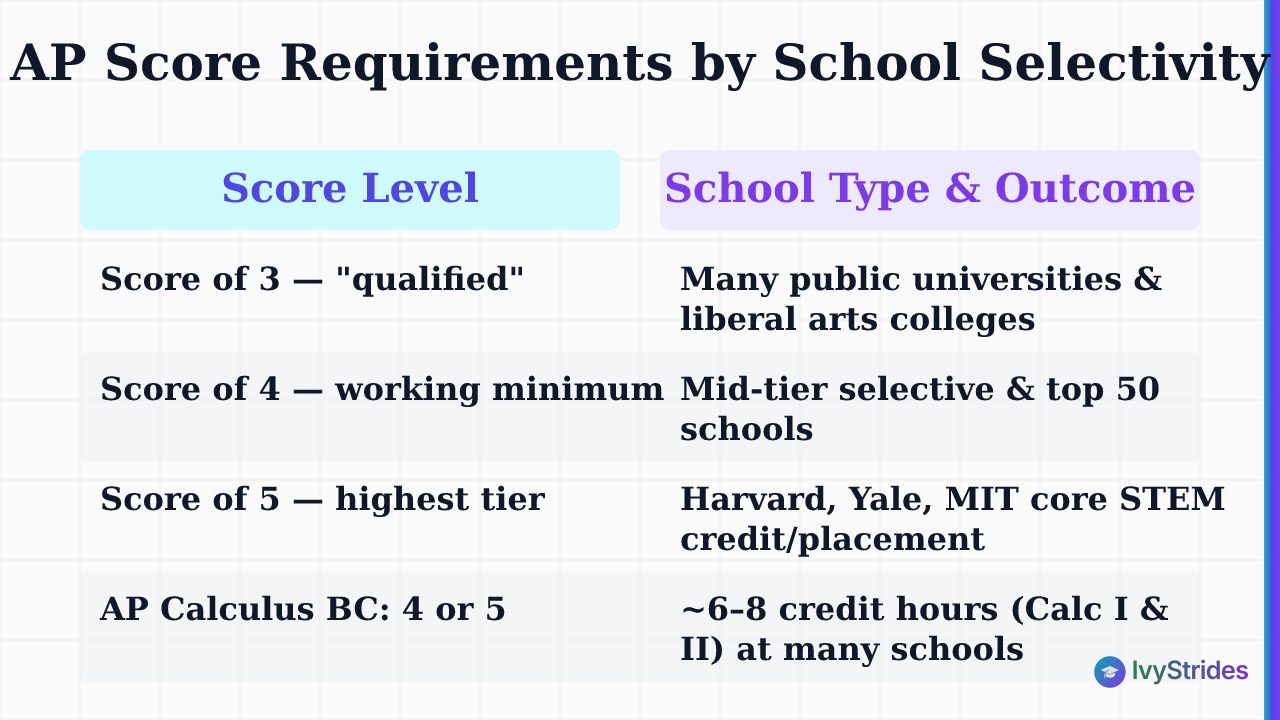
A score of 3 is treated as "qualified" by the College Board and is accepted for credit at many public universities and liberal arts colleges in subjects like AP English Language, AP US History, and AP Psychology. If your target list is heavy on state flagships, a 3 often earns credit hours.
A score of 4 is the threshold most mid-tier selective schools and many Ivy-adjacent institutions require. If you're targeting schools ranked around the top 50, plan for a 4 as the working minimum.
A score of 5 is what Harvard, Yale, and MIT expect in core STEM subjects for either credit or placement. It's also the score at which credit becomes portable across most highly selective schools.
Subject-level examples clarify the picture.
AP Biology. A score of 4 or 5 typically covers one semester of introductory biology at many universities. At Harvard, a 5 is generally expected for placement consideration in the biology sequence; confirm current policy at college.harvard.edu. In our coaching, students who set a specific score target based on their target school's policy, rather than aiming generically for a passing score, tend to approach exam prep with more focus.
AP Calculus BC. A score of 4 or 5 commonly earns credit for both Calculus I and Calculus II at many schools, which can mean roughly 6 to 8 credit hours from a single exam. This is one of the higher-return AP subjects when you can reach a 4 or 5.
AP Physics 1. Widely noted as one of the more difficult AP exams, with a lower rate of 5s per College Board score distributions. Students targeting credit at selective schools should factor this into their subject selection strategy.
A bachelor's degree typically requires around 120 credit hours. Earning roughly 15 to 30 AP credit hours can meaningfully reduce your required coursework, which in turn can lower tuition costs or free up your schedule for a double major or study abroad.
Choosing the right subjects and hitting the right scores is where subject-specialist coaching earns its keep. Our ap prep courses pair students with per-subject experts. If you're weighing the total cost of AP participation, our breakdown of how much does AP cost for families is a useful next read.
How AP Credit Affects Your High School GPA (A Separate Question from College Credit)
Worth separating cleanly. AP courses affect your high school GPA. AP exams affect your college credit. These are two distinct outcomes, and confusing them is one reason families overinvest in AP courses without a score plan.
Most high schools weight AP courses on a 5.0 scale, meaning an A in an AP class contributes 5.0 to your weighted GPA instead of the 4.0 an A in a regular class would contribute. That boost applies whether you score a 1 or a 5 on the AP exam. It applies even if you skip the exam entirely, though skipping the exam is a poor strategic move for the reasons already covered.
Taking four AP courses in junior year can meaningfully raise a weighted GPA, which is what many selective colleges use in early filtering. But the college credit question is entirely separate. Admissions officers reading your file see both data points: your weighted GPA and your AP exam scores. A strong GPA paired with weak AP scores signals a mismatch between grade inflation and true subject mastery, and admissions readers notice.
If you're also strategizing around your standardized test profile, our post on ACT score ranges for top colleges shows how the pieces fit together.
How to Choose Which AP Courses Are Worth Taking for College Credit
Start with your target college list. Not your interests. Not your friend's list. Yours.
For each target school, look up the AP credit policy in the College Board search tool. Note the minimum score required in each subject. Then compare that to your realistic academic profile. If your target is Yale and Yale requires a 5 in AP Chemistry, and your diagnostic AP Chemistry practice test is landing around a 3, that's a signal to either commit to a serious prep plan or pick a different AP subject where a 5 is reachable.
Three questions to run through before enrolling in any AP course:
-
Do my target schools award credit for this subject? If none of your target schools give credit for AP Environmental Science, taking it purely for credit is a weak investment. Take it for interest or for the GPA weight, but don't count on credit.
-
Can I realistically score a 4 or 5? Look at your grades in the prerequisite courses. If you're a strong writer, AP English Language is a reasonable bet. If your math background is uneven, AP Calculus BC is a stretch.
-
What is the 5-rate for this exam? AP subjects with higher 5-rates typically offer better credit return. AP Physics 1 has one of the lowest 5-rates; AP Calculus BC is on the higher end. Factor this in.
In our coaching, students who align AP subject selection with their target schools' credit thresholds and their own diagnostic strengths are more likely to earn credit that actually reduces their college coursework. That alignment work is exactly what per-AP-subject specialist coaching addresses. If you're weighing which AP subjects to take online this year, our ap courses online page outlines the subjects we cover and how each course is structured around the official College Board exam. For students preparing for the newer AP Precalculus exam specifically, our AP Precalculus online course is built around the same diagnostic-driven methodology.
Is AP Credit Better Than Dual Enrollment for College Admissions
Both signal academic rigor. Both can earn college credit. The differences are in standardization and transferability.
AP credit is standardized. The College Board exam is the same for every student regardless of school, region, or course provider. Admissions officers at highly selective colleges know exactly what a 5 on AP Chemistry means, and they can compare AP scores across applicants directly.
Dual enrollment earns actual college course credit on a real college transcript. That credit may transfer more reliably to schools within the same state system, especially at public universities. But dual enrollment credit from a community college may or may not transfer to a selective private college, and the receiving school makes that call one course at a time.
Our honest take:
- AP is generally better if you can score a 4 or 5, if your target schools have clear credit policies for that subject, and if you're applying to highly selective national schools where AP is universally recognized.
- Dual enrollment is generally better if you want grade-based credit on an accredited college transcript, if your target schools are in-state public institutions with clear transfer articulation agreements, and if the college course is from an institution the target school already recognizes.
For admissions purposes, both signal rigor. AP has slightly more universal recognition among admissions offices as a standardized benchmark. Dual enrollment can look stronger in a transcript context if the courses are at a genuinely rigorous four-year institution.
One caveat: dual enrollment transfer policies vary by college and state; always verify with the target school's registrar before assuming credit will transfer. And if college admissions essays are the next piece of the strategy for you, our essay coaching classes work with students in parallel with their AP planning.
How to Register for the AP Exam and Send Your Scores to Colleges
The process is more administrative than students expect. Miss a deadline and you lose the seat.
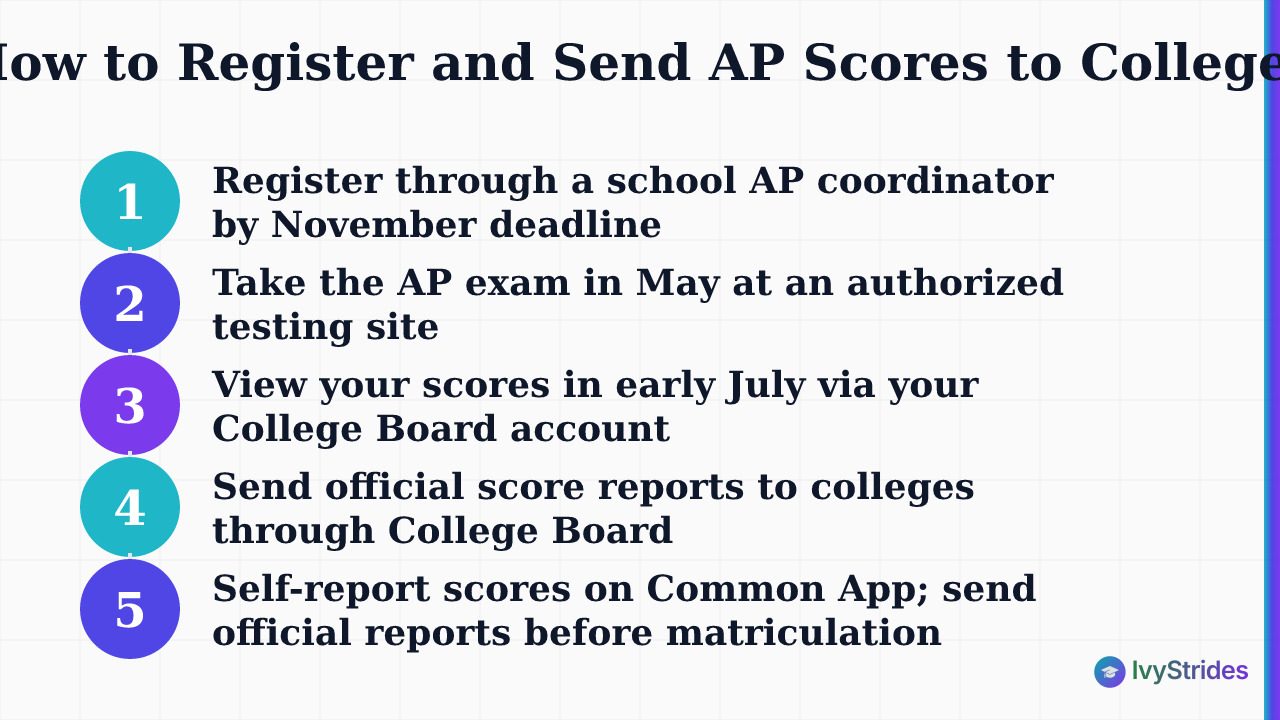
AP exams are administered each May by the College Board at authorized testing sites worldwide. Students taking online AP courses must register through a school AP coordinator or an authorized testing site, typically by the November registration deadline for the following May exam. Late registration is possible with fees but isn't guaranteed.
Score release happens in early July following the May administration. You log into your College Board account, view your score, and then decide whether to send it to colleges.
Sending scores works like this. Through your College Board account, you can send official score reports directly to any college at any time. Many students send scores after admission to establish credit and placement. Self-reporting AP scores on the Common App is separate from an official score send; some colleges accept self-reported scores during admissions review but require official reports before matriculation.
One free score send is included when you register for the exam. Additional sends carry a fee per report, so plan your list before submitting. Before committing to multiple AP courses, families should understand the full cost picture, including exam registration fees, prep costs, and potential savings from credit earned, which is exactly what our post on AP exam fees for international students breaks down.
If you're also working on your Common App essays and supplements alongside AP prep, our essay review service pairs with AP coaching for students building a full admissions strategy. You can learn more about our team on the IvyStrides about page. The section-specialist coaches are listed on the tutors page.
FAQ
Does taking an AP course automatically give you college credit?
No. Completing an AP course, whether online or in school, doesn't by itself earn college credit. You must register for and pass the official College Board AP exam in May, and the college you attend must accept your score under its credit policy. The course is preparation for the exam; the exam score is what colleges evaluate.
Do you get college credit for a score of 3 on an AP exam?
It depends on the college and the subject. Many public universities and liberal arts colleges award credit for a score of 3 in subjects like AP English Language, AP Psychology, or AP US History. Selective and highly selective schools typically require a 4 or 5. Use the College Board AP Credit Policy Search to check the specific threshold at each of your target schools before assuming a 3 will count.
Does Harvard give college credit for AP scores?
Harvard does not award college credit for AP exam scores. Instead, Harvard uses strong AP scores, typically a 5 in core subjects, to grant advanced standing, which can allow students to place out of certain introductory courses or pursue an accelerated degree path. This is different from receiving transferable credit hours. Always verify current policy directly with Harvard's registrar, as policies change.
Can you add online AP course credits to your college application or transcript?
Online AP courses appear on your high school transcript if your school records them, and the AP exam score appears on your official College Board score report. Colleges see both. The course itself signals academic rigor on your application; the exam score determines whether you receive college credit after enrollment. You can self-report AP scores on the Common App, but official score reports must be sent directly from College Board.
Which AP subjects are most widely accepted for college credit?
AP Calculus AB and BC, AP Chemistry, AP Biology, AP English Language and Composition, AP US History, and AP Computer Science Principles are among the most widely accepted subjects for credit at colleges nationwide. Acceptance still depends on your score and the specific college's policy. Use the College Board AP Credit Policy Search to verify credit for each subject at each of your target schools.
How many college credit hours does an AP exam typically earn?
This varies by subject and institution. A single AP exam typically earns roughly 3 to 8 credit hours at colleges that grant credit. AP Calculus BC, for example, may earn credit for both Calculus I and II at some schools, totaling around 6 to 8 credit hours. AP Psychology might earn about 3 credit hours. Since a bachelor's degree typically requires around 120 credit hours, earning roughly 15 to 30 AP credit hours can meaningfully reduce your required coursework.
The AP credit pathway isn't automatic, but it is learnable. Verify each target school's policy, pick subjects where a 4 or 5 is realistic given your starting point, and treat the exam, not the course, as the milestone that matters.

Two decades teaching quantitative and verbal aptitude on standardized tests. Rare dual expertise across Math and Verbal — particularly effective for students with gaps on both sides. Senior AP Mentor for our Calculus and English tracks.