
Can You Take AP Classes Online? Here Is What the College Board Actually Says
On this page
- The Short Answer: Yes, and Here Is Exactly What That Means
- What the College Board Actually Says About Online AP Courses
- My School Does Not Offer the AP I Need: Your Real Options Online
- How AP Exams Work When You Take the Course Online
- Free vs. Paid Online AP Courses: What You Actually Get
- Online AP Courses for International Students: What Is Different
- Can You Take AP Classes Online Over the Summer?
- How Many AP Classes Do You Actually Need for College Admissions
- How AP Classes Online Fit Into Your College Admissions Strategy
- FAQ
- Can AP classes be taken fully online, including the exam?
- Which AP class is considered the hardest to take online?
- What is the easiest AP class to take online for a student new to AP?
- Is AP harder than the SAT?
- Can I take an AP exam if my school does not offer the AP course?
- Is a score of 70 percent on an AP exam equivalent to a 5?
- How do I take AP classes online as a homeschool student?
Yes, you can take AP classes online. Students enroll through accredited virtual schools, state online programs, and private supplemental providers that follow the College Board's AP curriculum frameworks. The College Board doesn't offer AP courses directly, but it sets the standards every AP course must meet. One critical distinction: the AP exam itself cannot be taken online from home. Since 2021, all AP exams have been administered in person at approved testing centers, per College Board policy.
The rest of this guide unpacks what "College Board approved" actually means, which online pathways are real options, how to register for the exam if your school doesn't offer the course, and how AP fits into a broader admissions strategy. International logistics are anchored to College Board's Taking AP Globally page.
The Short Answer: Yes, and Here Is Exactly What That Means
An AP course is a year-long (or semester-intensive) sequence built to a curriculum framework the College Board publishes for each of the 38 AP subjects. Any school or provider can teach an AP course, provided the syllabus passes the AP Course Audit. That mechanism is more permissive than most families expect.
Here's the piece that trips people up. Two separate things are happening: the course you take, and the exam you sit in May. You can take the course online from a provider in another state or another country. The exam has to be taken in person at an approved testing center. That's been College Board policy since 2021, when the pandemic-era at-home options were retired.
AP exams are scored on a 1-5 scale. A score of 3 is generally considered passing, and most colleges award credit for scores of 3, 4, or 5. That said, AP credit policies vary meaningfully by institution, so verify each target college through the College Board AP credit policy search.
If your school doesn't offer the AP subject you need, or if you're an international or homeschool student, our ap courses online page walks through the specific subjects we teach with per-subject specialists.
What the College Board Actually Says About Online AP Courses
The College Board's role is often misdescribed. It publishes the curriculum framework, runs the AP Course Audit, and administers the AP exam. It does not accredit schools, endorse specific providers, or issue any "College Board certified course" designation. If a provider claims that label, treat it as a red flag.
The AP Course Audit works like this. A school or provider submits a syllabus showing how the course covers each unit of the AP curriculum framework. If the syllabus passes review, the course can be labeled "AP" on a student's official transcript. That's why a course delivered by an accredited online high school can appear on a transcript as "AP Chemistry," while a supplemental prep course typically cannot, even if it prepares the student equally well for the exam.
College Board also provides two free resources any enrolled AP student can use: AP Daily (short video lessons taught by experienced AP teachers, one per unit) and AP Classroom (progress checks, practice questions, and personal progress dashboards). Both are available at no cost through a College Board account and are worth using regardless of who teaches your course.
Before enrolling anywhere, families should understand the full how much does AP cost for families picture, which includes exam fees on top of any tuition. Exam fees change annually, so check current figures at apstudents.collegeboard.org.
My School Does Not Offer the AP I Need: Your Real Options Online
This is the most common reason families search for online AP options. Small schools, international schools without an AP program, and homeschool families all hit the same wall. There are four legitimate pathways.
State virtual schools. Many U.S. states run free online course programs open to in-state residents, and most include a slate of AP courses. Florida Virtual School, Georgia Virtual School, and North Carolina Virtual Public School are examples. Availability, subject list, and eligibility rules vary by state, so search your state's department of education site directly.
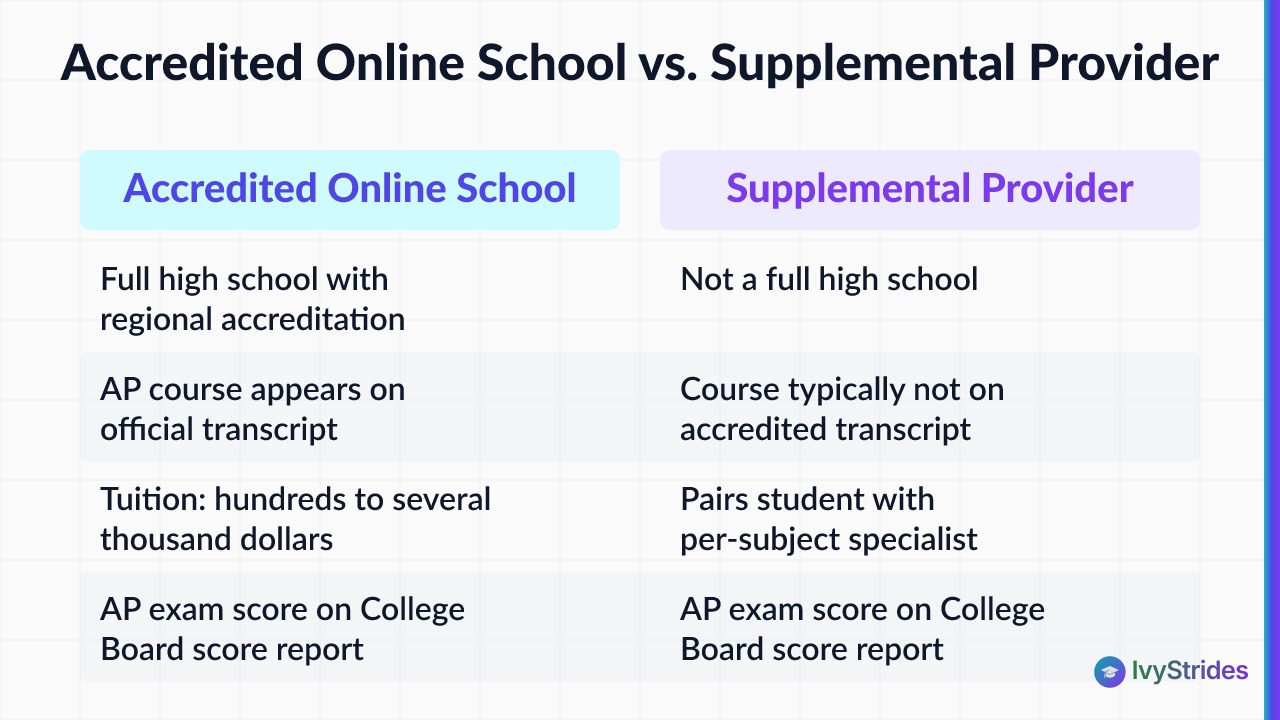
Accredited private online high schools. These are full online high schools with regional accreditation. A course grade earned here appears on an official transcript as an AP course (assuming the course passed the AP Course Audit). Tuition varies significantly, from roughly a few hundred dollars per course to several thousand.
Supplemental private AP providers. This is the category IvyStrides sits in. A supplemental provider isn't a full high school. It teaches the AP curriculum, prepares the student for the exam, and (in our case) pairs the student with a per-subject specialist. The course typically doesn't appear on a traditional transcript as an accredited AP course, but the AP exam score does appear on the student's official AP score report, which is what colleges care about most. Honest providers name this distinction up front.
Free resource platforms. These are content-rich but generally don't provide personalized feedback, adaptive pacing, or exam-strategy coaching.
Homeschool students can use any of the pathways above. For the exam, homeschoolers register through a local school that administers AP exams. Start that outreach by November for a May exam sitting, because some schools cap the number of outside students they accept.
If you want a deeper look at which subject tracks we offer, our best online ap courses page breaks it down. Parents weighing the options may also find our guide on how to support your AP student useful.
How AP Exams Work When You Take the Course Online
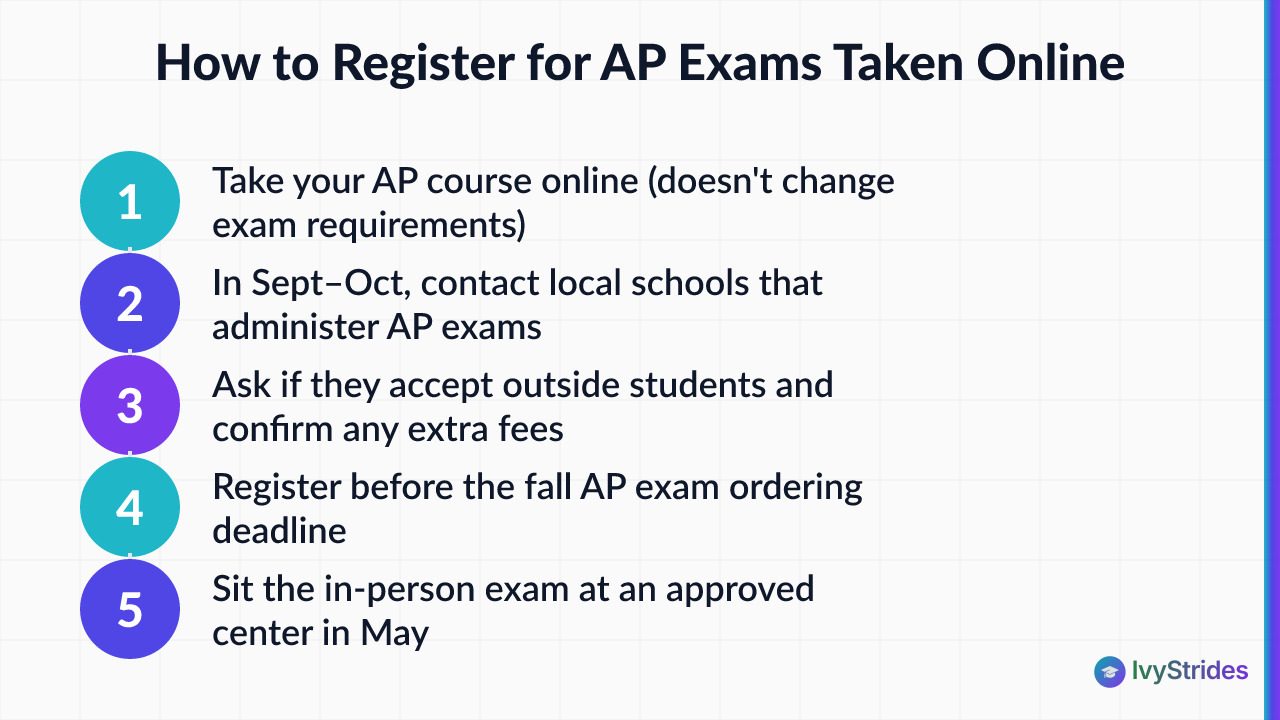
Taking the course online doesn't change how you sit the exam. All AP exams are administered in person at approved testing centers, on the dates College Board publishes for that year's May exam window. There is no at-home AP exam option.
If your school doesn't offer the AP course you took online, you can still register for the exam. The process: contact schools in your area that administer AP exams and ask if they accept outside students. Some do, some don't, and some charge an additional proctoring fee. Start this outreach in September or October for a May exam, because AP exam ordering typically closes in the fall for schools using the standard timeline. Check apcentral.collegeboard.org for the current year's deadlines.
For the 2026 exam administration, College Board is transitioning many AP subjects to the Bluebook digital exam platform, the same platform used for the Digital SAT. Some subjects will be fully digital, others hybrid (digital multiple choice, paper free-response), and a small number remain paper-based. The transition schedule is subject to change by subject, so verify at apcentral.collegeboard.org before your exam year.
For students outside the United States, taking an AP class online is only half the equation. You also need to locate an approved testing center and budget for international exam fees, which our full breakdown of AP exam fees for international students covers in detail. Once you know the exam logistics, our ap prep courses team can align coursework to your test date.
Free vs. Paid Online AP Courses: What You Actually Get
Let's be honest about this. Free resources are genuinely good, and students who use them well can score 4s and 5s. The real question isn't "are the free options legitimate?" It's "what do they leave out, and does that gap matter for your target score?"
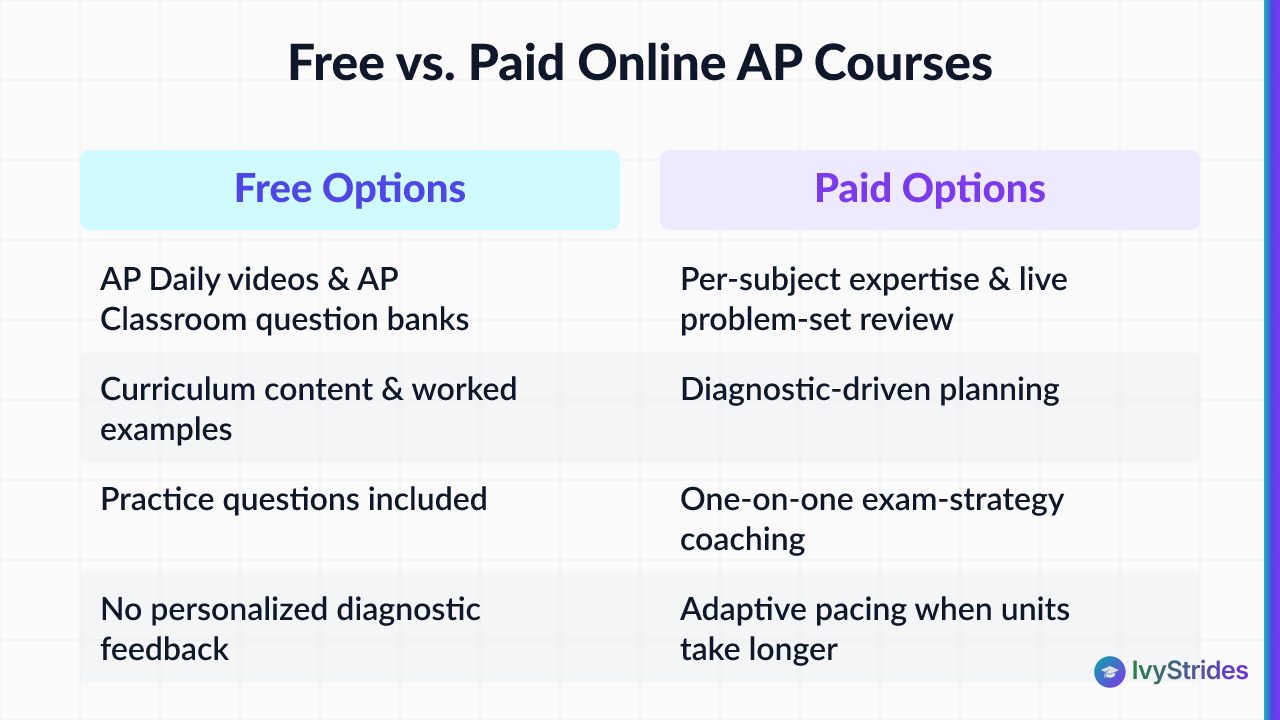
Free options include College Board's own AP Daily videos and AP Classroom question banks (available to students enrolled in an AP class section or an exam-only section in My AP, per College Board's international AP page) and state virtual school offerings for eligible residents. These deliver curriculum content, worked examples, and practice questions. What they typically don't deliver: personalized diagnostic feedback on your specific weaknesses, adaptive pacing when a unit takes you longer than expected, and one-on-one exam-strategy coaching for the free-response section.
Paid options range from full accredited online high schools to supplemental providers like IvyStrides AP Classes Online. What the paid tier buys you is per-subject expertise, live problem-set review, and diagnostic-driven planning.
Here's the pattern we see. In our coaching with students preparing for AP Calculus BC and AP Chemistry online, the most common gap is not content knowledge; it's exam strategy. Which free-response sub-parts to attempt first. How to allocate the 45-minute free-response window when you're stuck on a mechanism question. When to leave points on the table and move on. That's the layer free content generally can't teach, because it requires someone watching your work in real time.
For families weighing this decision, we teach subject-specific tracks including ap classes online across the sciences and math sequence. If your student is starting AP Precalculus and needs a foundation before Calculus AB, our AP Precalculus online coaching is a common starting point.
Before enrolling in any online AP course, it helps to understand the full cost picture, from exam registration fees to provider tuition, which our guide on how much AP costs for families breaks down honestly.
Online AP Courses for International Students: What Is Different
Students in India, the UAE, Singapore, Nigeria, or anywhere outside the US can participate in AP with College Board's explicit support. The Taking AP Globally page lists international exam options, and India has a dedicated page at international.collegeboard.org/students/ap/taking-ap-india with authorized exam center listings.
Course logistics are identical to a US student's. You enroll online, complete the units, and prepare for the May exam. The exam logistics are what differ. You need to identify an approved testing center in your country (or a reachable one nearby), register through that center by their local deadline, and pay any applicable international exam fee, which is higher than the domestic US fee. Confirm current fees at apstudents.collegeboard.org.
The strategic question, which parents often ask: do US colleges view AP scores from international students the same way? Short answer: yes. A 5 on AP Calculus BC or AP Physics C signals college-level readiness regardless of where the student sat the exam. The exam and the curve are identical worldwide. Caveat: AP credit-granting policies vary by college, so verify each target school's policy.
In our coaching, international students in India, the UAE, Singapore, and Nigeria have located approved testing centers and sat AP exams after completing online AP courses. The logistics are manageable with roughly 3-4 months of lead time. Students in these regions who are also planning to sit standardized tests should read our note on SAT fees for international students, since the exam-fee dynamics are similar. For students pursuing an ap certification online path in preparation for US applications, aligning AP subjects to intended major is the highest-use decision.
Can You Take AP Classes Online Over the Summer?
Yes, and it's a common strategy. Many online providers, including IvyStrides, offer AP course enrollment year-round. The question is what you're using the summer for.
Two scenarios come up most. In the first, you take a summer AP course to get ahead on a difficult subject before the academic year, then continue reviewing and sit the exam the following May. This is especially common for AP Chemistry, AP Physics 1, and AP Calculus BC, where front-loading the harder units over the summer creates breathing room during a busy junior or senior year. In the second, you use the summer as concentrated exam-prep time immediately before a May exam. That compresses the timeline uncomfortably unless you already know most of the content.
How do colleges view summer AP courses? Honestly, slightly differently than academic-year AP courses. A transcript full of academic-year APs signals sustained rigor across a normal course load, which is what admissions officers use to calibrate GPA. A summer-only AP course is fine, but it doesn't carry the same "this student handles heavy rigor over 10 months" signal. What ultimately matters is the AP exam score: a 5 on the May exam is a 5 whether you prepared over the summer or across the school year.
Two subjects where a summer runway pays off: ap calculus ab, because the derivative and integral foundations reward extended practice. ap chemistry, because the equilibrium and thermodynamics units are conceptually dense.
Caveat: admissions outcomes depend on the full application, not AP timing alone.
How Many AP Classes Do You Actually Need for College Admissions
The Reddit answer ("Is 7 AP classes enough for Harvard?") is the wrong question. The right question: what does your school offer, how many of those APs did you take, and what were your scores?
Here's the calibration we use. For highly selective colleges (Harvard, Yale, Princeton, MIT, Stanford), admitted students commonly have roughly 7-12 AP courses on their transcripts, but the number by itself isn't the signal. Scores of 4 or 5 on those exams are what validate the rigor. Taking 10 APs and earning 2s and 3s reads worse than taking 6 APs and earning 4s and 5s. For strong regional universities and honors programs, roughly 3-5 AP courses with strong scores are generally competitive.
Choosing how many AP courses to take online is a strategic decision that intersects directly with your overall college application, and the answer depends on your target schools, your current course load, and your realistic capacity to score 4s and 5s on the exams.
Admissions officers also read your AP selection against your school's course catalog. Taking 7 APs at a school that offers 8 reads as maxing out rigor. Taking 7 APs at a school that offers 20 reads as selective. Context matters, and the counselor's school profile is what tells admissions officers what was actually available to you.
In our coaching, students who overload on APs and land 2s and 3s consistently rank lower in the applicant pool than students who take 4-6 APs and earn 4s and 5s. GPA protection matters. So does bandwidth for essays, activities, and the SAT or ACT.
For students building rigor through specific STEM subjects, our ap physics 1 and ap computer science a tracks are two of the most common entry points into a serious AP sequence. For course-selection guidance from the source, see apstudents.collegeboard.org/choosing-courses.
Caveat: college admissions outcomes depend on the full application, not AP course load alone.
How AP Classes Online Fit Into Your College Admissions Strategy
AP scores don't live in isolation. They're read alongside SAT or ACT scores, GPA, essays, and activities. Understanding how they interact is what separates a strong AP strategy from a scattered one.
AP scores and SAT scores are read together by admissions officers, so a strong AP performance can reinforce a competitive SAT score or, in test-optional contexts, partially compensate for a weaker one. Caveat: test-optional policies vary by school and year. Verify at fairtest.org and each target school's admissions page. Our take on should you submit ACT scores if test-optional walks through the specific decision framework.
Two additional signals to track. First, AP rigor gives context to your GPA. A 3.9 GPA in 8 AP courses reads differently than a 3.9 GPA in no AP courses. Admissions officers use the course rigor row on your school report to normalize this. Second, students who are also preparing for the PSAT/NMSQT will find that the analytical skills built in rigorous AP courses, particularly AP English Language and AP Statistics, transfer directly to the Reading and Writing and Math sections of the PSAT.
IvyStrides operates five connected service lines (SAT, ACT, PSAT, AP, and admissions essays) because families rarely need just one. A junior planning a 1500+ SAT is usually also targeting 5s on 3-4 AP exams and starting Common App brainstorming by August. Coordinating those workstreams matters. Our SAT prep overview explains how we structure diagnostic-driven prep at each score band. The ACT prep overview mirrors that diagnostic model for ACT-focused students.
FAQ
Can AP classes be taken fully online, including the exam?
The coursework can be completed entirely online through accredited providers or supplemental programs. The exam cannot. Since 2021, all AP exams have been administered in person at approved testing centers, and there is no at-home option. Locate an approved testing center near you before enrolling in an online AP course, especially if you're international or homeschooled.
Which AP class is considered the hardest to take online?
AP Physics 1 is widely cited as one of the toughest AP courses, and the difficulty is amplified online without hands-on lab work. AP United States History and AP Chemistry are also consistently high-difficulty. In our coaching, students in these subjects benefit most from a per-subject specialist rather than a generalist instructor, because the exams reward deep conceptual reasoning rather than surface-level content coverage.
What is the easiest AP class to take online for a student new to AP?
Based on College Board pass-rate data, AP Computer Science Principles, AP Psychology, AP Human Geography, AP Environmental Science, and AP U.S. Government and Politics tend to have the highest rates of scores of 3 or above. For a student new to AP taking their first course online, AP Computer Science Principles or AP Psychology are often the most manageable starting points. The content is accessible and the exam formats are relatively straightforward.
Is AP harder than the SAT?
They test different things, so a clean comparison is hard. The SAT measures general verbal and quantitative reasoning across two sections in about 2 hours and 14 minutes. AP exams test deep subject-specific knowledge in one discipline, running roughly 2-3 hours depending on the subject. Most students find a rigorous AP exam (AP Physics 1, AP Calculus BC) more demanding in content depth than the SAT, while the SAT's adaptive format and pacing pressure create their own challenges. Both matter for admissions, and strong performance on each reinforces the other.
Can I take an AP exam if my school does not offer the AP course?
Yes. The College Board allows students to sit AP exams even if their school doesn't offer the corresponding course. Contact nearby schools that administer AP exams and ask about registering as an outside student. Fees and availability vary. Full guidance is at apstudents.collegeboard.org. Start outreach in the fall for a May exam, because ordering deadlines close well before the exam window.
Is a score of 70 percent on an AP exam equivalent to a 5?
Not necessarily. AP exams aren't scored on a flat percentage scale. Raw scores are converted to the 1-5 scaled score using a curve that varies by subject and by exam year. On some AP exams, roughly 65-70 percent of available points yields a 5. On others, the threshold sits higher or lower. College Board publishes score distributions annually at apstudents.collegeboard.org, and the exact conversion is finalized after each year's administration.
How do I take AP classes online as a homeschool student?
Homeschool students can enroll through accredited virtual schools or supplemental providers. For the exam, register through a local school that administers AP exams. Start that outreach by November for a May exam, because some schools cap outside-student registrations. College Board's AP Students site has specific homeschool guidance. Our tutors page shows the per-subject specialists we pair with homeschool families.
Online AP courses are a legitimate, College Board-supported pathway for students whose schools don't offer the subject they need, for homeschoolers, and for international students preparing for US college admissions. The decisions that matter most are provider quality, exam logistics, and how the AP course fits into the rest of your application.
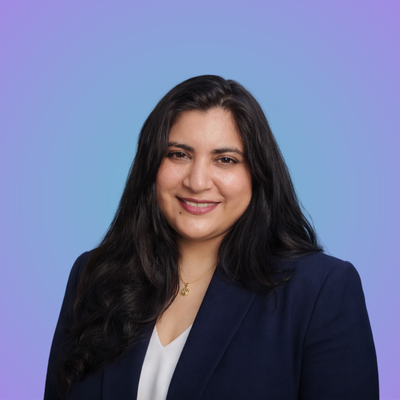
Two decades teaching quantitative and verbal aptitude on standardized tests. Rare dual expertise across Math and Verbal — particularly effective for students with gaps on both sides. Senior AP Mentor for our Calculus and English tracks.