
How to Support your AP Student in 2026: A Step-by-Step Guide That Actually Works
On this page
- What Supporting an AP Student Actually Means (and What It Does Not)
- Step 1: Help Your Student Choose the Right AP Course Load
- Step 2: Build a Weekly Study Routine That Holds Up Under AP Pressure
- When Your Student Is Falling Behind in AP: Three Warning Signs and What to Do
- Not Sure If Your Student Needs AP Coaching Right Now?
- How to Help Your Student Stay Calm Before and During AP Exams
- How AP Scores Fit Into the Bigger College Admissions Picture
- When to Step In and When to Step Back: A Parent's Practical Guide
- FAQ
- What is the hardest AP class to score a 5 on?
- Does a 70% raw score get a 5 on an AP exam?
- Is a B+ in an AP class a good grade for college applications?
- How many AP classes do you need for Ivy League admission?
- How do I download a PDF of my student's AP scores?
- What should I do if my student got a low AP score?
- Your Student Has One Shot at This Year's AP Exams. Make It Count.
To support an AP student well in 2026, four things matter more than everything else combined: help them pick a course load they can actually carry (2 to 4 APs per year fits most students), lock in a weekly study routine that includes free-response practice, protect the 72 hours before each exam from stress and cramming, and know the specific warning signs that mean it's time to bring in outside coaching. AP scores run 1 to 5; a 3 earns credit at many colleges, and selective schools prefer 4s and 5s.
Scoring, credit rules, and 2026 format changes come from the College Board's AP Program; credit policies vary by institution, so verify at each target school. Where a claim reflects patterns from our own AP coaching, we've said so directly. The rest of this guide walks the AP school year step by step.

What Supporting an AP Student Actually Means (and What It Does Not)
The parent role in AP prep is structural, not academic. You aren't the second teacher. You're the person who makes sure the calendar exists, the study block is protected, the sleep happens, and outside help gets called in early enough to matter. That's the job.
The academic side belongs to three other people: the AP teacher (in-school instruction and grading), the student (daily execution), and, when needed, a subject-specialist AP coach. Trying to occupy any of those three roles as a parent is the fastest way to add friction without adding score.
Here's what changes in 2026. Per the College Board AP Program, 28 AP exams are now delivered digitally through the Bluebook app, with a built-in Desmos calculator available on applicable exams. Some exams remain paper, some are hybrid, and the exact format varies by subject. Confirm your student's specific subject at apstudents.collegeboard.org before exam week. AP exam dates begin May 4, 2026.
The main school-side resource your student already has is AP Classroom. It's the official College Board platform where the AP teacher assigns progress checks, practice multiple-choice questions, and released free-response questions (FRQs). Progress check scores are the single most reliable in-year signal of whether your student is on track for a 4 or 5, and they're visible to the teacher. Parents don't need to police AP Classroom. But you should know it exists, and you should ask your student, casually, what their most recent progress check scores look like by unit.
One clarification that saves families a lot of confusion: the AP class grade and the AP exam score are two different things, scored two different ways, by two different parties. A B+ in AP Biology and a 3 on the AP Biology exam are both plausible outcomes for the same student. Colleges see both. We come back to why that matters in the admissions section.
If your school doesn't offer an AP subject your student needs, or if the in-school pace isn't working, our ap classes online with a subject-specialist teacher are the standard fix.
Step 1: Help Your Student Choose the Right AP Course Load
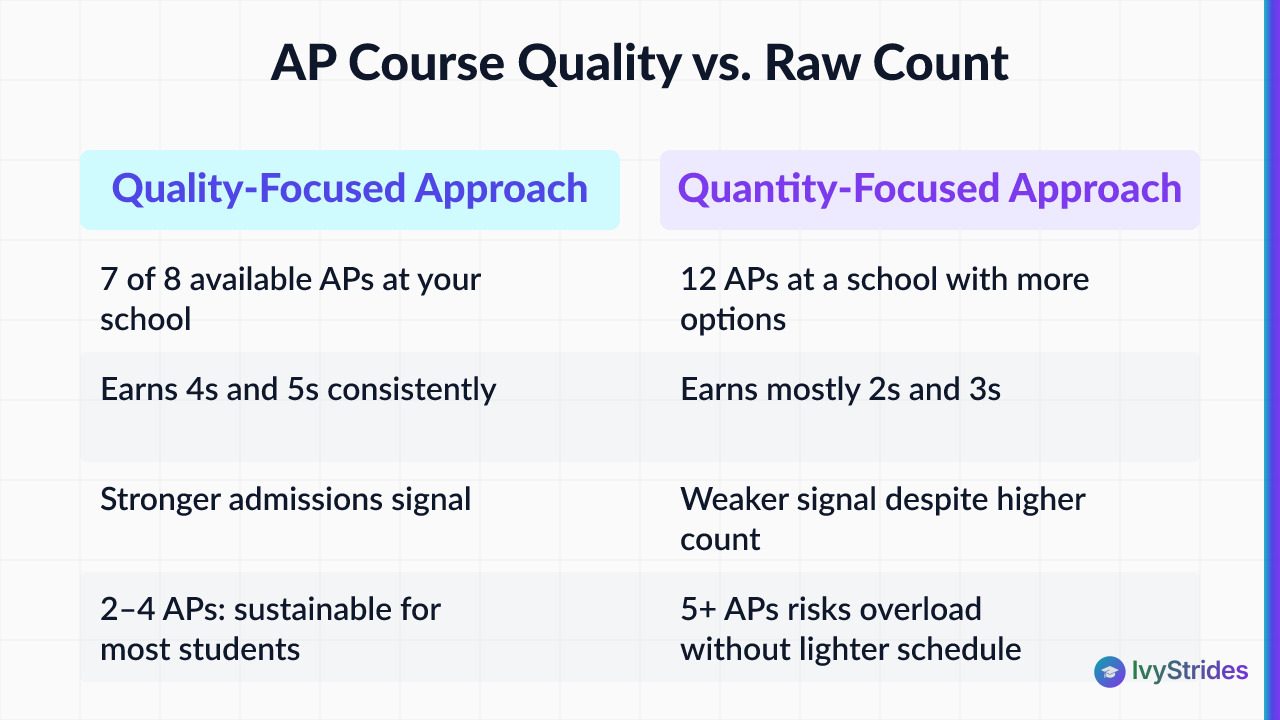
The single most common question we get from parents in the spring: how many APs should my student take next year? The honest answer is that roughly 2 to 4 APs per year is a sustainable load for most students, adjusted for the student's demonstrated capacity, extracurricular commitments, and the specific difficulty of the courses chosen. A student running 3 APs plus a varsity sport and a research project is not in the same situation as a student running 5 APs with a lighter schedule.
Now the college question. Is 7 AP classes enough for Harvard? Roughly speaking, most Ivy League admits complete around 10 to 14 AP courses by graduation, though a student with 6 or 7 APs and strong performance across all of them can absolutely be competitive at selective schools. Admissions offices evaluate rigor in the context of what your school offers. A student who takes 7 out of 8 available APs at their high school and earns 4s and 5s is a stronger signal than a student who takes 12 APs and earns mostly 2s and 3s. Quality and consistency of performance beat raw count. Every time.
What about the hardest AP class? AP Physics 1 is widely regarded as the toughest, with one of the lowest 5-rates nationally per the College Board's AP score distributions. AP U.S. History and AP Chemistry are close behind. That doesn't mean avoid them. It means budget more weekly study hours for those subjects and take the diagnostic seriously before enrolling. AP Physics 1 was redesigned for the 2025 exam cycle, so make sure any prep materials your student uses are aligned to the current framework at AP Central.
A quick note for students at schools with limited AP offerings. If your school offers 4 APs and your target colleges compare you to students at schools offering 20, the gap gets filled through the best online ap courses. This is a real strategic move for internationals and for students at smaller public and private schools. Our full guide on online AP courses for schools that don't offer them breaks down how it works and what colleges see on the transcript.
One caveat before you build the four-year plan: AP credit policies vary substantially by college and by subject. A 4 in AP Calculus AB might waive Calc I at one university and count only as elective credit at another. Verify each of your student's target schools individually.
Step 2: Build a Weekly Study Routine That Holds Up Under AP Pressure
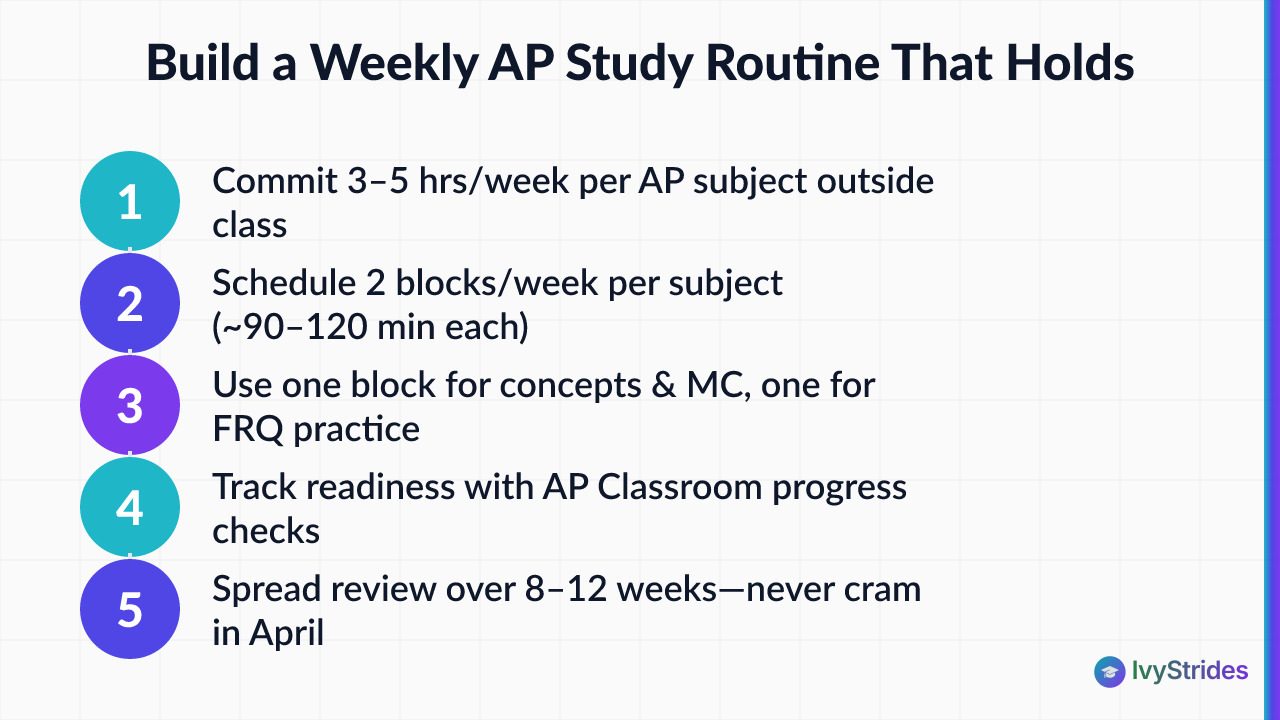
Here's the study-hours question, answered directly. In our coaching with AP students, those who dedicate roughly 3 to 5 hours per week per AP subject outside of class time show meaningfully better May exam outcomes than those who rely on class time alone. Two APs at 4 hours each is 8 hours of weekly AP study. Four APs at 4 hours each is 16 hours. That number isn't negotiable, and it's the reason course load matters so much: if the hours don't fit in the calendar, the plan doesn't exist.
The weekly structure that holds up under real pressure looks something like this. Two blocks per subject per week, roughly 90 minutes to 2 hours each. One block for concept work and multiple-choice practice on the current unit. The other block for FRQ practice, ideally on a released FRQ from a prior unit so the student is also building spaced recall. This second block is the one students skip. Don't let them.
Why the FRQ obsession? Because free-response questions are where students actually lose the points that separate a 3 from a 5. Multiple-choice sections reward pattern recognition and content coverage. FRQs reward the ability to structure a response the way trained readers expect to see it. In our coaching, students who practice at least one FRQ per subject per week from October through April outperform students who wait until March to start.
AP Classroom progress checks are the built-in self-assessment tool. They're scored, aligned to the College Board's own framework, and give a reliable readiness signal by unit. If your student is scoring above roughly 75% on progress checks across all units, they're on track for a 4 or 5. Around 60 to 75%, they're on track for a 3 with real risk of a 2 if a weak unit shows up on the exam. Below 60% consistently, something is wrong and it won't fix itself. More on that in the next section.
Spaced practice beats cramming. Not close. In our coaching observations, a student who reviews prior units in short weekly blocks for roughly 8 to 12 weeks scores better than a student who does the same total hours in a 2-week sprint in April. The AP exam is a cumulative test of the full year's content. Your review schedule should reflect that.
Two more pieces. If your student is also prepping for the SAT or ACT in the same semester, don't run two uncoordinated schedules. AP FRQ writing overlaps with Digital SAT Reading and Writing skills, and AP quantitative subjects reinforce SAT Math and ACT Math skills. A coordinated schedule typically saves about 4 to 6 hours a week compared with treating them as separate tracks. Second, be honest about whether the current plan is working. Our take on is free AP prep enough covers when free resources hit a ceiling and when structured coaching pays off. If the question is whether to use live instruction or recorded video, our comparison on live online AP vs self-paced video walks through the tradeoffs.
When Your Student Is Falling Behind in AP: Three Warning Signs and What to Do
This is the section parents actually read at 11 p.m. in February. Your student's grade is slipping in one AP class, or their AP Classroom scores don't match what they're telling you, or they've stopped opening the textbook and you don't know how bad it is. Here are the three warning signs we see most often, and the intervention ladder in order.
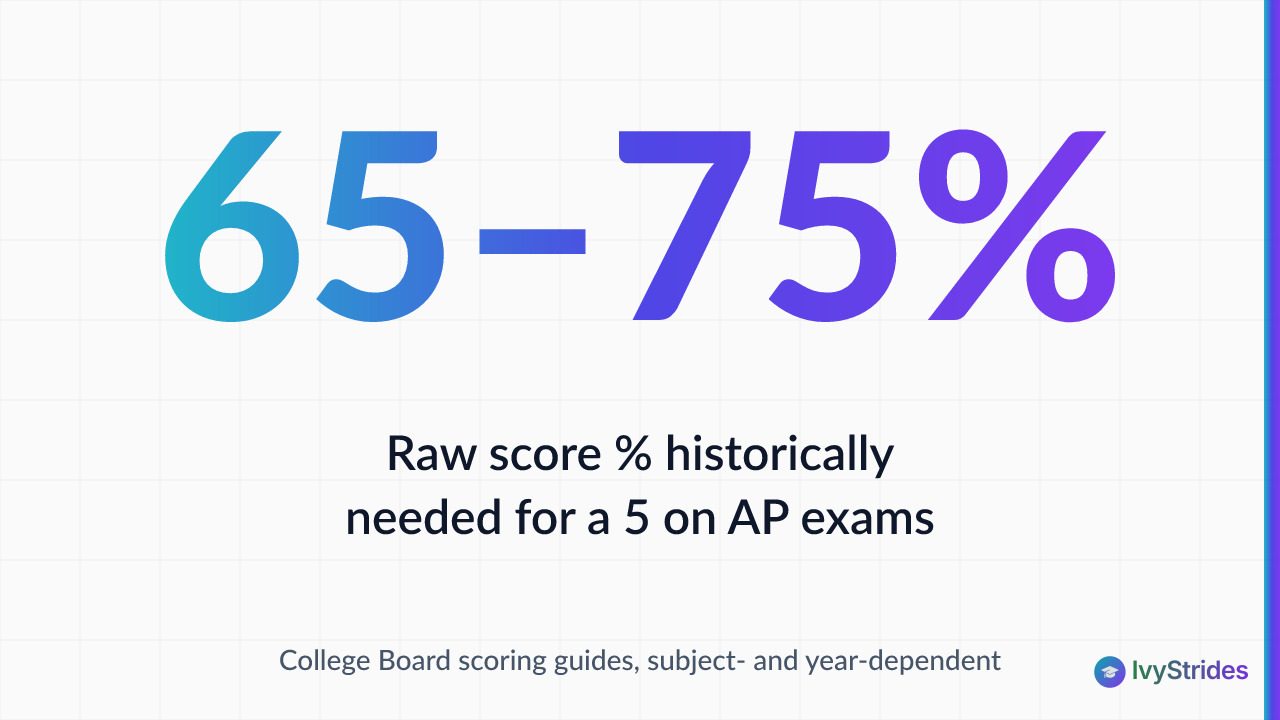
Warning sign 1: AP Classroom progress check scores consistently below 60%. On most AP subjects, the composite raw percentage for a 5 has historically hovered around 65 to 75%, subject-dependent and year-dependent, per the College Board's scoring guides. A student stuck below 60% on in-year practice needs a diagnostic, not more hours of the same self-study. The gap isn't effort. It's a concept gap that self-study won't close because the student doesn't know which units are the problem.
Warning sign 2: the student is avoiding FRQ practice entirely. Not "doing it inconsistently." Actively avoiding it. This is the single most diagnostic signal we see. Multiple-choice questions let a student feel productive without exposing what they don't understand. FRQs force the student to construct a response, which surfaces every gap. When a student avoids FRQs, it's almost always because the concept knowledge isn't there yet, not because they're lazy.
Warning sign 3: the AP class grade drops below a B- with less than 8 weeks until the exam. At this point the student is behind on class content and, mathematically, likely also behind on exam readiness. There's time to recover a 3 or maybe a 4, but the plan needs to change this week, not next month.
The intervention ladder, in order. Start with the AP teacher's office hours. Free, most direct feedback, and the teacher already knows the student's specific gaps. If office hours aren't enough or the student won't go, move to structured self-study with a focused plan on the 2 to 3 weakest units. In our coaching with students who came to us roughly 6 to 8 weeks before the AP exam, those who focused exclusively on their 2 to 3 weakest units and drilled FRQs in that format saw the most meaningful score movement.
If the gap is still there after 2 to 3 weeks of structured self-study, that's the point where subject-specialist coaching earns its keep. A generalist tutor who covers all APs isn't the same as a subject-specialist AP teacher who works only in, say, AP Physics 1 and knows exactly where students lose points on the FRQ section. For students whose schools don't offer a subject, or whose in-school AP class moves too fast, enrolling in AP classes online gives them a subject-specialist teacher and a structured pace they can actually keep up with. Our ap prep courses run on the subject-specialist model, one teacher per subject.
The subjects where we see the highest use from specialist coaching: AP Physics 1, AP Calculus BC, AP Chemistry, and AP Computer Science A. The common thread is that these subjects punish specific procedural errors heavily on the FRQ section, and a specialist catches those errors in a way a generalist tutor won't. AP Precalculus is another one, especially for students building toward Calc BC the following year. If that's your student, our AP Precalculus online page walks through the format.
Not Sure If Your Student Needs AP Coaching Right Now?
In 15 minutes, an IvyStrides AP specialist will review where your student stands, identify the highest-leverage units to target before May, and recommend the right next step: AP Classes Online, 1-on-1 coaching, or a structured self-study plan.
How to Help Your Student Stay Calm Before and During AP Exams
The 72 hours before an AP exam aren't for cramming. They're for consolidation, sleep, and getting the logistics right. Here's what actually helps, addressed to the student directly.
Sleep first. Eight or more hours the two nights before the exam. Not just the night before. The night two nights out matters more than most students realize because sleep deprivation compounds. If you sleep 5 hours the Sunday before a Tuesday exam, no amount of Monday-night sleep fully recovers you by Tuesday morning.
Nutrition. Skip the heavy breakfast the morning of. Protein and complex carbs, moderate portion. Big meals shunt blood flow away from the brain during digestion, which isn't what you want during a 3-hour exam.
Review strategy. In the final 24 hours, keep it light. Skim the formula sheet for quantitative subjects. Re-read the FRQ scoring criteria for your specific subject on AP Central. Look at one or two FRQs you already scored well on, not new material. In our coaching observations, students who do a 30-minute light review of FRQ scoring criteria the evening before outperform students who either cram heavily or do nothing at all.
Breathing and grounding for exam-day anxiety. Box breathing works: 4 seconds in, 4 seconds hold, 4 seconds out, 4 seconds hold. Do 4 cycles when you sit down. If the first FRQ throws you, take one full box-breath before starting to write. That 16 seconds is the best investment you'll make on the exam. Our full breakdown of test-day anxiety tactics is in 10 Strategies to Overcome SAT Anxiety and Boost Your Score; the same tactics apply directly to AP.
Logistics. In 2026, per the College Board AP Program, 28 AP exams are delivered digitally through Bluebook. Confirm your specific exam's format at apstudents.collegeboard.org at least a week before exam day. If your exam is digital, download and open Bluebook the day before to confirm it runs on your device. Bluebook includes a built-in Desmos calculator on applicable exams. If your exam is paper, know exactly what materials you're allowed to bring. Arrive at the testing room about 20 minutes early. That buffer is what keeps a flat tire or a late bus from becoming a crisis.
For last-minute pacing rules that translate across timed exams, our last minute sat tips piece has the pacing framework we use.
A note to parents on the morning of the exam. Don't quiz your student. Don't ask if they've reviewed. Don't project your anxiety onto their morning. Make breakfast. Get them to the testing site. Say something short and calm as they walk in. Then step back. Your job that morning is logistics and calm, not academics.
How AP Scores Fit Into the Bigger College Admissions Picture
Here's where the AP score does its work in the admissions file. Selective colleges read AP scores as an independent signal of subject mastery, separate from the class grade. A 5 on AP Chemistry from a student applying to engineering programs carries more weight than the same student's A- in the class, because the exam is standardized and the class isn't. This is why the AP score matters even when your student's transcript already looks strong.
Per the College Board AP Program, a score of 3 or higher is considered passing and earns credit at many colleges, while selective institutions typically prefer 4s and 5s for both admissions weight and credit-granting. Credit policies vary by college and by subject; always verify at each target school's admissions or registrar page.
Strong AP scores reinforce the academic narrative a student builds in their college admissions essays, so the two preparation tracks work together rather than competing for time. A student who writes about a research interest in biology and has a 5 on AP Biology is telling a coherent story. A student who writes about the same interest and has a 2 on AP Biology is telling a story that doesn't hold. This is why we treat essays and AP prep as one strategy, not two. Our full walk-through on essay revision is in how to edit and revise your college essay. Families building the Common App personal statement should look at our common app essay tutor coaching.
Students juggling AP prep and SAT or ACT prep in the same semester benefit from a coordinated schedule that treats both as part of one admissions strategy, not two separate to-do lists. If ACT prep is the next thing on the calendar, our take on when should my child start ACT prep covers the timing question.
Families focused on National Merit recognition through the PSAT/NMSQT should note that AP rigor in 10th and 11th grade correlates with the analytical skills tested on the PSAT/NMSQT. The overlap isn't perfect, but the reading load and quantitative reasoning students build in AP courses transfer directly.
Now the test-optional question. At test-optional schools, a transcript loaded with strong AP scores (4s and 5s) can carry significant weight in lieu of a submitted SAT or ACT score, though policies vary by institution and year. Check FairTest for current test-optional status by school, and check the school's own admissions page for the most recent policy. Test-optional doesn't mean test-blind; strong scores still help even where they're not required.
One more angle. Selective schools also read AP scores in the context of the student's intended major. AP Calculus BC for engineering applicants, AP Biology and AP Chemistry for pre-med, AP U.S. History and AP English Language for humanities and social science tracks. A student building a case for a specific major benefits from strong AP performance in that major's foundational subjects. It's one of the highest-use strategic choices in the four-year plan.
The caveat, said plainly: admissions outcomes depend on the full application, including essays, extracurriculars, recommendations, and context, not AP scores alone. AP performance is a strong signal, not a deciding one.
When to Step In and When to Step Back: A Parent's Practical Guide
The parent-student dynamic is the hardest part of AP support, and it's where families most often get it wrong in both directions. Here's the framework.
Step in when: AP Classroom progress check scores are consistently below 60% by February. The student is avoiding FRQ practice entirely. The exam is less than 6 weeks away and no structured plan exists. The student's grade in the AP class has dropped below a B- with weeks remaining. In any of these cases, the situation won't fix itself, and waiting another two weeks makes the recoverable gap harder to close.
Step back when: the student has a plan and is executing it. Progress check scores are in the roughly 65 to 85% range and trending upward. The student can articulate which units are weakest and what they're doing about it. In this case, more parental involvement adds anxiety without adding output. Nagging a student who is already on plan is one of the fastest ways to sabotage the plan.
The hardest part is the conversation about outside help. In our coaching with families, the most common pattern is a parent who waits until roughly 3 to 4 weeks before the exam to seek help. By that point, the highest-use move is triage: pick the two weakest units, drill them, and accept that a 4 is more realistic than a 5. Students who start structured coaching roughly 8 to 10 weeks out have real time to close concept gaps and move a full point on the score scale.
Why does specialist coaching work better than more self-study at that stage? Two reasons. A subject-specialist AP tutor focuses only on the exam-relevant content for that subject, which is different from a generalist tutor who covers all APs at a shallower level. Second, a coach is a neutral third party. The parent-student tension that builds around a struggling AP class dissolves when the accountability moves to someone outside the family. In our experience, that alone recovers hours of weekly friction.
Every IvyStrides AP coaching engagement starts with a practice assessment to identify the 2 to 3 highest-use units to target. That's the diagnostic-led methodology in one sentence. No blanket "review everything" plans. No generic problem sets. You can read more about how we work on our about page.
How do you have the conversation with your student about getting help? Frame it as use, not remediation. "You've put in real work this year. I want to make sure you get the score that reflects it." Not: "You're falling behind, we need to fix this." The framing changes whether the student walks into coaching engaged or defensive.
For parents supporting students on the ACT track alongside AP prep, our take on how can parents support ACT prep uses the same framework in the ACT context. If you're evaluating whether an ap certification online course is the right structural fit versus 1-on-1 coaching, the choice usually comes down to how much scaffolding your student needs and whether they've already tried self-study.
FAQ
What is the hardest AP class to score a 5 on?
AP Physics 1 is widely cited as the hardest AP exam, with one of the lowest 5-rates nationally. AP U.S. History is close behind, and AP Chemistry rounds out the top three most commonly. Difficulty depends on the student's strengths, though: a student strong in algebra but weak in reading may find AP Physics 1 more manageable than AP English Literature. Check the College Board's annual AP score distributions for the most current pass rates by subject.
Does a 70% raw score get a 5 on an AP exam?
On most AP subjects, the composite raw percentage needed for a 5 has historically hovered around 65 to 75%, making 70% a reasonable working target. The exact threshold is subject-dependent and year-dependent because the College Board uses a statistical process to set cut scores each year. Treat 70% as a planning benchmark, not a guarantee, and verify against the College Board's scoring guidelines for your specific subject.
Is a B+ in an AP class a good grade for college applications?
A B+ in an AP class is a solid grade and signals to colleges that a student challenged themselves with rigorous coursework. It doesn't automatically hurt an application. That said, the AP exam score is reported separately; a B+ in the class paired with a 2 on the exam is a weaker signal than a B+ paired with a 4 or 5. The goal is to align strong class performance with strong exam performance.
How many AP classes do you need for Ivy League admission?
Most Ivy League admits complete around 10 to 14 AP courses by graduation, but the number alone isn't the deciding factor. Admissions offices look at whether a student took the most rigorous courses available at their school and performed well in them. A student at a school offering 8 APs who takes all 8 and earns 4s and 5s is more competitive than a student who takes 12 APs and earns mostly 2s and 3s. Quality and consistency of performance matter more than raw count.
How do I download a PDF of my student's AP scores?
AP scores are released each July and are accessible through the student's College Board account at apstudents.collegeboard.org. Students can view and download their score report from the My AP dashboard. Scores aren't automatically sent to colleges; students must request official score sends through their College Board account, which may involve a fee per school.
What should I do if my student got a low AP score?
A low AP score (1 or 2) doesn't have to be reported to colleges; students choose which scores to send. If the score reflects a genuine gap in the subject, the most productive response is a diagnostic review to identify which units or question types caused the most point loss, then a targeted plan before any retake or related coursework. In our coaching with students who received a 2 on their first attempt, those who addressed specific FRQ weaknesses and unit gaps in a structured 8 to 10 week program showed the most meaningful improvement on a retake.
AP support done right isn't dramatic. It's a calendar that holds, a study routine that includes weekly FRQ practice, a set of warning signs you know how to read, and outside help brought in early enough to matter. The families who do this well tend to look calm in April. That's the tell.
Your Student Has One Shot at This Year's AP Exams. Make It Count.
Book a free 15-minute call with an IvyStrides AP specialist. You will leave with a diagnostic snapshot, a clear sense of which subjects need the most attention, and a concrete recommendation on whether AP Classes Online, 1-on-1 coaching, or a self-study plan is the right fit for your student's timeline and goals.

Two decades teaching quantitative and verbal aptitude on standardized tests. Rare dual expertise across Math and Verbal — particularly effective for students with gaps on both sides. Senior AP Mentor for our Calculus and English tracks.