
Live Online AP vs. Self-Paced Video: Which Actually Gets You a 5?
On this page
- The Short Answer: Format Fit Matters More Than Format Prestige
- What Self-Paced AP Video Actually Looks Like (Including the Free Options)
- What Live Online AP Classes Actually Deliver
- The Real Risk Nobody Talks About: Why Self-Paced AP Prep Often Stalls
- Which Format Is More Likely to Get You to a 5? A Subject-by-Subject Look
- Live Online AP vs. Self-Paced Video: What Each Format Actually Costs
- Who Should Choose Live Online AP Classes
- Who Can Realistically Self-Study AP with Video Alone
- How to Make the Final Call: A Decision Framework for Students and Parents
- FAQ
- What is a self-paced online AP course?
- What is the difference between a self-paced AP course and a regular live AP class?
- Are AP Daily videos free, and where can I find them?
- How long does a self-paced AP course realistically take to complete?
- Is it worth paying for a live online AP class when free video resources exist?
- Can I self-study for an AP exam using only YouTube or free videos?
Live online AP classes and self-paced video both prepare students for AP exams, but they produce different outcomes depending on the subject and the student. Live online instruction offers real-time feedback, fixed pacing, and a subject-specialist teacher, which makes it the stronger choice for high-difficulty subjects like AP Physics 1, AP Chemistry, and AP Calculus BC. Self-paced video, including the free AP Daily videos available through College Board AP Classroom, works best for highly self-directed students tackling lower-complexity subjects like AP Human Geography or AP Psychology. The format that fits your accountability style and subject difficulty is the one most likely to get you to a 5.

The Short Answer: Format Fit Matters More Than Format Prestige
AP exams are scored on a 1-to-5 scale. A 3 is considered passing at many colleges, and a 5 sits in the top band, which qualifies for college credit at most selective institutions, per the College Board AP Program. The distance between a 4 and a 5 is where the format decision actually earns or loses its money, because some colleges only award credit at the 5 threshold.
Here's the part most students miss. The debate isn't really "live versus video" in the abstract. It's a two-variable problem: how much external accountability you need to finish, and how hard the subject is. Get those two right and the format almost picks itself.
Live online AP classes are synchronous. You meet on a fixed schedule with a subject-specialist teacher who answers questions in real time. Self-paced video is asynchronous. You control the schedule, watch pre-recorded modules, and no one is waiting on you. The most widely used free version of the second option is AP Daily videos, housed inside AP Classroom and available to students enrolled through a teacher; self-study students can access them through the College Board international help center.
Take two subjects as anchors. AP Physics 1 and AP Chemistry have historically sat among the lower 5-rates across all AP subjects. AP Human Geography and AP Psychology have historically posted higher 5-rates. That gap tells you something real about how much a live specialist matters, and we'll map it subject by subject below. If you want the honest answer on whether free resources alone can carry you, our companion article on is free AP prep enough breaks it down by subject and score band.
What Self-Paced AP Video Actually Looks Like (Including the Free Options)
Self-paced means you control the calendar, not that there's less to learn. A full AP course covers roughly 5 to 10 College Board units depending on the subject, each with multiple lessons and practice sets. Nothing about "self-paced" shrinks that load. It just removes the person who would otherwise keep you moving through it.
The most relevant free example is AP Daily videos, now called AP Videos inside AP Classroom. These are short, searchable clips taught by master AP teachers, organized unit by unit. If you are weighing whether free resources like AP Daily videos can carry you to a 5 without any paid support, our companion article on whether is free AP prep enough gives an honest answer by subject and score band. The short version: the videos cover content and skills, but they don't grade your free-response answers, they don't correct your misconceptions in real time, and they don't set a deadline.
Students enrolled in an AP course through a teacher get AP Classroom access automatically. Self-study students can access AP Classroom resources through the College Board international help center; verify the current policy before you rely on it, since College Board has adjusted self-study access rules in the past. Beyond AP Daily, there's a whole category of third-party self-paced platforms with pre-recorded lessons, some free at the base tier and some paid.
Picture the typical self-paced arc. A student decides to prep AP Chemistry over roughly eight weeks using unit videos on AP Classroom, no fixed deadlines. Week one goes great. By week four, other coursework crowds in, and there's no teacher noticing that Unit 4 videos still sit unwatched. That's the completion-rate risk in one sentence. Self-paced and instructor-led formats show a documented gap in completion rate, and the missing accountability is usually the cause, not ability.
Our own ap classes online sit on the live side of this line for exactly that reason. For students whose school offers no path to the course at all, the calculus shifts further; see No AP at Your School: How to Take AP Online and Still Earn Credit.
What Live Online AP Classes Actually Deliver
Live online AP instruction runs on a fixed weekly schedule, paced to land you exam-ready by the May test window. That structure is the product. You show up at a set time, a specialist teaches, you ask questions, and graded assignments create checkpoints that tell you and the teacher whether you're actually on track.
The teacher is a per-AP-subject specialist. This is the difference that shows up on score reports: one teacher who lives inside AP Chemistry, or AP Calculus BC, or AP Physics 1, not one generalist stretched across every AP. Each of our ap prep courses is built around a single-subject expert who knows exactly which units the free-response section punishes, mapped against the College Board Course and Exam Description for that subject.
Real-time Q&A is where synchronous instruction pulls ahead. When a student misreads how to set up an equilibrium expression, a live teacher catches it in the same session and corrects it before the error hardens. In self-paced video, that same misconception can ride quietly through three more units before a practice test finally exposes it, and by then the student has built bad habits on top of it. For a subject like AP Calculus BC, where Unit 6 integration and accumulation of change stacks directly onto everything after, catching an error early is worth more than any amount of extra video. The same holds for AP Chemistry, where Unit 5 chemical equilibrium is the hinge the back half of the course swings on.
The Real Risk Nobody Talks About: Why Self-Paced AP Prep Often Stalls
Here's the failure mode we see most often. A capable student starts self-paced AP video prep in the fall with real intentions, moves well for a month, then drifts. Not because the material is beyond them. Because nothing external forces the pace, and the May exam is still an abstraction.
AP exams are administered in early May, per the College Board AP Program. That date is a hard external deadline with no buffer. A student who is three units behind in March cannot negotiate a later exam. In our coaching with students who attempted self-study for AP Physics 1 or AP Chemistry, the most common reason for a low score wasn't ability at all. It was incomplete unit coverage by exam week. They ran out of runway.
The accountability gap is concrete, not vague. In self-paced video, no one flags that you haven't watched the Unit 4 videos by week six. No graded assignment comes back marked. No teacher pings you. The three real disadvantages of an unsupported online format are the same three every honest account names: no face-to-face interaction, a heavy self-motivation requirement, and a standing risk of quietly falling behind.
And subject difficulty amplifies all of it. AP Physics 1 has historically posted one of the lowest 5-rates of any AP subject, per College Board AP score distributions. When the subject is unforgiving and the format has no guardrails, a stall doesn't cost you a few points. It costs you the score band.
Here is a pattern we see repeatedly, described generally rather than as any one student. Self-directed prep runs smoothly through the early units, then stalls on a high-difficulty unit like AP Chemistry Unit 5 equilibrium, where the content compounds and a video can't watch you set up a problem. Students who add structured live sessions at that point, with roughly ten weeks still on the clock, typically cover the remaining units and reach a 4. The live format didn't make anyone smarter. It gave the last stretch a pace and a person.
Which Format Is More Likely to Get You to a 5? A Subject-by-Subject Look
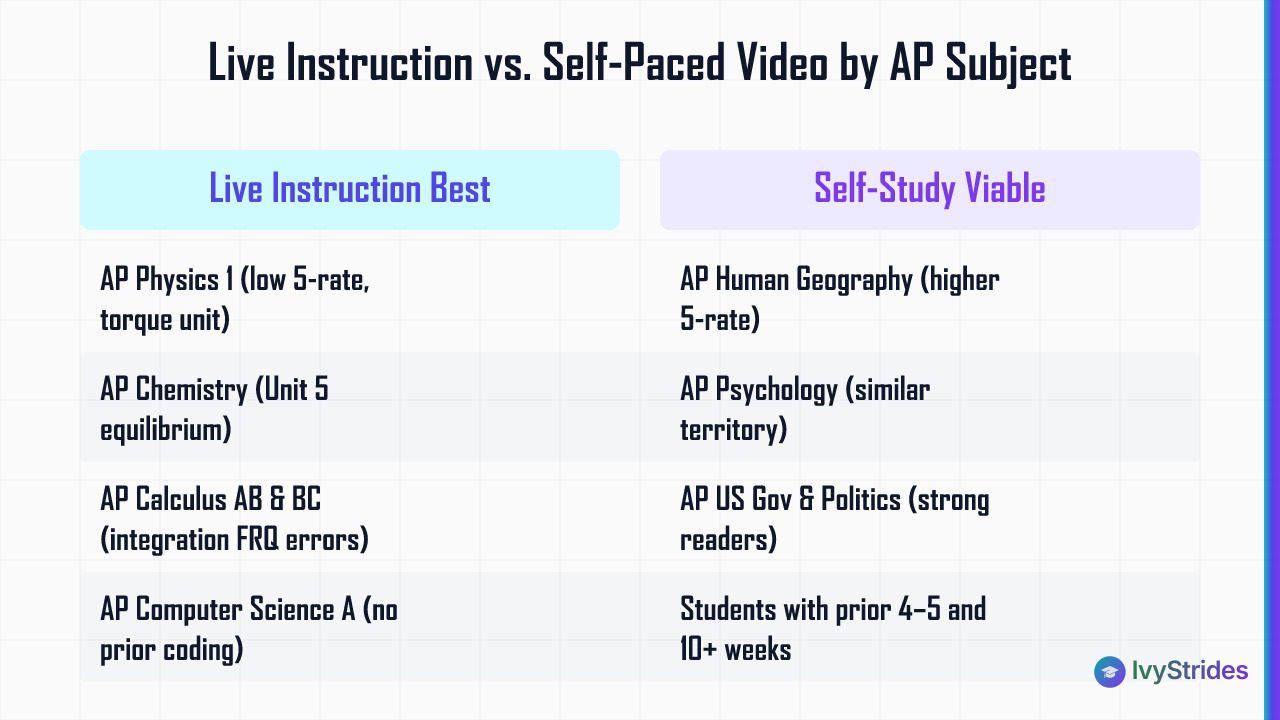
Most comparisons stop being useful right here, because they treat every AP subject as one thing. They aren't. The same diagnostic-driven principle that drives SAT and ACT score gains applies to AP prep: knowing exactly which units and question types are costing you points is the prerequisite for choosing the right format.
Start with the high-difficulty tier, where live instruction has the highest marginal value. AP Physics 1 is the clearest case; its 5-rate has historically been among the lowest of any AP subject, and Unit 7 torque and rotational motion trips up self-studiers who never get their setup checked. AP Chemistry sits alongside it, with Unit 5 chemical equilibrium as the unit that separates a 3 from a 5. AP Calculus AB and Calculus BC belong here too; BC's Unit 6, integration and accumulation of change, generates the free-response errors we see most. AP Computer Science A rounds out the tier for students who arrive without prior coding, since debugging logic is exactly the thing a video can't watch you do.
In our coaching with students preparing for AP Chemistry and AP Calculus BC, those who had a live specialist walking them through the hinge units, equilibrium and integration, made fewer free-response errors than self-study peers who started at the same level. The free-response rubric is why. A teacher can spot a partial-credit setup error, the kind that quietly loses rubric points on a problem you "got right," where a video simply moves on.
Now the tier where self-study is genuinely viable. AP Human Geography has historically posted a higher 5-rate than the physics and chemistry exams, per College Board AP score distributions, and a motivated reader can carry it with AP Daily videos and official practice. AP Psychology sits in similar territory. AP US Government and Politics is workable for a self-directed learner with strong reading habits and steady discipline.
So what actually predicts self-study success? Three conditions, in our experience. The student has strong reading comprehension, has already scored a 4 or 5 on a prior AP exam, and has 10 or more weeks before the exam date. Meet all three on a lower-complexity subject and self-paced video is a reasonable bet. Miss any of them on a high-difficulty subject and you're gambling the score.
Live Online AP vs. Self-Paced Video: What Each Format Actually Costs
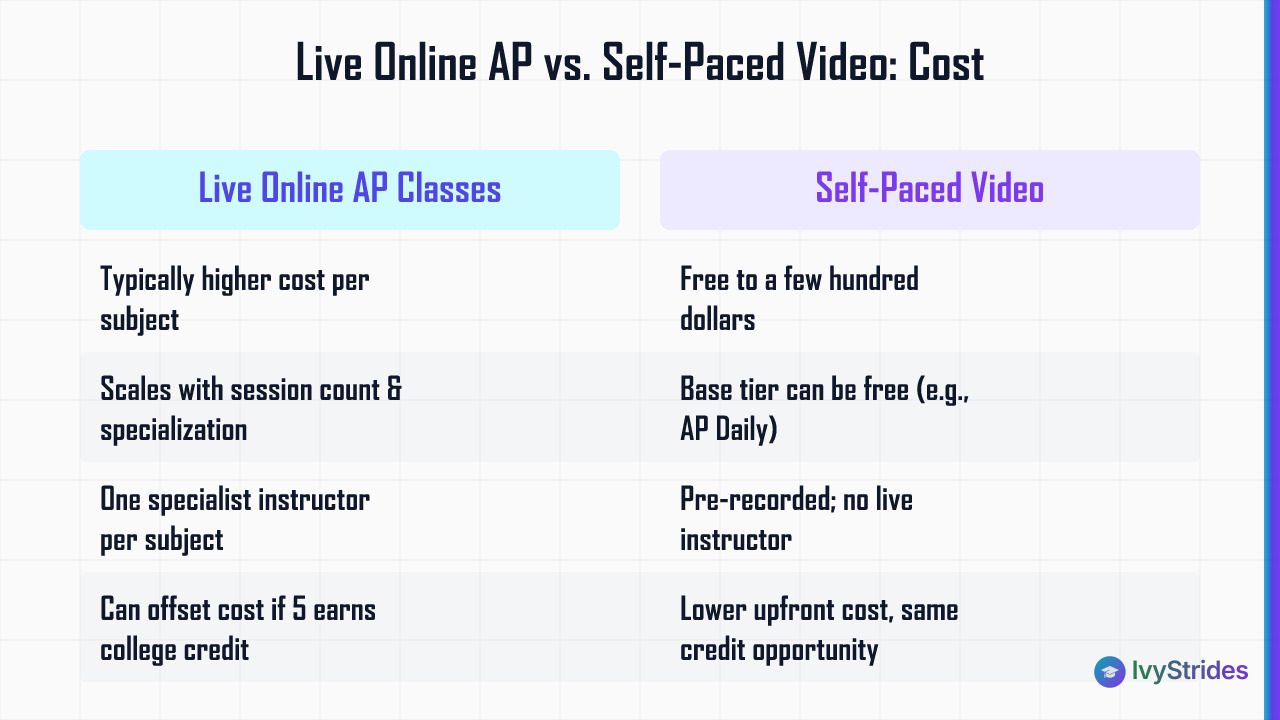
Cost is real, and it's also secondary to the outcome when the exam is high-stakes. Before comparing live online AP classes and self-paced video on cost alone, it helps to see the full price range, which we break down in our detailed guide to How Much Do Online AP Courses Cost.
There are three tiers. AP Daily videos through AP Classroom are free. Paid self-paced platforms typically run from nothing at the base tier up to a few hundred dollars per subject; verify current rates directly, since they move. Live online AP classes from specialist providers typically run higher per subject, scaling with session count and the depth of the instructor's specialization. Our full breakdown lives in the How Much Do Online AP Courses Cost guide.
Now the number that reframes all of it. A single introductory course at a selective university commonly costs several thousand dollars in tuition. If a 5 on AP Chemistry exempts your student from that course, the credit can offset the entire cost of live prep, even at the top of the range. That's the return-on-investment case in one line.
One firm caveat: AP credit policies vary by college and by score threshold, per the College Board AP Program. Some schools grant credit at a 4, others only at a 5, and a handful of the most selective grant placement rather than credit. Check your target school's published policy before you decide how hard to push for that top band. If you're comparing providers on quality rather than price alone, start with the best online AP courses that assign one specialist per subject.
Who Should Choose Live Online AP Classes
Some student profiles point clearly to live instruction. If your student is externally motivated, meaning deadlines and a real teacher are what keep them moving, live is the safer path by a wide margin. In our coaching, students who described themselves as needing a teacher to stay on track completed AP course content at a materially higher rate in live classes than peers who tried self-paced video alone.
The second profile: a student tackling a high-difficulty AP subject for the first time, especially the physics, chemistry, and calculus tier where a single uncorrected misconception compounds across units. The third: any student targeting a college that awards AP credit only at a 5, where the marginal cost of one missed point is a full course's worth of tuition.
There's a fourth, structural case. For students whose school doesn't offer a specific AP course, live online AP classes are often the only structured path to the exam, a situation we cover in detail for students navigating that gap in online AP courses for schools that don't offer them. A student who wants AP CS Principles or AP Physics 2 but whose school lists neither has no in-building alternative. Live online is how they reach the exam at all.
Who Can Realistically Self-Study AP with Video Alone
Self-paced video isn't a trap. For the right student on the right subject, it's a smart, efficient path to a 5. Self-paced courses reward students who genuinely progress through material at their own speed without needing external accountability, and some students are exactly that.
The clearest candidate: a highly self-directed student who has already scored a 4 or 5 on a prior AP exam, working a lower-complexity subject. A student who earned a 4 on AP World History and now wants to self-study AP US History is a reasonable bet. A student attempting AP Physics 1 with no prior physics is not, no matter how disciplined. A genuinely irregular schedule also tips toward asynchronous learning: the recruited athlete, the touring performer, the student five time zones off a live session's clock.
Be clear-eyed about what the free layer does and doesn't do. AP Daily videos cover content and skills by unit. They do not provide exam strategy, timed section practice, or feedback on your free-response answers. That last gap is the one that quietly caps self-study scores.
Which is why a hybrid approach is often the smartest move. Use AP Daily videos for baseline content review across all units, then add targeted live specialist sessions for the two or three units where your practice-test scores are lowest. A student self-studying AP Precalculus online might carry most units solo and book live help only for the trig-heavy stretch. You pay for instruction exactly where it moves the score, and nowhere it doesn't.
How to Make the Final Call: A Decision Framework for Students and Parents
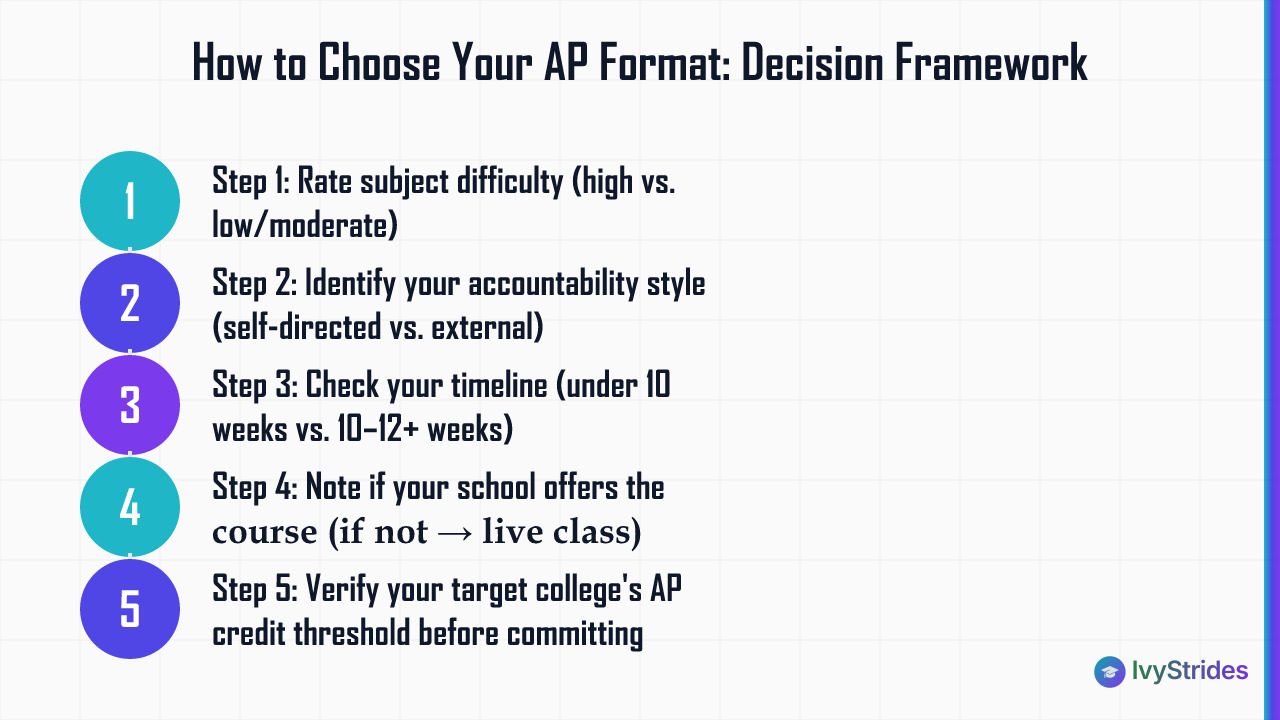
Put the two variables together with your timeline and the decision resolves fast. Here's the framework we use with families on strategy calls.
| Subject Difficulty | Accountability Style | Time to Exam | Recommended Format |
| High (Physics 1, Chemistry, Calc BC) | Externally motivated | Under 10 weeks | Live online AP class |
| High | Self-directed | 10+ weeks | Live class, or hybrid with live sessions on hardest units |
| Low/moderate (Human Geo, Psych, US Gov) | Self-directed | 12+ weeks | Self-paced video, AP Daily as baseline |
| Any difficulty | Any style | Any timeline, school doesn't offer the course | Live online AP class |
Read it as a whole, not one column at a time. High difficulty plus an externally motivated learner plus under ten weeks points hard at live instruction. Low difficulty plus a self-directed learner plus a twelve-week runway makes self-paced video with AP Daily as your content spine a sound, economical choice. And any row where your school doesn't offer the course collapses to one answer, because a structured live path is the only reliable one.
The same format-fit logic applies when students are deciding between the SAT and ACT: matching the test structure to your strengths matters more than picking the test everyone else takes. If that decision is also on your plate, see ACT vs SAT 2026: Key Differences and Which Test to Choose.
One last caveat before you commit money to reaching a 5. AP credit policies vary by college and score threshold, per the College Board AP Program. Verify your target school's threshold first. If a 4 earns the same credit as a 5 there, the calculus on how hard to push, and how much to spend, changes. AP scores are one input to an admissions and credit picture that also includes the SAT or ACT, your essays, and the full application, never the whole story on their own.
You can read how we build per-subject specialist coaching on our About page. You can also meet the AP subject specialists who teach these courses on our tutors page.
FAQ
What is a self-paced online AP course?
A self-paced online AP course is an asynchronous program where you watch pre-recorded video lessons and complete practice materials on your own schedule, with no fixed class times. The most widely used free example is AP Daily videos, now called AP Videos, inside College Board AP Classroom. Unlike a live class, there's no teacher available for real-time questions and no external deadline keeping you on pace.
What is the difference between a self-paced AP course and a regular live AP class?
The core difference is timing and interaction. A live AP class meets on a fixed schedule with a teacher who answers questions, corrects misconceptions in real time, and holds you accountable to a pacing plan. A self-paced course lets you choose when to study but provides no live feedback and no external accountability. For high-difficulty AP subjects, that feedback gap is the main reason self-paced students tend to score lower on average.
Are AP Daily videos free, and where can I find them?
Yes, AP Daily videos are free. They're now called AP Videos and live inside College Board AP Classroom. Students enrolled in an AP course through a teacher access them directly, and self-study students can access AP Classroom resources through the College Board international help center; confirm the current policy before you rely on it. The videos are short, searchable, and organized by unit, but they cover content review rather than full exam strategy or free-response coaching.
How long does a self-paced AP course realistically take to complete?
A full AP course covers roughly 5 to 10 College Board units depending on the subject, each with multiple lessons and practice sets. A student working around 5 to 8 hours per week should budget roughly 12 to 20 weeks to cover every unit thoroughly before the May exam. Starting in September or October gives comfortable runway; starting in February for a May exam is a tight timeline that demands consistent daily study.
Is it worth paying for a live online AP class when free video resources exist?
For high-difficulty subjects like AP Physics 1, AP Chemistry, and AP Calculus BC, the answer is typically yes. The free AP Daily videos cover content but don't provide real-time feedback on misconceptions, structured pacing, or free-response coaching. In our coaching with students in these subjects, those who had a live specialist covering the hardest units scored higher on average than those relying on video alone. For lower-complexity subjects and highly self-directed students, free resources can be enough.
Can I self-study for an AP exam using only YouTube or free videos?
It's possible for some subjects and some students, but the risk is uneven coverage and no feedback on your free-response answers. AP Daily videos through College Board AP Classroom are the most structured free option because they follow the official AP units. General video channels vary widely in quality and alignment to the current AP Course and Exam Description. If you go this route, pair the videos with official College Board practice exams and a strict unit-by-unit checklist so you don't finish May with coverage gaps.
The format decision isn't about which option sounds more serious. It's about matching your subject's difficulty and your own accountability style to the path that will actually get you across all the units and into the top band, on time.

Two decades teaching quantitative and verbal aptitude on standardized tests. Rare dual expertise across Math and Verbal — particularly effective for students with gaps on both sides. Senior AP Mentor for our Calculus and English tracks.