
Early Birds vs. Night Owls: What’s the Best Time to Study?
On this page
- Are You an Early Bird or a Night Owl?
- Does the Time of Day Change How Well You Think?
- The SAT Problem: Test Day Starts at 7:45 a.m.
- How to Plan Your Study Hours by Chronotype
- Night Owl Mistakes to Avoid
- FAQ: Early Birds, Night Owls, and the SAT
- Is it better to study in the morning or at night?
- Is it bad to study late at night?
- How do I become more of a morning person before the SAT?
- Should I study right before bed?
- What time does the SAT start?
- Your Next Step
Founder of IvyStrides chips in on what's the best time to study
The best time to study is when you are most alert, but the SAT still starts at 8:15 a.m. Teen body clocks drift later during adolescence, and students tend to reason better at their preferred time of day. So do your hardest learning at your peak hours, and train your mornings for test day.
That is the short answer to the early bird vs. night owl debate. Neither type is better at learning; the problems start when your study hours fight your sleep, or when test day lands at your worst time.
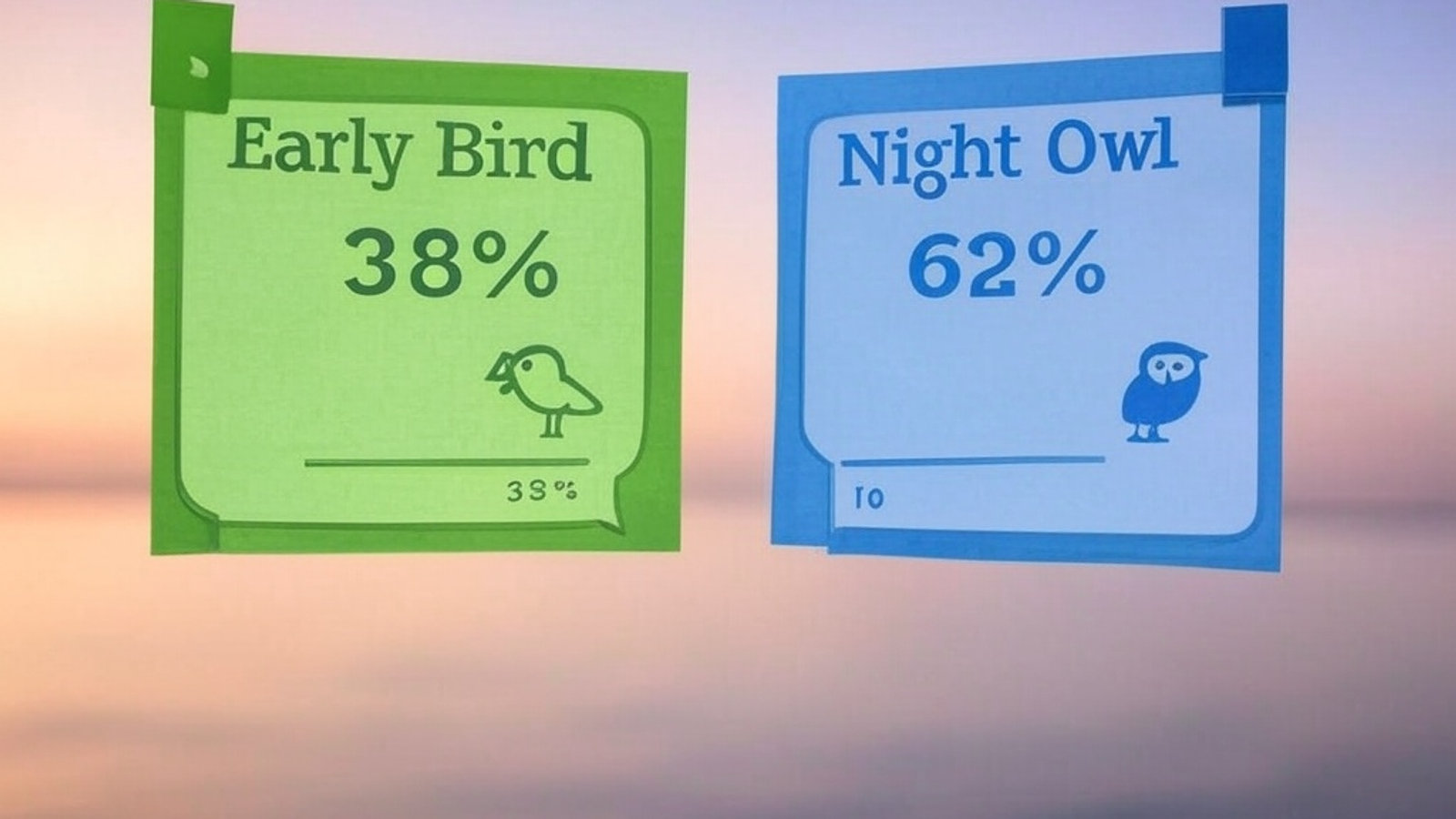
Are You an Early Bird or a Night Owl?
Your chronotype is your body clock's natural timing: when you get sleepy, when you wake easily, and when you feel sharpest. Early birds peak in the morning; night owls peak later in the day.
For teenagers, that clock moves. A longitudinal study by Crowley and colleagues followed two groups of adolescents, starting at ages 9 to 10 and 15 to 16, for about two and a half years. Both groups fell asleep later as they got older, and the evening rise of melatonin, a marker of the body clock, also shifted later with age.
The American Academy of Pediatrics lists the biological sleep changes of puberty among the reasons teens struggle to get enough sleep, and names school start times before 8:30 a.m. as a key contributor. In other words, many students lean toward night owl because of biology, not laziness.
A quick way to find your own pattern is to track it for a week:
- When do you feel most focused on hard problems?
- When do you get sleepy if nothing keeps you up?
- On a free day with no alarm, when do you wake up?
- When do your practice-set scores tend to be highest?
Your answers do not need to be precise. If your focus and your best practice scores cluster after 4 p.m., plan like a night owl; if they cluster before noon, plan like an early bird. Many students fall somewhere in between, and the planning table below works for them too: put the hardest work wherever focus peaks.
Does the Time of Day Change How Well You Think?
Yes, at least for some kinds of thinking. Researchers call it the synchrony effect: people perform better when the task time matches their chronotype.
Goldstein and colleagues tested morning-type and evening-type adolescents either in the morning or in the afternoon. On fluid intelligence measures, the kind that involve solving new problems, students did better at the times that matched their preference. Across the subtests used, the gap worked out to a 6-point difference in IQ estimates. The authors concluded that adolescents tested at their nonoptimal time of day may be at risk for poorer academic performance.
Schedules that respect teen sleep show results too. When Seattle's school district moved high school start times nearly an hour later, Dunster and colleagues measured a 34-minute increase in students' median daily sleep, along with a 4.5% rise in median grades and better attendance.
| Study | What was tested | What it found | What it means for you |
| Crowley et al., 2014 | Sleep timing and body-clock markers in adolescents over 2.5 years | Sleep onset and melatonin timing shifted later with age | Feeling like a night owl as a teen is normal |
| Goldstein et al., 2007 | Morning and evening types tested at different times | Better fluid reasoning at the preferred time of day | Do your hardest new learning at your peak hours |
| Dunster et al., 2018 | Seattle's later high school start time | 34 more minutes of median sleep, 4.5% higher median grades | Protecting sleep is part of performing well |
| Gais et al., 2006 | High school students learning vocabulary | Recall improved when sleep followed study within a few hours | An evening review session before bed is useful |
The SAT Problem: Test Day Starts at 7:45 a.m.
Whatever your chronotype, the SAT runs on a morning schedule. College Board's test day timeline has students checking in at 7:45 a.m., doors closing at 8:00, and testing starting between 8:15 and 8:30 a.m.
For an early bird, that is close to peak time. For a night owl, it can be the least favorable hour of the day, which is exactly the mismatch the synchrony research warns about. The fix is not to change who you are, but to prepare your mornings:
- Take your full-length practice tests on weekend mornings, starting around 8:15 a.m.
- In the last one to two weeks, move your wake time toward test-day wake time, a little each day.
- Keep your bedtime steady so the earlier alarm does not just cut your sleep.
Testing runs to late morning, so the length of the SAT matters as much as the start time: you need to stay sharp from check-in to the last module.
How to Plan Your Study Hours by Chronotype
Match the type of work to your energy, and keep sleep fixed. New, difficult material goes where you are sharpest; lighter review can go elsewhere.
| Task | Early bird | Night owl |
| New concepts and hard problem sets | Morning or right after school | Late afternoon or early evening |
| Timed sections | Morning, when possible | Mix in some mornings to build test-day comfort |
| Light review and flashcards | Evening, before bed | Evening, before bed, without pushing bedtime later |
| Full-length practice tests | Weekend mornings | Weekend mornings, starting 8:15 a.m. |
The evening review slot works for both types for a reason. Gais and colleagues found that memory for new vocabulary was better when sleep followed study within a few hours, so a short review before bed lines up with how memory consolidates. The catch is that it has to end on time.
If your school schedule leaves little choice, protect at least one peak-hour block each week for the hardest material, such as a full Math module or a timed Reading and Writing set. If you work with a tutor or a structured SAT prep course, ask for the hardest sessions to fall in that window.
Spacing helps either schedule. Short reviews spread across days hold up better than long single sessions, which is the idea behind spaced repetition.
Night Owl Mistakes to Avoid
The risk for night owls is not studying late; it is studying late and still waking early. That combination is what quietly shortens sleep night after night.
- Late-night cramming before school days. You lose sleep and still have to show up at 7 or 8 a.m., and losing a night of sleep weakens your memory for what you studied.
- Big weekend swings. Sleeping until noon on Saturday makes an 8:15 a.m. practice test, and the real test, feel much harder.
- Never practicing in the morning. If every timed section happens at 10 p.m., test day becomes the first time you reason hard at 8 a.m.
- Noisy late sessions. Background music while studying slightly reduces reading performance, and lyrics do the most harm.
In our coaching, we ask night-owl students to schedule at least a few morning practice sessions well before test week, so the shift is gradual rather than sudden.
FAQ: Early Birds, Night Owls, and the SAT
Is it better to study in the morning or at night?
Study when you are most alert, which depends on your chronotype. Research on adolescents found better reasoning at their preferred time of day, so do hard new material at your peak and keep lighter review for other hours.
Is it bad to study late at night?
Not by itself. It becomes a problem when late study pushes your sleep below the 8 to 10 hours teens need, or when it replaces practice at the morning hours the SAT is given.
How do I become more of a morning person before the SAT?
Shift gradually. Over the final one to two weeks, move your wake time and bedtime earlier in small steps, and take practice tests at the real start time so 8:15 a.m. feels familiar.
Should I study right before bed?
A short review before bed is useful. Memory for material studied within a few hours of sleep was better in a study of high school students learning vocabulary. Keep it light and stop on time.
What time does the SAT start?
On weekend test dates, students check in at 7:45 a.m., doors close at 8:00, and testing starts between 8:15 and 8:30 a.m., according to College Board. Standard-time testing ends between 10:45 and 11:00 a.m., so the whole test sits in the morning.
Your Next Step
Find your peak hours this week, then put your hardest prep there and your practice tests in the morning.
- Track your focus and practice scores by time of day for one week.
- Move new material and hard problem sets into your peak window.
- Schedule weekend practice tests to start around 8:15 a.m.
- In the final two weeks, shift your wake time toward test-day wake time.

Rajesh is a technology leader, entrepreneur, and angel investor with 28+ years in Business & Technology Leadership and Product & Solution Engineering. He is passionate about education, mentoring, and driving digital transformation.