
How ACT Scores Affect Merit Scholarships? The Honest, Data-Backed Answer for 2026
On this page
- The Short Answer: How ACT Scores Affect Merit Scholarships
- Which ACT Score Bands Unlock the Most Scholarship Dollars
- What ACT Score Do You Need for a Full Scholarship
- Test-Optional Admissions Does Not Mean Test-Optional Scholarships
- National Merit Scholarships and the ACT: What the Confirming Score Actually Does
- Is Retaking the ACT Worth It for Scholarship Money? The ROI Math
- How to Use Your ACT Score Strategically Before Scholarship Deadlines
- FAQ
- Can I get a scholarship with a 24 ACT score?
- Do test-optional schools still require an ACT score for merit scholarships?
- What is the difference between a confirming ACT score for National Merit and a scholarship-qualifying ACT score for universities?
- How much can a higher ACT score realistically increase my scholarship money?
- Are there scholarships specifically for a 35 ACT score?
ACT scores affect merit scholarships in two concrete ways: they trigger automatic award tiers at hundreds of universities, and they determine eligibility for state scholarship programs with fixed score cutoffs. A composite of 28 or higher opens meaningful institutional merit aid at many schools; a 33 or higher reaches full-tuition or near-full-tuition tiers at several flagship universities. Even at test-optional schools, submitting a strong ACT composite is often required to qualify for merit aid. Per ACT, Inc., students who retake the test most often see their composite rise, which is why a targeted retake is one of the highest-ROI decisions in the whole prep cycle.
The numbers below come from published university financial aid pages, state scholarship program sites, and the National Merit Scholarship Corporation. Scholarship thresholds and dollar amounts change year to year, so treat every figure here as a benchmark to verify directly with the school before you plan around it.

The Short Answer: How ACT Scores Affect Merit Scholarships
Two mechanisms do most of the work.
First, universities publish score-based automatic merit award tiers. A student who hits a specific ACT composite score, usually paired with a minimum GPA, receives a scholarship of a fixed dollar amount, renewable for four years if conditions are maintained. The University of Alabama, University of Kentucky, University of Mississippi, and dozens of other flagships operate this way. Score in a higher band, get a bigger award.
Second, state-funded scholarship programs use ACT composite thresholds as eligibility gates. Louisiana's TOPS Performance Award requires a 23; TOPS Honors requires a 27. Florida's Bright Futures, Georgia's HOPE, and similar state programs each set their own cutoffs.
There's a category most families miss on the first read: even test-optional schools often require ACT scores for scholarship consideration. Test-optional admissions and test-optional scholarships aren't the same policy. More on that below.
One more piece of context worth stating early. Per ACT, Inc., the majority of students who retake the ACT improve their composite. That matters because a one- or two-point increase can be the difference between two scholarship tiers, and four years of a higher tier compounds into real money.
Which ACT Score Bands Unlock the Most Scholarship Dollars
Here is the score-band framework we walk students through, mapped to typical award ranges. Verify each figure against the specific school's current financial aid page before you plan around it; policies change annually.
ACT 22-24 (roughly the 63rd-74th percentile)
At this band, automatic institutional awards exist but are limited, and they tend to appear at regional universities where the enrolled 25th percentile sits in the 22-24 range. Louisiana residents at 23+ qualify for the TOPS Performance Award, full tuition at any Louisiana public college plus a small annual stipend. Private scholarship eligibility also opens up around this band. At flagship universities, though, this band typically falls below the automatic merit floor.
ACT 25-27 (roughly the 78th-87th percentile)
Entry-level automatic awards at flagship universities start appearing. Louisiana's TOPS Honors Award kicks in at 27. At the University of Alabama, a 25 with a 3.5 GPA opens the lower automatic tier for out-of-state students (verify current thresholds at afford.ua.edu). Typical award range at this band: roughly $2,000 to $8,000 per year, renewable.
ACT 28-30 (roughly the 89th-93rd percentile)
This is where the math starts to get interesting. A 28+ triggers mid-tier automatic awards at many flagships, typically in the $8,000 to $16,000 per year range for out-of-state students. It's also the band where many test-optional schools set their internal cutoff for merit scholarship consideration.
ACT 31-33 (roughly the 95th-98th percentile)
Upper-tier awards. At the University of Alabama, a 32 with a 3.5 GPA reaches the Presidential Scholarship, and a 33 unlocks the top out-of-state tier at full tuition value (again, verify current thresholds at afford.ua.edu). Similar tier structures exist at Kentucky (see studentsuccess.uky.edu), Mississippi State, Arkansas, and Ole Miss.
ACT 34-36 (99th percentile)
Highest institutional tiers, often full tuition plus a stipend, plus realistic eligibility for competitive national programs like Robertson Scholars and Morehead-Cain. These national programs still require a full application, essays, and interviews; the score is a floor, not a ticket.
If you're still deciding whether to sit the ACT or the SAT before running these numbers, our ACT vs. SAT comparison breaks down format, scoring, and which test tends to favor which student profile. For selective-school context, our guide on ACT score ranges for top colleges covers where the mid-50% sits at Ivy-tier and near-Ivy institutions.
What ACT Score Do You Need for a Full Scholarship
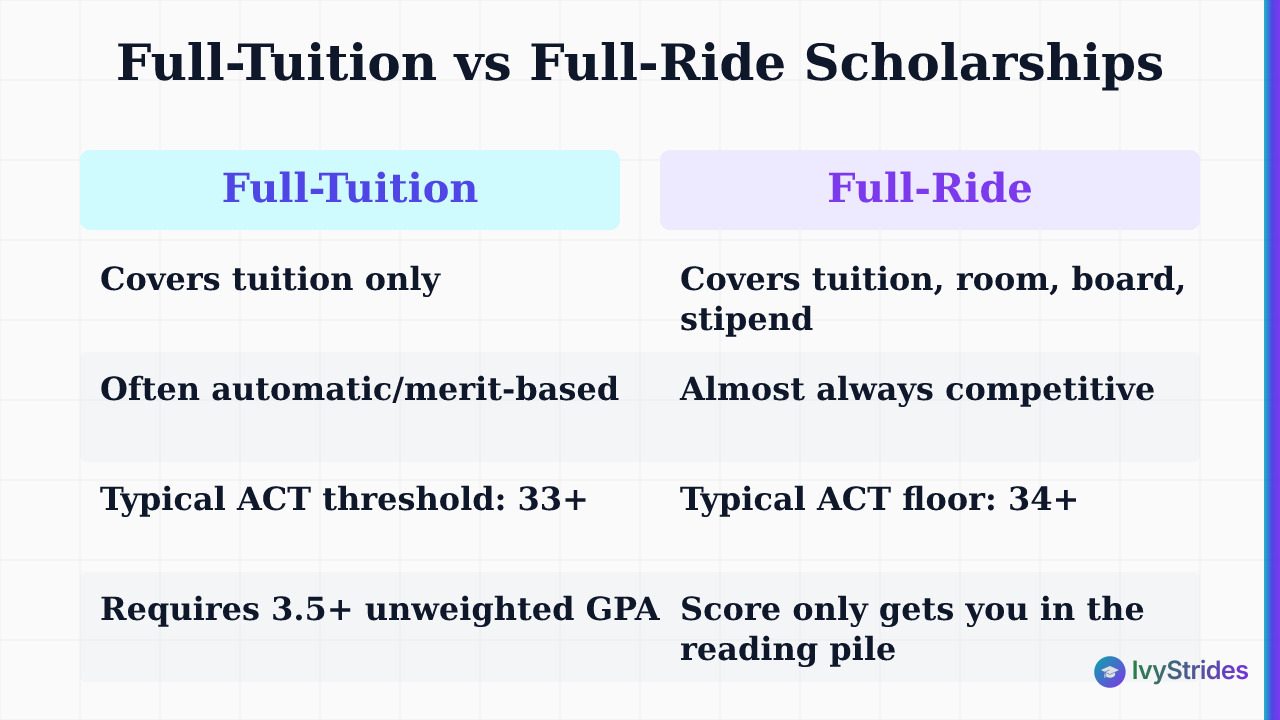
Two different things get called "full scholarships," and conflating them is one of the more expensive mistakes families make.
Full-tuition means the school covers tuition. You still pay for room, board, books, and fees. At flagship universities with tiered automatic merit programs, a 33 or higher paired with a 3.5+ unweighted GPA is the typical threshold for full-tuition institutional awards. Alabama, Mississippi State, and several other SEC and mid-South flagships publish these thresholds openly on their financial aid pages.
Full-ride means tuition plus room, board, and often a stipend. These are almost always competitive, not automatic. Programs like Robertson Scholars (Duke and UNC), Morehead-Cain (UNC), Stamps Scholarships (multiple universities), and Presidential Scholars at various flagships fall in this category. The ACT floor for competitive full-ride programs is typically a 34 or higher, but the score only gets you into the reading pile. Essays, interviews, leadership evidence, and academic record do the rest.
In our coaching with students targeting full-ride programs, a 34+ composite is typically the floor, not the ceiling. A student who arrives at a 34 with a strong application still needs to write essays that distinguish them from the many other 34+ applicants. If your target list is heavy with the most selective schools, our guide on ACT score ranges for top colleges will help you calibrate whether admissions strength or scholarship strength should drive your prep timeline.
For students working toward the 33-36 band, 1-on-1 ACT prep with section-specialist coaches is typically the most efficient path. At that band, the composite-limiting section is usually a specific weakness (Science pacing, or the Math geometry cluster, for example), not a general knowledge gap.
Caveat, because this is YMYL territory: no ACT score guarantees a scholarship. Every full-ride program and most full-tuition programs consider GPA, essays, and other factors alongside the composite.
Test-Optional Admissions Does Not Mean Test-Optional Scholarships
This is the single most costly misconception in the entire query space.
Test-optional admissions means a school will consider your application without requiring an ACT or SAT score. It doesn't automatically mean the same school will consider you for merit scholarships without a score. Many test-optional universities still list a minimum composite, often 28 to 30, as a condition for automatic merit award consideration or as a required input on the separate scholarship application.
The result: a student who assumes "test-optional" applies across the board can be admitted to a school and forfeit five figures per year in merit aid because they never submitted an ACT score. In our coaching with students who assumed test-optional meant they could skip the ACT entirely, we regularly find their target school requires a 28+ composite to unlock its merit scholarship application. By the time this gets noticed, the last useful test date has passed.
Two rules to save you money here:
-
Check each target school's financial aid or scholarship page directly. Not a third-party aggregator, not a blog. The school's own page.
-
Use FairTest to check current test-optional admissions policy, but understand that FairTest tracks admissions policy, not scholarship policy. These are separate.
Even if a college is test-optional for admissions, submitting a strong ACT score is often required to qualify for merit aid, a distinction we cover in detail in our guide on whether to submit ACT scores if test-optional.
Caveat worth stating plainly: test-optional scholarship policies vary by school and by year. Verify directly with each institution before you decide to skip a test date.
National Merit Scholarships and the ACT: What the Confirming Score Actually Does
Short version: the ACT doesn't qualify a student for National Merit. The PSAT/NMSQT does. But the ACT does play a role at the Finalist stage.
The National Merit Scholarship pathway is separate from university merit aid: it begins with the PSAT/NMSQT Selection Index, not your ACT composite, though a confirming ACT score is required at the Finalist stage. The PSAT/NMSQT is taken in 11th grade. Your Selection Index is calculated as (Reading and Writing section score × 2) + Math section score, on a 48-228 scale.
Roughly the top 50,000 scorers nationally are named Commended Students, with a Selection Index cutoff that typically lands around 207-209 depending on year. About 16,000 of those advance to Semifinalist status, and the Semifinalist cutoff is state-specific, ranging from roughly 209 in lower-competition states to around 221 or higher in states like New Jersey, Massachusetts, and California. Verify current cutoffs with the National Merit Scholarship Corporation each year.
To advance from Semifinalist to Finalist, the student must submit an application, maintain a strong academic record, and provide a confirming score from either the SAT or the ACT. The confirming score isn't a specific composite. It's a score that verifies the PSAT/NMSQT result was consistent with the student's actual testing ability. An ACT composite that reasonably aligns with a high PSAT Selection Index will confirm; a large downward gap can jeopardize Finalist status.
So the ACT is a verifier, not a qualifier, for National Merit. If your student is a strong PSAT performer, the ACT still matters for confirming-score purposes, and it obviously still matters for the university merit aid pathway covered above.
For a full breakdown of how the PSAT/NMSQT Selection Index is calculated and what state cutoffs look like, see our guide on how the PSAT is scored. For the score range and percentile context, PSAT score range and percentiles covers the distribution in detail.
Is Retaking the ACT Worth It for Scholarship Money? The ROI Math
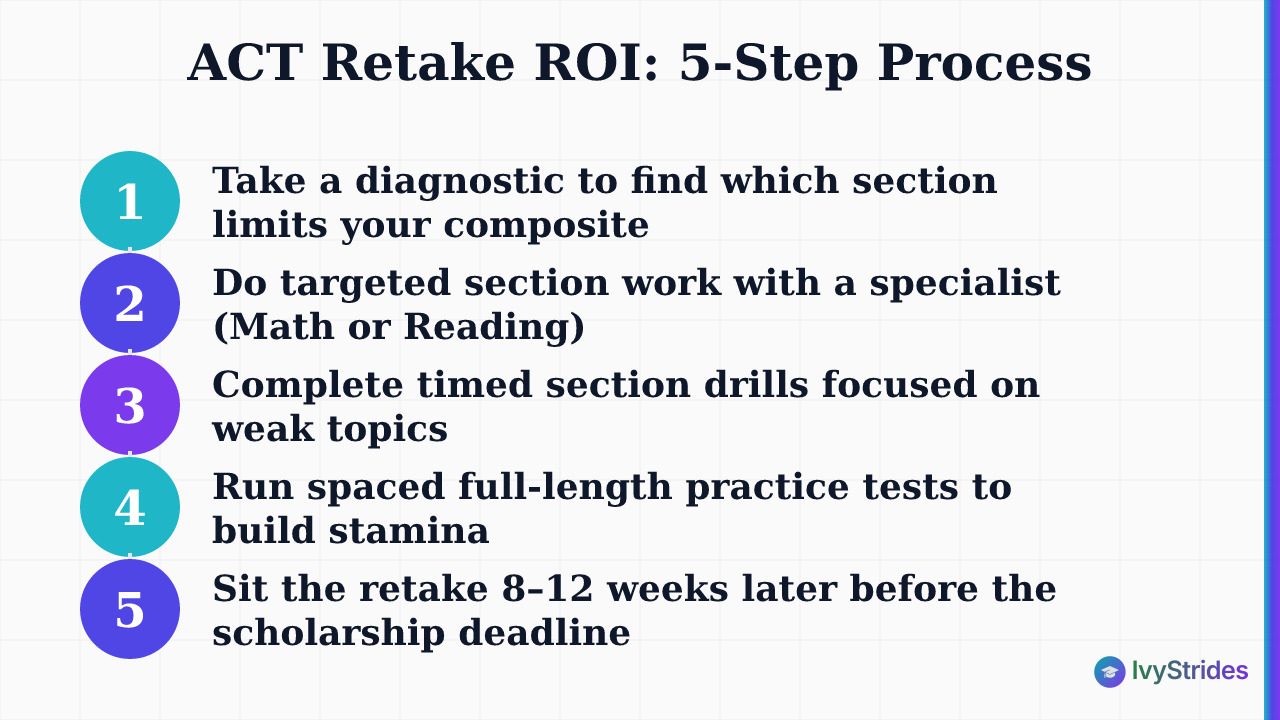
Almost always yes, if the current score sits within two points of a meaningful threshold.
Here's the math with a concrete example. Say a student currently sits at a 27 composite. Their top-choice out-of-state flagship has an automatic merit tier structure that pays $12,000 per year for a 28-30 composite and $8,000 per year for a 25-27. A one-point increase, from 27 to 28, is worth $4,000 per year. Over four renewable years, that's $16,000. If the same student can push to a 30, they enter the higher tier the school might set at roughly $16,000 per year, a delta of about $8,000 per year, or $32,000 over four years.
Compare that to the cost of targeted prep. Even at the higher end of the market, four figures of prep spending against five figures of scholarship gain is a straightforward ROI decision.
The reason retakes work is that a diagnostic-driven plan identifies exactly which section or sections are holding the composite down. In our coaching with students in the 26-29 composite range, the most common composite-limiting section is ACT Math or ACT Reading, not English. A student scoring 30-29-25-27 doesn't need a general review of the whole test; they need targeted Reading pacing work and a Math weak-topic audit.
For students completing a diagnostic-led, section-specialist retake program, a 4+ composite point increase is a typical outcome. Not guaranteed, and not universal, but typical when the student completes the full cycle: diagnostic, targeted section work with a specialist, timed section drills, spaced full-length retakes.
A realistic retake timeline is roughly eight to twelve weeks of consistent work between test dates. If you have a scholarship deadline in February of senior year, the December ACT is usually the last useful sitting; that means starting focused prep no later than September.
For self-directed students, our act practice test online library provides full-length sittings and score-band analysis. For families who want section-specialist support, our ACT prep overview covers how the 1-on-1 program is structured.
How to Use Your ACT Score Strategically Before Scholarship Deadlines

Photo by Andy Barbour on Pexels
A four-step checklist to convert a good composite into actual scholarship dollars.
1. Find each target school's published scholarship thresholds. Start with the school's financial aid page and its scholarship page. If those don't publish specific thresholds, search "Common Data Set [University Name]" for admissions data, then call the financial aid office directly to ask about score-based awards. The Common Data Set is a standardized report most universities publish annually; it contains the 25th and 75th percentile scores of enrolled students, which is useful context even when direct scholarship thresholds aren't published.
2. Calculate the gap. Your current composite, minus the nearest threshold above it. That's your target improvement. Also identify the section or sections most likely responsible for the gap, because a two-point composite jump often comes from a five-point jump in one section, not one point across all four.
3. Set a retake timeline against scholarship deadlines, not admissions deadlines. These are often different. Scholarship application deadlines commonly fall between November 1 and February 1 of senior year, and many require the composite in hand before the priority date. If your December score arrives too late for a November 15 scholarship deadline, the score didn't help. Map deadlines backward from the earliest scholarship priority date on your list.
4. Verify each school's superscoring policy specifically for scholarships. Some universities superscore the ACT for admissions but use single-sitting composite for scholarship tiers, or vice versa. This isn't a detail to guess about. Once you have a scholarship-qualifying score, knowing whether to self-report or send official ACT scores to each school is the next logistical question our separate guide answers.
If you want to see who does this work with students at each score band, our ACT coaching team page introduces the section specialists. English, Math, Reading, and Science are each staffed by dedicated coaches, not generalists.
FAQ
Can I get a scholarship with a 24 ACT score?
A 24 ACT composite sits above the national average and does qualify for some institutional merit awards, particularly at regional universities and schools where the enrolled 25th percentile sits in the 22-24 range. The most substantial automatic merit tiers at flagship universities typically begin at 28 or higher. A 24 is a reasonable starting point, but in our coaching with students at this score band, even a three- or four-point increase to 27-28 can meaningfully expand scholarship options at flagship universities.
Do test-optional schools still require an ACT score for merit scholarships?
Many do. Test-optional policy typically applies to the admissions decision, not the separate merit scholarship application. Several universities that don't require ACT scores for admission still list a minimum composite, often around 28-30, as a condition for automatic merit award consideration. Always check the financial aid page of each target school directly, because policies vary by school and change year to year.
What is the difference between a confirming ACT score for National Merit and a scholarship-qualifying ACT score for universities?
These are two entirely separate processes. A confirming ACT score for National Merit is submitted to the National Merit Scholarship Corporation to verify that a student's PSAT/NMSQT performance was consistent with their actual testing ability; it doesn't need to be a specific number, only reasonably aligned with the PSAT result. A scholarship-qualifying ACT score for a university is a composite threshold, for example 28, 30, or 33, set by that institution's financial aid office to trigger an automatic merit award. A student can have one without the other.
How much can a higher ACT score realistically increase my scholarship money?
The dollar impact depends entirely on which threshold you cross. At schools with tiered automatic merit awards, moving from a 27 to a 28 might add roughly $4,000 per year, which compounds to about $16,000 over four renewable years. Moving from a 30 to a 31 at a school with a higher upper tier could add around $6,000 to $8,000 per year. In our coaching with students specifically targeting scholarship thresholds, identifying the one or two sections limiting the composite and addressing them with section-specialist work is the most direct path to a meaningful score increase before the next test date.
Are there scholarships specifically for a 35 ACT score?
A 35 ACT composite places a student at roughly the 99th percentile and qualifies for the highest automatic merit tiers at virtually every university that uses score-based awards. At flagship universities with tiered programs, a 35 typically reaches the full-tuition or near-full-tuition level. Competitive national scholarship programs, including Presidential Scholars at various flagships and programs like Robertson Scholars and Morehead-Cain, also become realistic targets at this score band, though they require a full application beyond the score alone.
The most useful frame for ACT prep isn't "how do I get admitted" but "how do I turn my composite into the largest possible scholarship offer." Once families see that a two-point increase can pay for two years of textbooks and housing, the calculus around a retake changes fast.

Award-winning author (South Asian Book Award) and graduate of BITS Pilani and UCLA Luskin School of Public Affairs. Brings a published writer's eye to Common App essays and grammatical precision to SAT and ACT R&W instruction.